

Iran is now enriching uranium to 20 per cent purity with new centrifuges — a step towards the 90 per cent required for a nuclear weapon, at its fortified underground Fordow plant.
Tehran had previously acknowledged possessing 43 kilograms of 60 per cent-enriched uranium — which some experts believe could already be enough to make a bomb.
But the activity at Fordow will raise further doubt about Iran’s commitment to any kind of nuclear deal, because the site — deep within mountains near the city of Qom, has been specially built to withstand enemy air attack.
The International Atomic Energy Agency (IAEA) said Tehran had started "feeding... a cascade of... centrifuges" at the Fordow fuel enrichment plant, which has recently been upgraded.
The techniques facilitate the process and would make it easier for Iran to switch to a different level of enriching uranium.
-
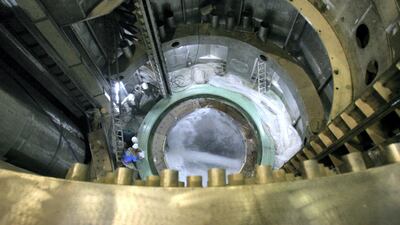
Russian contractors work at the Bushehr nuclear reactor site in 2007. The plant opened four years later. Bloomberg -
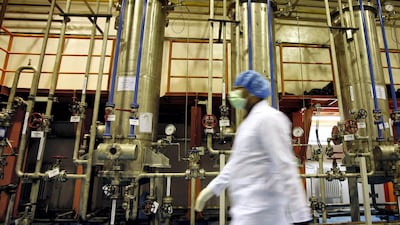
An Iranian technician at the International Atomic Energy Agency inspects the country's Isfahan plant in 2007. Tehran is no longer co-operating with the agency at nuclear sites across the country. EPA -

Workers wait to begin constructing a second reactor at the Bushehr nuclear power plant in 2019. AFP -
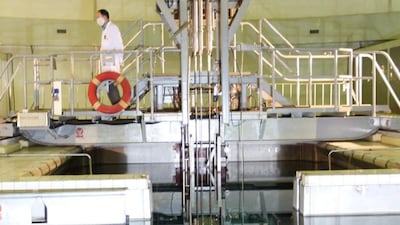
A metal-encased rod with 20 per cent enriched nuclear fuel is inserted into a reactor in Tehran in 2012. AFP -
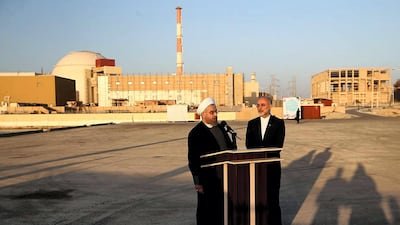
Fomer Iranian President Hassan Rouhani and the country's Atomic Energy Organisation chief Ali Akbar Salehi speak at the Bushehr nuclear site in 2015. AFP -
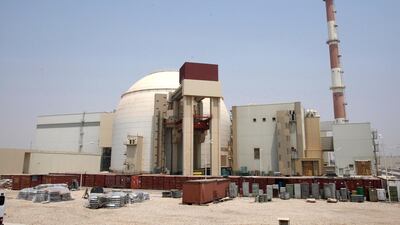
Iran's Bushehr nuclear plant has been restarted. EPA -
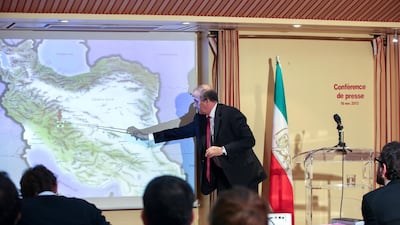
Mehdi Abrichamtchi, chairman of the Peace and Security Committee at the National Council of Resistance of Iran, shows journalists the location of a secret nuclear site in Iran in 2013. AFP -
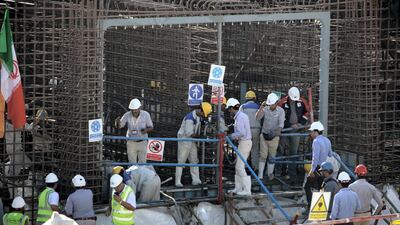
Workers prepare to begin the construction of a second reactor at the Bushehr site. AFP


Multilateral talks to revive a 2015 nuclear deal, whereby Iran allowed inspectors to monitor its nuclear programme in exchange for an easing of trade sanctions, have faltered.
While the EU and Britain have been party to the talks — which were held in several rounds in Vienna and most recently in Qatar — the US and Iran have repeatedly blamed each other for obstructing a new agreement.
The US special envoy for Iran, Robert Malley, described a recent round of negotiations between Iranian and US officials in Qatar as "a little bit of a wasted occasion".
Behrouz Kamalvandi, spokesman for Iran’s Atomic Energy Organisation, said uranium enriched to 20 per cent was collected for the first time from advanced IR-6 centrifuges on Saturday. He said Tehran had informed the UN nuclear watchdog about the development two weeks ago.
A centrifuge is used to spin enriched uranium into higher levels of purity. The 2015 nuclear agreement with world powers had called for Fordow to become a research-and-development centre and restricted its centrifuges to non-nuclear uses. Before the deal, the site had been used to create 20 per cent uranium but using older centrifugal apparatus.
US intelligence believes Iran began tunnelling work at Fordow about 20 years ago. It is now thought to feature an elaborate system of concrete tunnels, reinforced doors and hardened bunkers protected by at least 100 metres of mountain rock.
Iran had previously told the IAEA that it was preparing to enrich uranium through a new cascade of 166 advanced IR-6 centrifuges at Fordow — but it failed to reveal the level at which the cascade would be enriching.
Iran did not comment on the latest IAEA finding. But the announcement that Tehran is enriching uranium up to 20 per cent purity — a technical step from weapons-grade levels of 90 per cent — with its most advanced IR-6 centrifuges deals yet another blow to the already slim chances of reviving the nuclear deal.

