


Israel's position on how to deal with Iranian threats is decided only behind closed doors and the final decision is taken by the government, Defence Minister Benny Gantz said.
While Israeli security services have a say on the policy for Iran, “it is the government echelon that makes the decisions,” Mr Gantz wrote on Twitter.
He said the defence establishment was dealing with the threat from Iran as the main concern for Israel's security.
“This is done in co-ordination between all the security arms, with the decisions being made by the political echelon,” Mr Gantz said. “We will continue holding open and deep dialogue behind closed doors only.”
Mr Gantz's tweet followed press reports that there was a heated debate within Israel's military and security services on the official stance on the resumption of talks between Iran and world powers.
The chiefs of military intelligence and strategic planning believe a revival of a 2015 deal that restricted Iran's nuclear programme would give Israel time to prepare an attack aimed at denying Iran the means to make a nuclear weapon, the Yedioth Ahronoth daily said on Friday.
“However, the national intelligence agency Mossad opposes a return to the tattered nuclear pact and believes that the reports [on Israeli generals favouring a bad deal] are part of a pressure campaign to sway Foreign Minister Yair Lapid, who is expected to assume the role of prime minister soon, to throw his weight behind the talks,” the Yedioth Ahronoth report said, without citing sources.
The EU and Iran agreed on Saturday to resume the nuclear negotiations that were being held in Geneva until recent months.
The administration of former US president Donald Trump abandoned the deal in 2018 and reimposed sanctions on Iran.
-
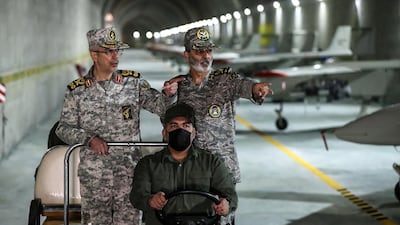
Maj Gen Mohammad Bagheri, left, Iran's Armed Forces Chief of Staff, and Maj Gen Abdolrahim Mousavi, Army Commander-in-Chief, visit an underground drone base at an undisclosed location in Iran. AFP -

Iranian state media revealed the existence of a drone base, said to be in the Zagros Mountains, in reports on a visit to the facility by Maj Gen Mohammad Bagheri, left, Iran's Armed Forces Chief of Staff. Reuters -

The Iranian Army released photos of a wide variety of drones lined up in long tunnels. AFP -

Iranian Army drones believed to be held at an underground facility in the Zagros Mountains, a range that runs 1,600 kilometres through Iran, Iraq and Turkey. AFP -

An army drone at an underground drone base somewhere in Iran. AFP -

An army drone at an underground drone base somewhere in Iran. Senior officers in the Iranian military say its drone force gives it regional leadership. AFP -

An Iranian military drone is inspected at a secret underground site. Reuters -
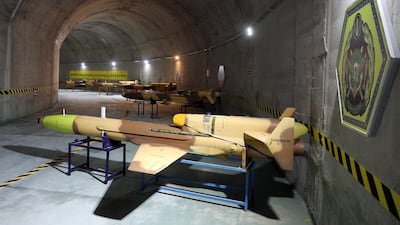
Iran's unmanned aircraft programme has come up with dozens of kinds of drones since the middle of the 1980s. AFP -
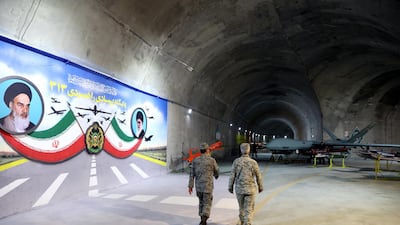
Reminders of the Iranian Army's revolutionary heritage are seen at an underground facility when drones are stored. AFP -
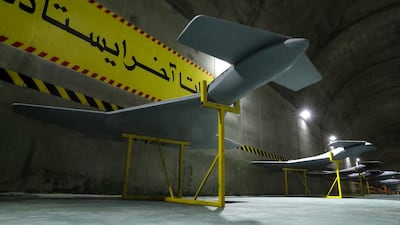
An army drone at an underground base somewhere in Iran. AFP -

An army drone at an underground base somewhere in Iran. AFP -
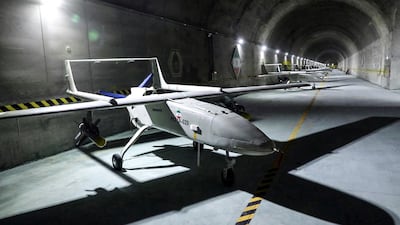
An army drone at an underground base somewhere in Iran. AFP -
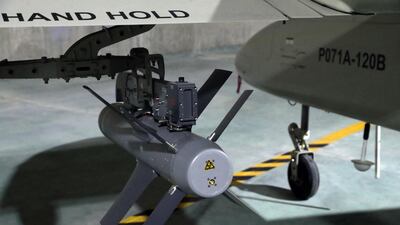
Iran's missile development has come along in tandem with programmes to developed military drones. AFP -
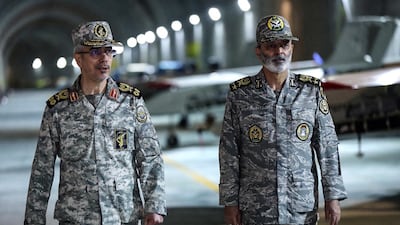
Iran's Armed Forces Chief of Staff Maj Gen Mohammad Bagheri and Army Commander-in-Chief Maj Gen Abdolrahim Mousavi. AFP -
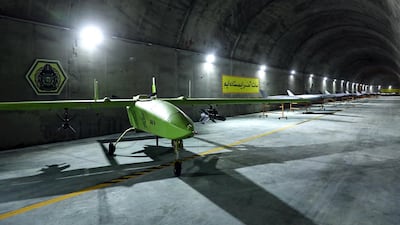
Photos from an underground Iranian military base show development of several drone platforms. AFP -
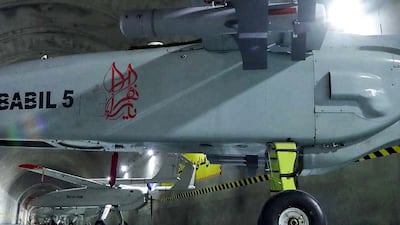
A heavy payload for a drone at a secret underground base somewhere in Iran. AFP -
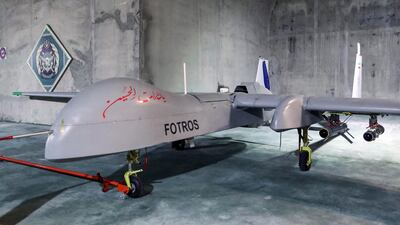
Iran introduced the IAIO Fotros surveillance drone late in 2013. AFP -
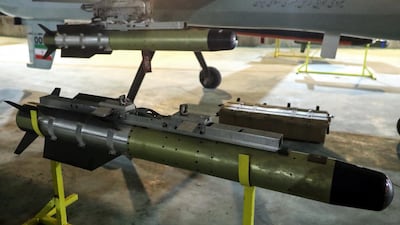
Iran's developing missile technology has been used by Tehran's allies around the Middle East. AFP -
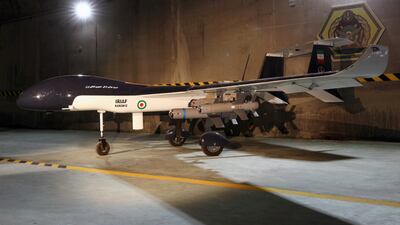
An army drone at an underground base somewhere in Iran. Reuters -
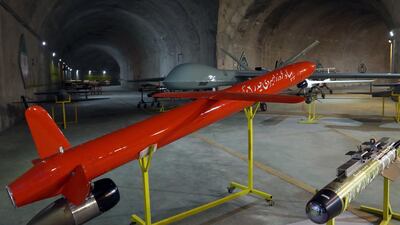
An army drone at an underground base somewhere in Iran. AFP -
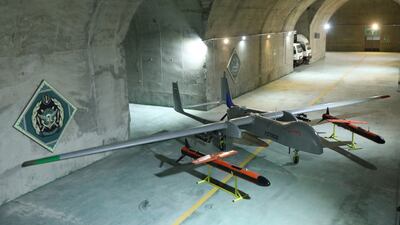
An army drone at an underground base somewhere in Iran. Reuters


Israel, which is not party to the talks but has opposed the 2015 deal, believes that Iran has been secretly enriching its uranium to weapons-grade level to produce nuclear weapons.
Iran insists that its nuclear programme is only for civilian purposes.
Iran has accused Israel of assassinating senior nuclear scientists and Islamic Revolutionary Guard Corps commanders on its territory.
Israel has not commented on the accusations but says it is opposed Iran's nuclear, missile and drone programmes.
On Thursday, the IRGC named a new intelligence chief after a string of suspicious deaths and killings of military officers and scientists in recent months.
It did not give a reason for replacing Hossein Taeb.
The change also followed an Israeli statement that it worked with Turkish intelligence and security services to foil an alleged Iranian plot to kidnap and kill Israelis in Istanbul.
Turkish news outlets reported last week that authorities arrested at least 10 suspects in Istanbul, including five Iranians, in connection with the alleged plot.
In his tweet, Mr Gantz did not comment on the EU-Iran announcement. Nor did Israeli Prime Minister Naftali Bennett during Sunday's Cabinet meeting, which was likely to be his last before handing over the post to Mr Lapid as part of a coalition deal.
Iran recently took an increasingly hardline stance against the UN nuclear watchdog and the US as it stepped up its enrichment programme despite concerns it was hiding some nuclear facilities.
The potential resumption of talks comes as Israel braces for another phase of political instability.
The fragile ruling coalition crumbled after losing its majority in Parliament with defections in recent weeks, prompting a decision to dissolve the chamber and hold fresh elections later this year.
The mixture of right-wing, leftist, centrist political parties along with an Arab party came together to remove Benjamin Netanyahu, the longest-serving prime minister in Israel's political history.
He had stayed in power for 12 years from 2009 after an earlier term from 1996 to 1999.

