

The US has said an agreement on the Iran nuclear deal is neither imminent nor certain.
The State Department said on Monday that Washington is preparing for scenarios both with and without a mutual return to the full application of the nuclear accord.
US State Department spokesman Ned Price gave a warning that the US is prepared to make "difficult decisions" to return Iran's nuclear programme to its limits under the nuclear deal.
It comes as Iran’s supreme leader on Monday signalled support for Tehran’s nuclear negotiations to secure sanctions relief, a rare reference to the halted talks as world powers near a diplomatic turning point.
Ayatollah Ali Khamenei stressed the importance of Iran's economic self-sufficiency during a lengthy televised speech on the occasion of Nowruz, the Iranian New Year.
But he added: “I do not say that you should not seek to lift the sanctions. Those who are trying and working in that field, there is no problem.”
Mr Khamenei, whose pronouncements are considered vital as he has the final say on all state matters, has remained largely silent on the negotiations to restore Iran's nuclear deal with world powers.
His vague but supportive comments signalled that Iranian negotiators retained political space and flexibility.
Former US president Donald Trump withdrew from the nuclear accord in 2018, though his successor, President Joe Biden, has promised to revive it.
-
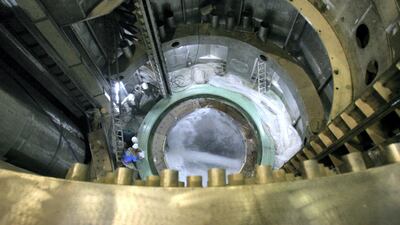
Russian contractors work at the Bushehr nuclear reactor site in 2007. The plant opened four years later. Bloomberg -
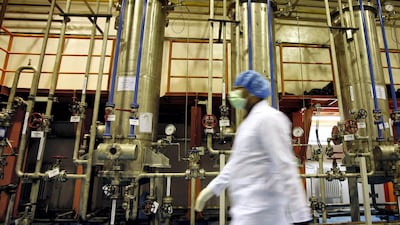
An Iranian technician at the International Atomic Energy Agency inspects the country's Isfahan plant in 2007. Tehran is no longer co-operating with the agency at nuclear sites across the country. EPA -

Workers wait to begin constructing a second reactor at the Bushehr nuclear power plant in 2019. AFP -
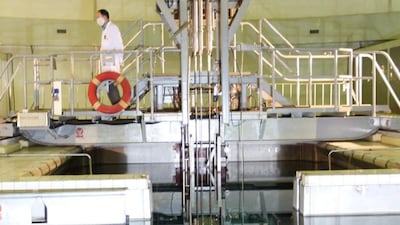
A metal-encased rod with 20 per cent enriched nuclear fuel is inserted into a reactor in Tehran in 2012. AFP -
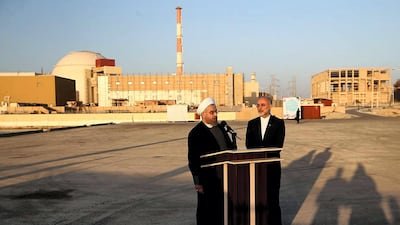
Fomer Iranian President Hassan Rouhani and the country's Atomic Energy Organisation chief Ali Akbar Salehi speak at the Bushehr nuclear site in 2015. AFP -
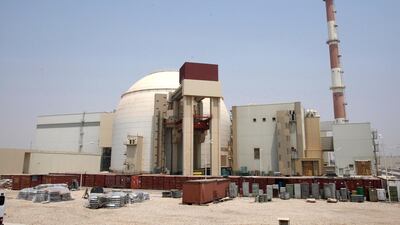
Iran's Bushehr nuclear plant has been restarted. EPA -
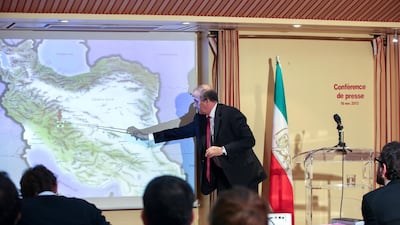
Mehdi Abrichamtchi, chairman of the Peace and Security Committee at the National Council of Resistance of Iran, shows journalists the location of a secret nuclear site in Iran in 2013. AFP -
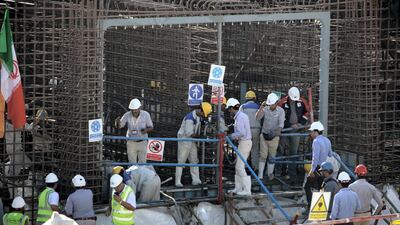
Workers prepare to begin the construction of a second reactor at the Bushehr site. AFP


Painstakingly slow talks in Vienna have dragged on for the past year. Iran, its economy strangled, has been seeking sanctions relief while resisting tough demands from the West.
Negotiations nearly reached completion this month before Moscow demanded that its trade with Iran be exempted from Western sanctions over the war Ukraine, throwing the process into disarray.
Negotiators have yet to reconvene in the Austrian capital and it’s unknown what hurdles lie ahead.
“The essence of the issue is to run the country in such a way that sanctions cannot hit the country seriously,” Mr Khamenei said, praising the hardline government of President Ebrahim Raisi for boosting Iran’s trade with its neighbours and shipping Iranian crude abroad despite sanctions.
“There is another way for us to use oil revenue for the country’s infrastructure.”
In his remarks, Mr Khamenei also weighed in on Russia’s war in Ukraine — echoing some of President Vladimir Putin’s talking points without ever mentioning Russia at all.
“You look at Ukraine, its president who was appointed by Western governments, what a sharp tone he now uses to address the West,” Mr Khamenei said, extolling Iran’s resistance to foreign interference and military development since the 1979 revolution.
“The choice of our nation was not surrender to arrogance — it was resistance, it was maintaining independence.”
Iran generally considers Russia an ally and feels united with Mr Putin’s anti-American and anti-Western stance.

