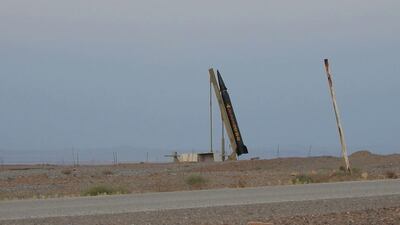
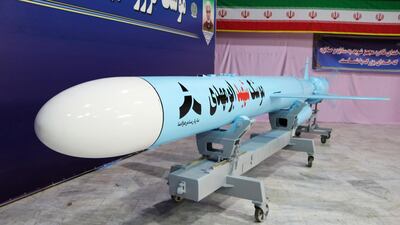
An Iranian Defence Ministry photo shows the Simorgh or "Phoenix" rocket prior to launch last year. AP

Iran's IRGC puts second satellite into space


  • English
  • Arabic

Iran’s Revolutionary Guard says it has successfully launched a second satellite into orbit, state media reported on Tuesday.

Western officials and experts said the country’s space programme and such launches by the paramilitary IRGC are covers for ballistic missile tests.

The launch took place in the Shahroud Desert in the country’s north-east — where the main pad of the country’s space agency is located ― state television reported, without saying when it took place.

The IRGC said the Noor-2 satellite reached low orbit on the Ghased satellite carrier, IRNA reported. It described the Ghased as a three-phase, mixed fuel satellite carrier.

The launch comes days after satellite pictures suggested Iran’s civilian programme suffered another failed launch.

A satellite image shows lorries and other equipment surrounding a scorched launch pad after an apparent failed launch at Iran's Imam Khomeini Spaceport in Semnan province on February 27. Photo: Maxar Technologies via AP

Noor means “light” in Farsi. The IRGC launched its first Noor satellite in 2020, revealing to the world that it ran its own space programme.

The head of the US Space Command later dismissed the 2020 satellite as “a tumbling webcam in space” that wouldn’t provide Iran vital intelligence — though it showed Tehran’s ability to successfully get into orbit after a series of setbacks.

Several Iranian satellite launches have ended in failure with rockets blowing up on the launch pad or shortly after take-off.

The US has yet to comment on the launch. However, it comes as Iran’s top diplomats left Vienna, where months of talks on reviving the 2015 nuclear deal with world powers are being held, and suddenly flew back to Tehran for consultations. The EU and US have said that the negotiations are nearing an end and final agreements need to be made if a deal is to be reached.

The West’s Middle East allies, led by Israel, have expressed concern about the revival of the deal that could involve sanctions being removed from Iran. The country’s nuclear developments, ballistic missile programme as well as support for proxies across the Middle East are of major concern.

The US has alleged Iran’s satellite launches defy a UN Security Council resolution and has called on Tehran to undertake no activity related to ballistic missiles capable of delivering nuclear weapons.

Iran, which has long said it does not seek nuclear weapons, previously maintained that its satellite launches and rocket tests do not have a military component. US intelligence agencies and the International Atomic Energy Agency say Iran abandoned an organised military nuclear programme in 2003.

Iran's ballistic missile tests — in pictures

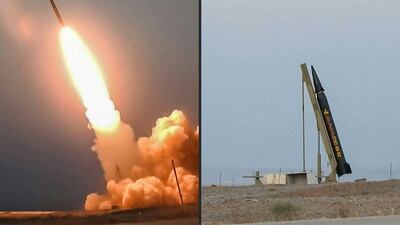
  • The ballistic missile named after Qassem Suleimani is being tested in an undisclosed location in Iran. AFP / Iranian Defence Ministry
    The ballistic missile named after Qassem Suleimani is being tested in an undisclosed location in Iran. AFP / Iranian Defence Ministry
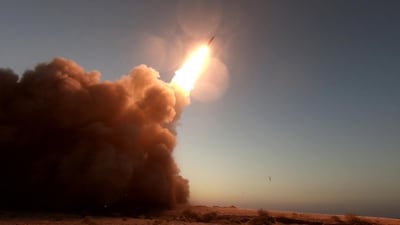
  • A missile unveiled by Iran is launched in an unknown location in Iran. Wana via Reuters
    A missile unveiled by Iran is launched in an unknown location in Iran. Wana via Reuters
  • A missile unveiled by Iran is launched in an unknown location in Iran. Wana via Reuters
    A missile unveiled by Iran is launched in an unknown location in Iran. Wana via Reuters
  • A missile unveiled by Iran is launched in an unknown location in Iran. Wana via Reuters
    A missile unveiled by Iran is launched in an unknown location in Iran. Wana via Reuters
  • A missile unveiled by Iran is launched in an unknown location in Iran. Wana via Reuters
    A missile unveiled by Iran is launched in an unknown location in Iran. Wana via Reuters
  • The ballistic missile named after Qassem Suleimani is being tested in an undisclosed location. EPA / Iranian Defence Ministry
    The ballistic missile named after Qassem Suleimani is being tested in an undisclosed location. EPA / Iranian Defence Ministry
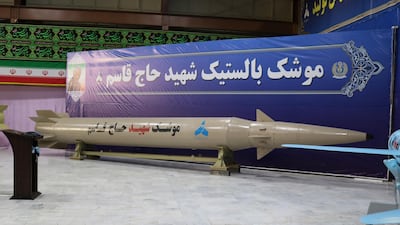
  • A new cruise missile named after Qassem Suleimani at in an unknown location in Iran. Wana via Reuters
    A new cruise missile named after Qassem Suleimani at in an unknown location in Iran. Wana via Reuters
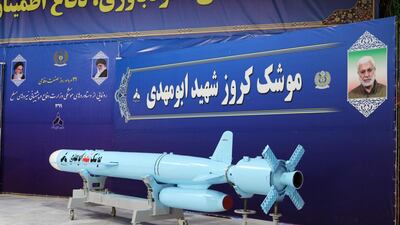
  • A new cruise missile named after Abu Mahdi Al Muhandis is seen in an unknown location in Iran. Wana via Reuters
    A new cruise missile named after Abu Mahdi Al Muhandis is seen in an unknown location in Iran. Wana via Reuters
  • A new cruise missile named after Abu Mahdi Al Muhandis is seen in an unknown location in Iran. Wana via Reuters
    A new cruise missile named after Abu Mahdi Al Muhandis is seen in an unknown location in Iran. Wana via Reuters
  • A new cruise missile named after Abu Mahdi Al Muhandis is seen in an unknown location in Iran. Wana via Reuters
    A new cruise missile named after Abu Mahdi Al Muhandis is seen in an unknown location in Iran. Wana via Reuters
  • A new cruise missile unveiled by Iran is seen at an unknown location in Iran. Wana via Reuters
    A new cruise missile unveiled by Iran is seen at an unknown location in Iran. Wana via Reuters

Mercer, the investment consulting arm of US services company Marsh & McLennan, expects its wealth division to at least double its assets under management (AUM) in the Middle East as wealth in the region continues to grow despite economic headwinds, a company official said.

Mercer Wealth, which globally has $160 billion in AUM, plans to boost its AUM in the region to $2-$3bn in the next 2-3 years from the present $1bn, said Yasir AbuShaban, a Dubai-based principal with Mercer Wealth.

Within the next two to three years, we are looking at reaching $2 to $3 billion as a conservative estimate and we do see an opportunity to do so,” said Mr AbuShaban.

Mercer does not directly make investments, but allocates clients’ money they have discretion to, to professional asset managers. They also provide advice to clients.

“We have buying power. We can negotiate on their (client’s) behalf with asset managers to provide them lower fees than they otherwise would have to get on their own,” he added.

Mercer Wealth’s clients include sovereign wealth funds, family offices, and insurance companies among others.

From its office in Dubai, Mercer also looks after Africa, India and Turkey, where they also see opportunity for growth.

Wealth creation in Middle East and Africa (MEA) grew 8.5 per cent to $8.1 trillion last year from $7.5tn in 2015, higher than last year’s global average of 6 per cent and the second-highest growth in a region after Asia-Pacific which grew 9.9 per cent, according to consultancy Boston Consulting Group (BCG). In the region, where wealth grew just 1.9 per cent in 2015 compared with 2014, a pickup in oil prices has helped in wealth generation.

BCG is forecasting MEA wealth will rise to $12tn by 2021, growing at an annual average of 8 per cent.

Drivers of wealth generation in the region will be split evenly between new wealth creation and growth of performance of existing assets, according to BCG.

Another general trend in the region is clients’ looking for a comprehensive approach to investing, according to Mr AbuShaban.

“Institutional investors or some of the families are seeing a slowdown in the available capital they have to invest and in that sense they are looking at optimizing the way they manage their portfolios and making sure they are not investing haphazardly and different parts of their investment are working together,” said Mr AbuShaban.

Some clients also have a higher appetite for risk, given the low interest-rate environment that does not provide enough yield for some institutional investors. These clients are keen to invest in illiquid assets, such as private equity and infrastructure.

“What we have seen is a desire for higher returns in what has been a low-return environment specifically in various fixed income or bonds,” he said.

“In this environment, we have seen a de facto increase in the risk that clients are taking in things like illiquid investments, private equity investments, infrastructure and private debt, those kind of investments were higher illiquidity results in incrementally higher returns.”

The Abu Dhabi Investment Authority, one of the largest sovereign wealth funds, said in its 2016 report that has gradually increased its exposure in direct private equity and private credit transactions, mainly in Asian markets and especially in China and India. The authority’s private equity department focused on structured equities owing to “their defensive characteristics.”

FIXTURES

All games 6pm UAE on Sunday: 
Arsenal v Watford
Burnley v Brighton
Chelsea v Wolves
Crystal Palace v Tottenham
Everton v Bournemouth
Leicester v Man United
Man City v Norwich
Newcastle v Liverpool
Southampton v Sheffield United
West Ham v Aston Villa

Desert Warrior

Starring: Anthony Mackie, Aiysha Hart, Ben Kingsley

Director: Rupert Wyatt

Rating: 3/5

Results

5pm: Maiden (PA) Dh80,000 (Turf) 1,200m, Winner: ES Rubban, Antonio Fresu (jockey), Ibrahim Aseel (trainer)

5.30pm: Handicap (PA) Dh85,000 (T) 1,200m, Winner: Al Mobher, Sczcepan Mazur, Ibrahim Al Hadhrami

6pm: Handicap (PA) Dh80,000 (T) 2,200m, Winner: Jabalini, Tadhg O’Shea, Ibrahim Al Hadhrami

6.30pm: Wathba Stallions Cup (PA) Dh70,000 (T) 2,200m, Winner: AF Abahe, Tadgh O’Shea, Ernst Oertel

7pm: Handicap (PA) Dh85,000 (T) 1,600m, Winner: AF Makerah, Tadhg O’Shea, Ernst Oertel

7.30pm: Maiden (TB) Dh80,000 (T) 1,600m, Winner: Law Of Peace, Tadhg O’Shea, Satish Seemar

the pledge

I pledge to uphold the duty of tolerance

I pledge to take a first stand against hate and injustice

I pledge to respect and accept people whose abilities, beliefs and culture are different from my own

I pledge to wish for others what I wish for myself

I pledge to live in harmony with my community

I pledge to always be open to dialogue and forgiveness

I pledge to do my part to create peace for all

I pledge to exercise benevolence and choose kindness in all my dealings with my community

I pledge to always stand up for these values: Zayed's values for tolerance and human fraternity

Updated: March 08, 2022, 10:02 AM