
Iran’s supreme leader on Wednesday dismissed initial offers at talks in Vienna to save Tehran’s tattered nuclear deal as “not worth looking at,” as Tehran seeks to pressure world powers after an attack on the country’s main nuclear enrichment site.
The comments by Ayatollah Ali Khamenei, who has a final say on all matters of state, came after a day that saw Iran’s president similarly ratchet up pressure over the accord. European powers, meanwhile, warned Tehran its actions were “particularly regrettable” and “dangerous.”
The talks have already been thrown into disarray by a weekend attack on Iran’s main Natanz nuclear enrichment site that Tehran says was carried out by Israel – who have made no official comment on the matter.
Tehran retaliated by announcing it would enrich uranium up to 60 per cent – higher than it ever has before but still lower than weapons-grade levels of 90 per cent.
“The offers they provide are usually arrogant and humiliating [and] are not worth looking at,” the 81-year-old Mr Khamenei said in an address marking the first day of Ramadan in Iran.
He also criticised the US and warned time could be running out.
“The talks shouldn’t become talks of attrition,” Mr Khamenei said. “They shouldn’t be in a way that parties drag on and prolong the talks. This is harmful to the country.”
Speaking to his Cabinet, an impassioned Iranian President Hassan Rouhani said the first-generation IR-1 centrifuges that were damaged in Sunday’s attack would be replaced by advanced IR-6 centrifuges that enrich uranium much faster.
“You wanted to make our hands empty during the talks but our hands are full,” Mr Rouhani said.
“Sixty per cent enrichment is an answer to your evilness. … We cut off both of your hands, one with IR-6 centrifuges and another one with 60 per cent,” he said.
-

Iranian President Hassan Rouhani, right, and the head of Atomic Energy Organization of Iran Ali Akbar Salehi inspect the nuclear technology on the occasion of Iran National Nuclear Technology Day in Tehran in 2019. EPA -
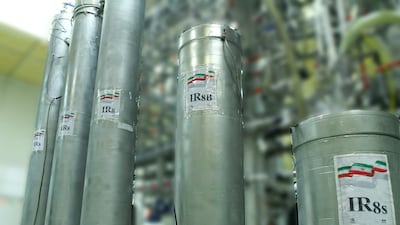
IR-8 centrifuges at Natanz nuclear power plant, some 300 kilometres south of capital Tehran. AFP -
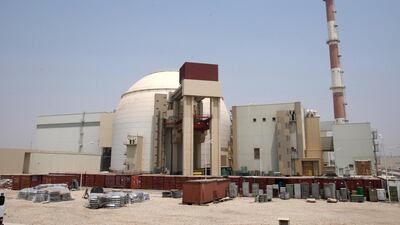
The Iranian nuclear power plant in Bushehr in 2010. EPA -

Salehi speaks with media while visiting Natanz enrichment facility, in central Iran in 2019. Atomic Energy Organization of Iran via AP -
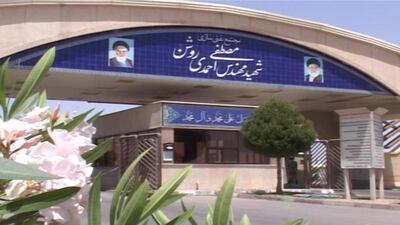
The gate of Natanz nuclear power plant in Natanz , Isfahan province, in 2019. EPA -
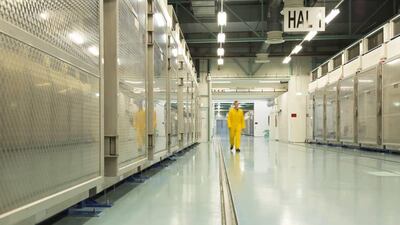
Inside of the Iran's Fordow nuclear facility, in Fordow, Qom province in 2019. EPA -
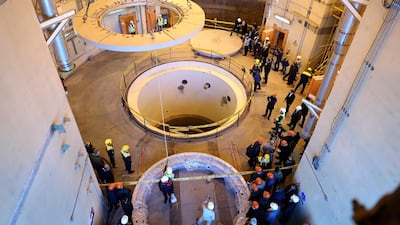
Technicians work at the Arak heavy water reactor's secondary circuit, as officials and media visit the site, near Arak, Iran in 2019. Atomic Energy Organization of Iran via AP -
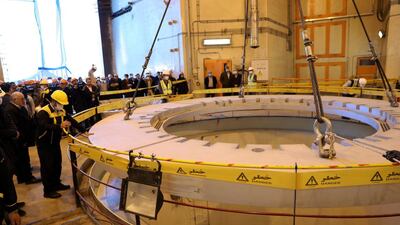
Members of the media and officials tour the water nuclear reactor at Arak in 2019. WANA via Reuters -
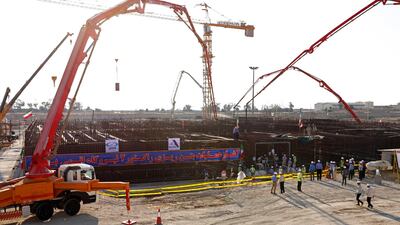
Concrete is poured for the base of the second nuclear power reactor at Bushehr plant in 2019. Atomic Energy Organization of Iran via AP


Mr Rouhani also accused Israel of being behind the Natanz attack and threatened to retaliate.
In Jerusalem at a Memorial Day commemoration, Israeli Prime Minister Benjamin Netanyahu appeared to reference Iran but spoke indirectly.
“We must never remain apathetic to the threats of war and extermination of those who seek to eliminate us,” he said.
Israel has not claimed the attack, though it rarely does in its ongoing shadow war against Tehran.
The talks in Vienna aim to find a way for the United States to re-enter Tehran’s nuclear agreement with world powers and have Iran comply again with its limits.
The accord, which former President Donald Trump unilaterally withdrew the US from in 2018, prevented Iran from stockpiling enough high-enriched uranium to be able to pursue a nuclear weapon in exchange for the lifting of economic sanctions.
Late on Wednesday, the EU said formal negotiations would resume Thursday in Vienna.
Mr Rouhani, in his comments Wednesday, insisted Iran is still hoping that the Vienna talks lead to a negotiated settlement over its programme – and the accompanying lifting of punishing sanctions. Mr Khamenei as well said he believed in his negotiators, but kept up the pressure on the West in his remarks Wednesday night.
“They must do what we say first, and we are assured that it’s done, then we will do what is we are required to do,” he said.

France, Germany and the UK, all parties to the nuclear deal, only hours earlier issued a joint statement Wednesday expressing their “grave concern” over Iran’s decision to increase enrichment.
“This is a serious development since the production of highly enriched uranium constitutes an important step in the production of a nuclear weapon,” the countries said. “Iran has no credible civilian need for enrichment at this level.”
China and Russia also took part in the deal.
US Secretary of State Antony Blinken also called Iran’s enrichment decision a “provocative announcement.”
“It calls into question Iran’s seriousness of purpose in the nuclear talks,” he said in Brussels.
Saudi Arabia similarly issued a statement, saying enriching at that level “could not be considered a programme intended for peaceful purposes.”
It called on Iran to “avoid escalation.”
Iran insists its nuclear programme is peaceful, though the West and the International Atomic Energy Agency says Tehran had an organised military nuclear programme up until the end of 2003.
An annual US intelligence report released on Tuesday maintained the American assessment that “Iran is not currently undertaking the key nuclear weapons-development activities that we judge would be necessary to produce a nuclear device.”
Iran previously said it could use uranium enriched up to 60 per cent for nuclear-powered ships.
However, the country currently has no such ships in its navy.
Iran had been enriching up to 20 per cent – even that was a short technical step to weapons-grade levels.
The deal limited Iran’s enrichment to 3.76 per cent.
Iran’s envoy to the International Atomic Energy Agency (IAEA), Kazem Gharibabadi, posted a letter online addressed to IAEA Director-General Rafael Grossi warning against “any adventurism by [the] Israeli regime” targeting Iranian nuclear sites.
“The most recent cowardly act of nuclear terrorism will only strengthen our determination to march forward and to replace all [damaged] centrifuges with even more advanced and sophisticated machines,” Mr Gharibabadi wrote.
IAEA inspectors visited Natanz on Wednesday on their first trip since the sabotage and found Iran preparing an aboveground area for the higher enrichment, the agency said.
Iran has “almost completed preparations to start producing [uranium gas] enriched up to 60 per cent,” the IAEA said in a later statement.
“Iran informed the agency that the necessary pipework was being finalised and that feeding of [uranium gas] enriched up to 5 per cent into a cascade of IR-6 centrifuges would start soon thereafter.”
The weekend attack at Natanz was initially described only as a power cut in the electrical grid feeding aboveground workshops and underground enrichment halls – but later Iranian officials began calling it an attack.
Alireza Zakani, the hard-line head of the Iranian parliament’s research centre, referred to “several thousand centrifuges damaged and destroyed” in a state TV interview.
However, no other official has offered that figure and no images of the aftermath have been released. – reporting by AP

