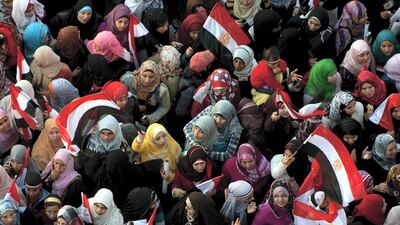

It was November 2012 – nearly two years after the eruption of mass protests on January 25, 2011 that toppled former Egyptian president Hosni Mubarak. Soraya Bahgat planned to go to Tahrir Square to demonstrate against his successor, Mohamed Morsi, but changed her mind when she saw footage of a mob of men assaulting a woman, tearing off her clothes.
She took action in the only way she felt she could. She started a Twitter account called Tahrir Bodyguard and hundreds of volunteers answered the call to protect female protesters.
Fast-forward to July 2020 when university student Nadine Abdel Hamid took to Instagram and Facebook to warn women about sexual predator Ahmed Bassam Zaki. Her post led to the creation of the Assault Police Instagram account, which encouraged others to share their experiences, a movement the media called Egypt’s #MeToo.

“People have become more courageous about speaking out on sexual harassment since 2011,” says human rights lawyer Ragia Omran. “Social media definitely helped to spread the word. The naming and shaming has become more popular as one of the tools to be used against sexual predators.”
In the decade since the uprising, women’s rights activists say, great strides have been made in the fight against sexual violence and harassment in Egypt, including growing awareness and changes to the law to strengthen punishments.
But they say more can be done to prevent such crimes and support the victims. A generation armed with social media accounts and the power to share is ensuring the fight is far from over.

“For me, whatever I can do, I will do,” says Ms Abdel Hamid, 22. “Getting the story out there is important. Making it widespread is important. It’s important for more and more people to know what’s happening.”
Although sexual violence against women in Egypt predates the 2011 revolution, mob assaults during the Tahrir demonstrations brought it to the forefront.
Several cases gained international attention, including the gang rape of South African reporter Lara Logan on February 11, 2011, the night Mubarak resigned. The anonymous “girl in the blue bra” who was stripped of her abaya while being dragged along the ground by security forces in December 2011 became a defining image and a rallying cry.
Ninety-nine per cent of women in Egypt interviewed in a 2013 UN survey said they had been sexually harassed during their lifetimes. The findings are based on the results of interviews with more than 2,300 girls and women, and 1,100 boys and men. The respondents, aged 10 to 35, were from seven regions of Egypt, including Cairo and Alexandria as well as more rural areas.

Engy Ghozlan, who worked on the first national campaign against sexual harassment with the Egyptian Centre for Women’s Rights, in 2005, says it was around that time that bloggers started describing mob sexual assaults taking place during Eid and other holidays.
“It was really challenging at the time because the social media platforms weren’t as available or as popular as now,” says Ms Ghozlan, 35. “And it was even challenging to say the words ‘sexual harassment’ because it was still a taboo.”
In December 2010, she co-founded HarassMap, an online interactive mapping tool for reporting assaults when they happen.
“We knew it was happening all over the place, but we wanted evidence generated by women themselves that this is everywhere,” she says.
The uprising started with a feeling of safety and “utopia”, but deteriorated into an “emergency situation where we all had to jump in and help”, Ms Ghozlan says.
In the months that followed, groups such as Operation Anti-Sexual Harassment/Assault, Bassma and Tahrir Bodyguard were formed to make the streets safer and draw attention to the problem. Tahrir Bodyguard volunteers in yellow vests and hard hats patrolled the area and helped women and girls who were being assaulted, intervening in more than 100 cases.

Tahrir Bodyguard founder Ms Bahgat, 37, says she could not have gathered the volunteers or the support without social media.
“I appreciated 10 years ago the opportunity that social media gave me, and I appreciate more and more how it can change mindsets,” she says.
Increased awareness and pressure also led to changes in legislation. In April 2011, the Supreme Council of the Armed Forces increased the penalties for offences against women and girls including kidnapping, sexual assault and rape. In June 2014, interim president Adly Mansour decreed sexual harassment a crime punishable by up to five years in prison.
“We’ve come far in the fact that sexual harassment is now recognised under the criminal code in Egypt – not just physical harassment, but also verbal,” says Ms Omran, who is representing several clients in the case against Zaki, 21.
But the challenge now is to make women feel “safe and protected” to come forward, she says. Often women are blamed for wearing attire deemed provocative or immodest, or for their own behaviour, then are vilified or threatened if they pursue charges.
When Ms Abdel Hamid posted a warning to others about Zaki in July 2020 after he had harassed and blackmailed her for years, she “didn’t imagine taking it up legally at first”.
“The problem, especially in Egyptian society, is that young girls are too afraid to come forward because of the whole idea of family values – what is my family going to think of this?” says Ms Abdel Hamid, a music technology student at the American University of Cairo. “We don’t know what our rights are, so we’re not sure ... are we capable of putting him behind bars? Is anyone going to listen to us? There are multiple different questions that come into play.”

Ms Abdel Hamid was threatened over the post and warned to remove it, which she did. But the floodgates had already opened; the revelation spurred fellow AUC student Nadeen Ashraf to start the Assault Police Instagram account and encourage other women to speak out.
More than 100 women and young girls provided evidence to Assault Police via email that Zaki had harassed them online or in person, including dozens who said he sexually assaulted them.
He was arrested and last month sentenced to three years in prison for "misusing" social media networks and phone applications. His trial on sexual assault charges is scheduled to begin in February.
The allegations prompted Egypt's two highest religious authorities, Al Azhar Mosque and the Mufti, to issue statements condemning sexual harassment and rejecting the notion that a woman's attire could make her culpable.
Zaki's arrest also led to an amendment to the criminal code enabling prosecutors to conceal the identities and personal data of victims to protect them from possible retribution.
Another case that came to light through the Assault Police account, which now has more than 237,000 followers, is an involving a group of young men from wealthy families said to have drugged and raped a woman at a five-star Cairo hotel in 2014. Several arrests have been made, but the trial has not yet begun.
After threats to her security, Ms Ashraf suspended the Assault Police account for 10 days in August. She clarified in a subsequent post that “Assault Police does not publish names or faces of any perpetrators before official police reports are filed with the Egyptian authorities”.
Ms Ghozlan says there has been a significant shift from the days of the uprising, when the highest priority was being able to walk on the street in safety.
“People are using social media to report on ... intimate partner sexual assault, sexual harassment that happens in workplaces, schools, universities ... and that’s quite the development,” she says.
Unfortunately, the power of social media goes both ways. At the same time that arrests are being made in connection with sexual assault, several arrests have been made in recent months of girls posting TikTok videos deemed to “violate family values” under the 2018 cyber crimes law.
“It takes a very long time to change the culture and the attitude and the approach, and the way that people think,” Ms Omran says. “And I think that’s the thing with sexual harassment in Egypt – we’re still not there.”
While deeply rooted gender norms and traditions may not change overnight, activists and self-described “survivors” are hopeful.
“People are always saying ‘What do you expect? Nothing’s going to change. Nothing that you say or do is going to fix this’. But here I am with one post that I made and then this blew up,” says Ms Abdel Hamid. “It’s a small seedling that’s planted, but it’s going to grow over time. As long as we keep persisting at it.”

