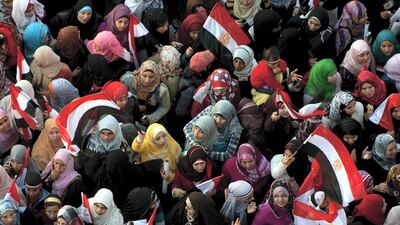
Women gather at Tahrir Square, Cairo, on February 18, 2011 during celebrations to mark one week since Egypt’s long-time president Hosni Mubarak was forced from office by mass protests. AFP

From Tahrir Bodyguard to Assault Police: how social media is fighting sexual predators in Egypt


Nada El Sawy
  • English
  • Arabic

It was November 2012 – nearly two years after the eruption of mass protests on January 25, 2011 that toppled former Egyptian president Hosni Mubarak. Soraya Bahgat planned to go to Tahrir Square to demonstrate against his successor, Mohamed Morsi, but changed her mind when she saw footage of a mob of men assaulting a woman, tearing off her clothes.

She took action in the only way she felt she could. She started a Twitter account called Tahrir Bodyguard and hundreds of volunteers answered the call to protect female protesters.

Fast-forward to July 2020 when university student Nadine Abdel Hamid took to Instagram and Facebook to warn women about sexual predator Ahmed Bassam Zaki. Her post led to the creation of the Assault Police Instagram account, which encouraged others to share their experiences, a movement the media called Egypt’s #MeToo.

Lawyer Ragia Omran is representing several women in the case against Ahmed Bassam Zaki. Nariman El Mofty / AP

“People have become more courageous about speaking out on sexual harassment since 2011,” says human rights lawyer Ragia Omran. “Social media definitely helped to spread the word. The naming and shaming has become more popular as one of the tools to be used against sexual predators.”

In the decade since the uprising, women’s rights activists say, great strides have been made in the fight against sexual violence and harassment in Egypt, including growing awareness and changes to the law to strengthen punishments.

But they say more can be done to prevent such crimes and support the victims. A generation armed with social media accounts and the power to share is ensuring the fight is far from over.

Women join a mass protest in Cairo’s Tahrir Square on November 24, 2011, as members of Egypt’s ruling military council reject calls to step down. AFP

“For me, whatever I can do, I will do,” says Ms Abdel Hamid, 22. “Getting the story out there is important. Making it widespread is important. It’s important for more and more people to know what’s happening.”

Although sexual violence against women in Egypt predates the 2011 revolution, mob assaults during the Tahrir demonstrations brought it to the forefront.

Several cases gained international attention, including the gang rape of South African reporter Lara Logan on February 11, 2011, the night Mubarak resigned. The anonymous “girl in the blue bra” who was stripped of her abaya while being dragged along the ground by security forces in December 2011 became a defining image and a rallying cry.

Ninety-nine per cent of women in Egypt interviewed in a 2013 UN survey said they had been sexually harassed during their lifetimes. The findings are based on the results of interviews with more than 2,300 girls and women, and 1,100 boys and men. The respondents, aged 10 to 35, were from seven regions of Egypt, including Cairo and Alexandria as well as more rural areas.

Engy Ghozlan worked with the Egyptian Centre for Women’s Rights on the country’s first campaign against sexual harassment. Engy Ghozlan

Engy Ghozlan, who worked on the first national campaign against sexual harassment with the Egyptian Centre for Women’s Rights, in 2005, says it was around that time that bloggers started describing mob sexual assaults taking place during Eid and other holidays.

“It was really challenging at the time because the social media platforms weren’t as available or as popular as now,” says Ms Ghozlan, 35. “And it was even challenging to say the words ‘sexual harassment’ because it was still a taboo.”

In December 2010, she co-founded HarassMap, an online interactive mapping tool for reporting assaults when they happen.

“We knew it was happening all over the place, but we wanted evidence generated by women themselves that this is everywhere,” she says.

The uprising started with a feeling of safety and “utopia”, but deteriorated into an “emergency situation where we all had to jump in and help”, Ms Ghozlan says.

In the months that followed, groups such as Operation Anti-Sexual Harassment/Assault, Bassma and Tahrir Bodyguard were formed to make the streets safer and draw attention to the problem. Tahrir Bodyguard volunteers in yellow vests and hard hats patrolled the area and helped women and girls who were being assaulted, intervening in more than 100 cases.

Soraya Bahgat started a Twitter account named Tahrir Bodyguard that led to hundreds of volunteers answering the call to protect female protesters. Bilo Hussein

Tahrir Bodyguard founder Ms Bahgat, 37, says she could not have gathered the volunteers or the support without social media.

“I appreciated 10 years ago the opportunity that social media gave me, and I appreciate more and more how it can change mindsets,” she says.

Increased awareness and pressure also led to changes in legislation. In April 2011, the Supreme Council of the Armed Forces increased the penalties for offences against women and girls including kidnapping, sexual assault and rape. In June 2014, interim president Adly Mansour decreed sexual harassment a crime punishable by up to five years in prison.

“We’ve come far in the fact that sexual harassment is now recognised under the criminal code in Egypt – not just physical harassment, but also verbal,” says Ms Omran, who is representing several clients in the case against Zaki, 21.

But the challenge now is to make women feel “safe and protected” to come forward, she says. Often women are blamed for wearing attire deemed provocative or immodest, or for their own behaviour, then are vilified or threatened if they pursue charges.

When Ms Abdel Hamid posted a warning to others about Zaki in July 2020 after he had harassed and blackmailed her for years, she “didn’t imagine taking it up legally at first”.

“The problem, especially in Egyptian society, is that young girls are too afraid to come forward because of the whole idea of family values – what is my family going to think of this?” says Ms Abdel Hamid, a music technology student at the American University of Cairo. “We don’t know what our rights are, so we’re not sure ... are we capable of putting him behind bars? Is anyone going to listen to us? There are multiple different questions that come into play.”

University student Nadine Abdel Hamid’s warnings on social media about a sexual predator prompted the creation of the Assault Police Instagram account. Ahmed Mourad

Ms Abdel Hamid was threatened over the post and warned to remove it, which she did. But the floodgates had already opened; the revelation spurred fellow AUC student Nadeen Ashraf to start the Assault Police Instagram account and encourage other women to speak out.

More than 100 women and young girls provided evidence to Assault Police via email that Zaki had harassed them online or in person, including dozens who said he sexually assaulted them.

He was arrested and last month sentenced to three years in prison for "misusing" social media networks and phone applications. His trial on sexual assault charges is scheduled to begin in February.

The allegations prompted Egypt's two highest religious authorities, Al Azhar Mosque and the Mufti, to issue statements condemning sexual harassment and rejecting the notion that a woman's attire could make her culpable.

Zaki's arrest also led to an amendment to the criminal code enabling prosecutors to conceal the identities and personal data of victims to protect them from possible retribution.

Another case that came to light through the Assault Police account, which now has more than 237,000 followers, is an involving a group of young men from wealthy families said to have drugged and raped a woman at a five-star Cairo hotel in 2014. Several arrests have been made, but the trial has not yet begun.

After threats to her security, Ms Ashraf suspended the Assault Police account for 10 days in August. She clarified in a subsequent post that “Assault Police does not publish names or faces of any perpetrators before official police reports are filed with the Egyptian authorities”.

Ms Ghozlan says there has been a significant shift from the days of the uprising, when the highest priority was being able to walk on the street in safety.

“People are using social media to report on ... intimate partner sexual assault, sexual harassment that happens in workplaces, schools, universities ... and that’s quite the development,” she says.

Unfortunately, the power of social media goes both ways. At the same time that arrests are being made in connection with sexual assault, several arrests have been made in recent months of girls posting TikTok videos deemed to “violate family values” under the 2018 cyber crimes law.

“It takes a very long time to change the culture and the attitude and the approach, and the way that people think,” Ms Omran says. “And I think that’s the thing with sexual harassment in Egypt – we’re still not there.”

While deeply rooted gender norms and traditions may not change overnight, activists and self-described “survivors” are hopeful.

“People are always saying ‘What do you expect? Nothing’s going to change. Nothing that you say or do is going to fix this’. But here I am with one post that I made and then this blew up,” says Ms Abdel Hamid. “It’s a small seedling that’s planted, but it’s going to grow over time. As long as we keep persisting at it.”


Results

6.30pm: Mazrat Al Ruwayah – Group 2 (PA) $36,000 (Dirt) 1,600m, Winner: RB Money To Burn, Tadhg O’Shea (jockey), Eric Lemartinel (trainer)

7.05pm: Handicap (TB) $68,000 (Turf) 2,410m, Winner: Star Safari, William Buick, Charlie Appleby

7.40pm: Meydan Trophy – Conditions (TB) $50,000 (T) 1,900m, Winner: Secret Protector, William Buick, Charlie Appleby

8.15pm: Al Maktoum Challenge Round 2 - Group 2 (TB) $293,000 (D) 1,900m, Winner: Salute The Soldier, Adrie de Vries, Fawzi Nass

8.50pm: Al Rashidiya – Group 2 (TB) $163,000 (T) 1,800m, Winner: Zakouski, William Buick, Charlie Appleby

9.25pm: Handicap (TB) $65,000 (T) 1,000m, Winner: Motafaawit, Sam Hitchcock, Doug Watson

Mercer, the investment consulting arm of US services company Marsh & McLennan, expects its wealth division to at least double its assets under management (AUM) in the Middle East as wealth in the region continues to grow despite economic headwinds, a company official said.

Mercer Wealth, which globally has $160 billion in AUM, plans to boost its AUM in the region to $2-$3bn in the next 2-3 years from the present $1bn, said Yasir AbuShaban, a Dubai-based principal with Mercer Wealth.

Within the next two to three years, we are looking at reaching $2 to $3 billion as a conservative estimate and we do see an opportunity to do so,” said Mr AbuShaban.

Mercer does not directly make investments, but allocates clients’ money they have discretion to, to professional asset managers. They also provide advice to clients.

“We have buying power. We can negotiate on their (client’s) behalf with asset managers to provide them lower fees than they otherwise would have to get on their own,” he added.

Mercer Wealth’s clients include sovereign wealth funds, family offices, and insurance companies among others.

From its office in Dubai, Mercer also looks after Africa, India and Turkey, where they also see opportunity for growth.

Wealth creation in Middle East and Africa (MEA) grew 8.5 per cent to $8.1 trillion last year from $7.5tn in 2015, higher than last year’s global average of 6 per cent and the second-highest growth in a region after Asia-Pacific which grew 9.9 per cent, according to consultancy Boston Consulting Group (BCG). In the region, where wealth grew just 1.9 per cent in 2015 compared with 2014, a pickup in oil prices has helped in wealth generation.

BCG is forecasting MEA wealth will rise to $12tn by 2021, growing at an annual average of 8 per cent.

Drivers of wealth generation in the region will be split evenly between new wealth creation and growth of performance of existing assets, according to BCG.

Another general trend in the region is clients’ looking for a comprehensive approach to investing, according to Mr AbuShaban.

“Institutional investors or some of the families are seeing a slowdown in the available capital they have to invest and in that sense they are looking at optimizing the way they manage their portfolios and making sure they are not investing haphazardly and different parts of their investment are working together,” said Mr AbuShaban.

Some clients also have a higher appetite for risk, given the low interest-rate environment that does not provide enough yield for some institutional investors. These clients are keen to invest in illiquid assets, such as private equity and infrastructure.

“What we have seen is a desire for higher returns in what has been a low-return environment specifically in various fixed income or bonds,” he said.

“In this environment, we have seen a de facto increase in the risk that clients are taking in things like illiquid investments, private equity investments, infrastructure and private debt, those kind of investments were higher illiquidity results in incrementally higher returns.”

The Abu Dhabi Investment Authority, one of the largest sovereign wealth funds, said in its 2016 report that has gradually increased its exposure in direct private equity and private credit transactions, mainly in Asian markets and especially in China and India. The authority’s private equity department focused on structured equities owing to “their defensive characteristics.”

The Brutalist

Director: Brady Corbet

Stars: Adrien Brody, Felicity Jones, Guy Pearce, Joe Alwyn

Rating: 3.5/5

TEAMS

US Team
Dustin Johnson, Jordan Spieth
Justin Thomas, Daniel Berger
Brooks Koepka, Rickie Fowler
Kevin Kisner, Patrick Reed
Matt Kuchar, Kevin Chappell
Charley Hoffman*, Phil Mickelson*

International Team
Hideki Matsuyama, Jason Day 
Adam Scott, Louis Oosthuizen
Marc Leishman, Charl Schwartzel
Branden Grace, Si Woo Kim
Jhonattan Vegas, Adam Hadwin
Emiliano Grillo*, Anirban Lahiri*

denotes captain's picks


Classification of skills

A worker is categorised as skilled by the MOHRE based on nine levels given in the International Standard Classification of Occupations (ISCO) issued by the International Labour Organisation. 

A skilled worker would be someone at a professional level (levels 1 – 5) which includes managers, professionals, technicians and associate professionals, clerical support workers, and service and sales workers.

The worker must also have an attested educational certificate higher than secondary or an equivalent certification, and earn a monthly salary of at least Dh4,000. 

While you're here
HEADLINE HERE
  • I would recommend writing out the text in the body 
  • And then copy into this box
  • It can be as long as you link
  • But I recommend you use the bullet point function (see red square)
  • Or try to keep the word count down
  • Be wary of other embeds lengthy fact boxes could crash into 
  • That's about it
Our legal columnist

Name: Yousef Al Bahar

Advocate at Al Bahar & Associate Advocates and Legal Consultants, established in 1994

Education: Mr Al Bahar was born in 1979 and graduated in 2008 from the Judicial Institute. He took after his father, who was one of the first Emirati lawyers

Yemen's Bahais and the charges they often face

The Baha'i faith was made known in Yemen in the 19th century, first introduced by an Iranian man named Ali Muhammad Al Shirazi, considered the Herald of the Baha'i faith in 1844.

The Baha'i faith has had a growing number of followers in recent years despite persecution in Yemen and Iran. 

Today, some 2,000 Baha'is reside in Yemen, according to Insaf. 

"The 24 defendants represented by the House of Justice, which has intelligence outfits from the uS and the UK working to carry out an espionage scheme in Yemen under the guise of religion.. aimed to impant and found the Bahai sect on Yemeni soil by bringing foreign Bahais from abroad and homing them in Yemen," the charge sheet said. 

Baha'Ullah, the founder of the Bahai faith, was exiled by the Ottoman Empire in 1868 from Iran to what is now Israel. Now, the Bahai faith's highest governing body, known as the Universal House of Justice, is based in the Israeli city of Haifa, which the Bahais turn towards during prayer. 

The Houthis cite this as collective "evidence" of Bahai "links" to Israel - which the Houthis consider their enemy. 


MATCH INFO

Tottenham Hotspur 1
Kane (50')

Newcastle United 0

The specs

Engine: 6.2-litre V8

Transmission: ten-speed

Power: 420bhp

Torque: 624Nm

Price: Dh325,125

On sale: Now

THE BIG THREE

NOVAK DJOKOVIC
19 grand slam singles titles
Wimbledon: 5 (2011, 14, 15, 18, 19)
French Open: 2 (2016, 21)
US Open: 3 (2011, 15, 18)
Australian Open: 9 (2008, 11, 12, 13, 15, 16, 19, 20, 21)
Prize money: $150m

ROGER FEDERER
20 grand slam singles titles
Wimbledon: 8 (2003, 04, 05, 06, 07, 09, 12, 17)
French Open: 1 (2009)
US Open: 5 (2004, 05, 06, 07, 08)
Australian Open: 6 (2004, 06, 07, 10, 17, 18)
Prize money: $130m

RAFAEL NADAL
20 grand slam singles titles
Wimbledon: 2 (2008, 10)
French Open: 13 (2005, 06, 07, 08, 10, 11, 12, 13, 14, 17, 18, 19, 20)
US Open: 4 (2010, 13, 17, 19)
Australian Open: 1 (2009)
Prize money: $125m

MATCH INFO

Uefa Champions League last-16, second leg:

Real Madrid 1 (Asensio 70'), Ajax 4 (Ziyech 7', Neres 18', Tadic 62', Schone 72')

Ajax win 5-3 on aggregate