
Three men in Egypt have been arrested after allegedly trying to steal a 10-tonne statue of the pharaoh Ramses II using a forklift.
Prosecutors said on Tuesday that the suspects snuck into a quarry in the Nile governorate of Aswan and — using "manual digging tools" as well as the forklift — tried to prise the 3-metre statue from its place.
The quarry itself is government property and is subject to Egypt's Antiquities Protection Law.
Other suspects are being investigated in connection with the attempted theft, prosecutors said.
"Upon examining their mobile phones, the Public Prosecution found video clips shared through social networking applications showing other excavation works," the authorities said.
The suspects will be detained for four days pending investigation.
-

An archaeological discovery in Jirzah, a village south of Cairo, has unearthed a large funerary complex. All photos: Egypt's Ministry of Tourism & Antiquities -
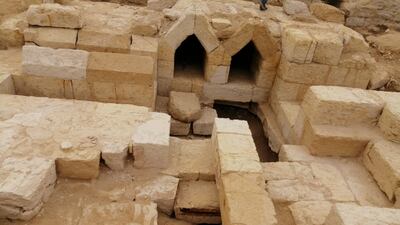
According to Adel Okasha, an antiquities official, the funerary complex’s floor was made of limestone and decorated with coloured tiles -

A number of classical-era mummy portraits dating back to the Roman rule of the country were the find's most exciting items -

An archaeological discovery in Jirzah, a village south of Cairo. The discovery includes several Fayum portraits, marking the first time they were seen since the first batch was discovered 115 years ago -

A terracotta statue of Isis-Aphrodite was found inside a wooden sarcophagus -

A number of papyrus records were also unearthed by the mission -

To the south of the complex, the remains of a colonnaded hall were unearthed, inside of which the remains of four fallen pillars were found -
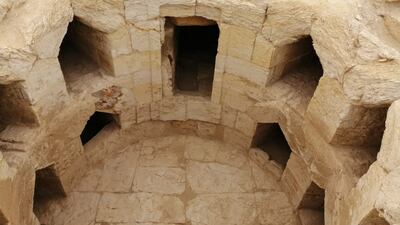
It is noteworthy that the village of Jirzah, which was known as the village of Philadelphia in the Greek era, was established in the third century BC as a central village within the agricultural reclamation project implemented by King Ptolemy II at the time -

The village was inhabited by Egyptian and Greek citizens -

A number of clay vessels and jars were also found -
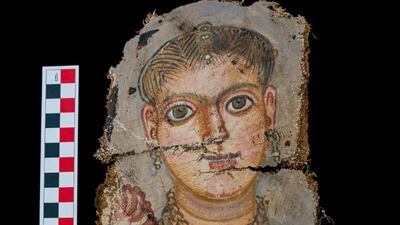
The discovered Fayum images, a type of mummy portrait, are the first to be found since the initial batch was discovered 115 years ago -
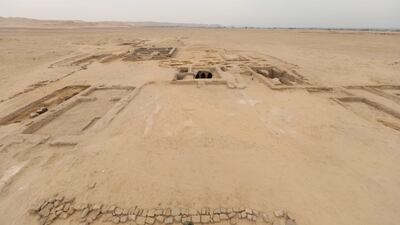
Several sarcophagi were also discovered
Aswan is home to some of Egypt's most prized archaeological sites. These include the Roman-era Temple of Isis and other areas that have become tourist attractions. More discoveries are made regularly.
Illegal archaeological excavations are not uncommon in Egypt, especially along the Nile where there are many antiquity sites.
In 2021, prominent businessman Hassan Rateb was arrested for funding illegal excavation works and was eventually convicted.

KYLIAN MBAPPE 2016/17 STATS
Ligue 1: Appearances - 29, Goals - 15, Assists - 8
UCL: Appearances - 9, Goals - 6
French Cup: Appearances - 3, Goals - 3
France U19: Appearances - 5, Goals - 5, Assists - 1
Five%20calorie-packed%20Ramadan%20drinks
The burning issue
The internal combustion engine is facing a watershed moment – major manufacturer Volvo is to stop producing petroleum-powered vehicles by 2021 and countries in Europe, including the UK, have vowed to ban their sale before 2040. The National takes a look at the story of one of the most successful technologies of the last 100 years and how it has impacted life in the UAE.
Read part four: an affection for classic cars lives on
Read part three: the age of the electric vehicle begins
Read part two: how climate change drove the race for an alternative
Ten tax points to be aware of in 2026
1. Domestic VAT refund amendments: request your refund within five years
If a business does not apply for the refund on time, they lose their credit.
2. E-invoicing in the UAE
Businesses should continue preparing for the implementation of e-invoicing in the UAE, with 2026 a preparation and transition period ahead of phased mandatory adoption.
3. More tax audits
Tax authorities are increasingly using data already available across multiple filings to identify audit risks.
4. More beneficial VAT and excise tax penalty regime
Tax disputes are expected to become more frequent and more structured, with clearer administrative objection and appeal processes. The UAE has adopted a new penalty regime for VAT and excise disputes, which now mirrors the penalty regime for corporate tax.
5. Greater emphasis on statutory audit
There is a greater need for the accuracy of financial statements. The International Financial Reporting Standards standards need to be strictly adhered to and, as a result, the quality of the audits will need to increase.
6. Further transfer pricing enforcement
Transfer pricing enforcement, which refers to the practice of establishing prices for internal transactions between related entities, is expected to broaden in scope. The UAE will shortly open the possibility to negotiate advance pricing agreements, or essentially rulings for transfer pricing purposes.
7. Limited time periods for audits
Recent amendments also introduce a default five-year limitation period for tax audits and assessments, subject to specific statutory exceptions. While the standard audit and assessment period is five years, this may be extended to up to 15 years in cases involving fraud or tax evasion.
8. Pillar 2 implementation
Many multinational groups will begin to feel the practical effect of the Domestic Minimum Top-Up Tax (DMTT), the UAE's implementation of the OECD’s global minimum tax under Pillar 2. While the rules apply for financial years starting on or after January 1, 2025, it is 2026 that marks the transition to an operational phase.
9. Reduced compliance obligations for imported goods and services
Businesses that apply the reverse-charge mechanism for VAT purposes in the UAE may benefit from reduced compliance obligations.
10. Substance and CbC reporting focus
Tax authorities are expected to continue strengthening the enforcement of economic substance and Country-by-Country (CbC) reporting frameworks. In the UAE, these regimes are increasingly being used as risk-assessment tools, providing tax authorities with a comprehensive view of multinational groups’ global footprints and enabling them to assess whether profits are aligned with real economic activity.
Contributed by Thomas Vanhee and Hend Rashwan, Aurifer
Company profile
Date started: 2015
Founder: John Tsioris and Ioanna Angelidaki
Based: Dubai
Sector: Online grocery delivery
Staff: 200
Funding: Undisclosed, but investors include the Jabbar Internet Group and Venture Friends
On Women's Day
Dr Nawal Al-Hosany: Why more women should be on the frontlines of climate action
Shelina Janmohamed: Why shouldn't a spouse be compensated fairly for housework?
Justin Thomas: Challenge the notion that 'men are from Mars, women are from Venus'
The National Editorial: Is there much to celebrate on International Women's Day 2021?
While you're here
Thomas Harding: Johnson and Biden on collision course over Northern Ireland
Thomas Harding: Biden victory will rejuvenate America's relations with Europe
Gavin Esler: Can the world continue to trust Britain after move to break law?
MO
Global state-owned investor ranking by size
|
1. |
United States |
|
2. |
China |
|
3. |
UAE |
|
4. |
Japan |
|
5 |
Norway |
|
6. |
Canada |
|
7. |
Singapore |
|
8. |
Australia |
|
9. |
Saudi Arabia |
|
10. |
South Korea |
How%20to%20avoid%20getting%20scammed
While you're here
Watch: Davos 2021 panel discusses the future of work for women
Alice Haine: Investing in gender parity 'makes good business sense'
Kareem Shaheen: How the pandemic could set Arab women back
Simon Rushton: Home schooling forces UK mothers to quit jobs
Palestine and Israel
Michael Young: Israel's 'iron wall' is sealing the country off from peace
Saeb Erekat: Palestine is capable of overcoming the coronavirus spread
Alexandra Chaves: Gazan artists paint to bring attention to the coronavirus


