


Luxor’s return to the archaeological spotlight with the reopening of the Avenue of Sphinxes last week rekindled a debate about Egyptian treasures in Europe.
As Egyptians watched the spectacle, where hundreds of performers dressed in period costume paraded along the 3,400-year-old road that links two of Egypt’s most popular tourist attractions, some noticed an omission.
Conspicuous by its absence was a 24-metre obelisk – one of a pair dating to the reign of Ramses II that was erected at the entrance to the Luxor temple but now stands in Paris.
“Dear France, we will be grateful to you if you bring back our obelisk, as it’s much needed now for a perfect symmetry in Luxor. It's our heritage,” wrote one Egyptian on Facebook.
Replies flew as that post went viral.
“Bring it back from Paris,” another read. “Shame! Our looted obelisk adorns a public square in France,” a third said.

But unlike many ancient treasures that made their way to Europe from across the ancient world, the obelisk was not stolen.
Muhammad Ali Pasha, Ottoman ruler of Egypt, gave both obelisks to France as a gift in the early 19th century.
The first of the two monuments, carved from pink granite and weighing 230 tonnes, was transported in a single piece to the French capital on a specially-designed barge that could sail the Nile, cross the Mediterranean and travel the Seine.
The voyage took more than two years, and the ship arrived in France on December 23, 1833. It was erected three years later, in the reign of King Louis-Phillipe, at the centre of Place de la Concorde, one of the five royal squares of the French capital.
The logistical challenge was accepted by Egyptologist Jean-Francois Champollion, who first decoded ancient Egyptian hieroglyphs and led an expedition to Egypt in the early 1800s.
The cost of moving the obelisk was estimated at 2.5 million Francs, about $19 million today. The expense is believed to be why the second obelisk never followed.
The Egyptian Supreme Council of Antiquities said the obelisk and other ancient objects, including the Rosetta Stone and the bust of Nefertiti, were wrongfully removed from Egypt.
In most cases, these treasures were taken long before national or international laws safeguarding them came into being.
It was not until 1972 that the General Conference of Unesco adopted the Convention concerning the Protection of World Cultural and Natural Heritage.
In 1983, Egypt passed a law which made all antiquities the property of the state and outlawed their sale or removal from the country in an effort to safeguard its national heritage.

Inas El Shafei, a former inspector at the Egyptian Antiquities Authority, said it was unlikely that anything that left the country before these rules came into force could be recovered.
Many of Egypt's greatest treasures now reside in institutions like the British Museum in London and the Louvre in Paris.
“These countries won’t give up [the treasures] without a robust legal fight,” she said.
In 1981, however, French president Francois Mitterand renounced possession of the second obelisk, effectively giving it back to Egypt. As yet there has been no campaign to return it.
Ms El Shafei, who holds a PhD in Egyptian theology from Tanta University in Gharbia, said that superstition was one of the reasons why so much of ancient Egypt’s treasure was allowed to leave.
“There was so much ignorance and so many myths going around that these pharaonic artefacts like statues and obelisks are haram or forbidden,” she said.
Many Egyptians, she said, used to refer to ancient artefacts like the Luxor obelisks, as well as other pharaonic statues, as Nusub El Shaytan – statues of the devil.
“They were also scared by the myth of the pharaohs’ curse. This played well into the hands of foreign excavators and orientalists like Champollion, who was not known in history books for vandalism but demonstrated a great sense of Egyptomania,” she said, referring to the craze for ancient Egypt that swept Europe in the first half of the 19th century.
The Avenue of Sphinxes Parade - in pictures
-
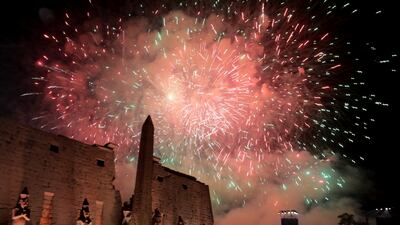
Fireworks explode during the opening ceremony for the restored Avenue of the Sphinxes, or Road of the Rams, a 3,000-year-old path that connects Luxor Temple with Karnak Temple, on November 25, 2021. Reuters -

After years of renovation and in a bid to reinvigorate Egypt's tourism sector, the 2,700-metre Avenue of the Sphinxes was reopened in a grand ceremony. Getty Images -
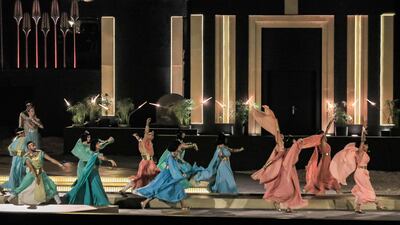
Performers dance during the official ceremony outside Luxor Temple. AFP -

The 2,700-metre Avenue of the Sphinxes is lit up for the event. Getty Images -
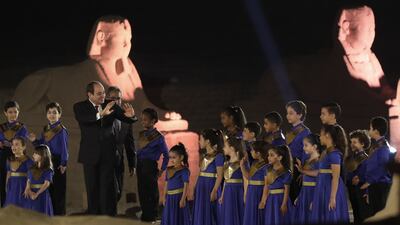
Egyptian President Abdel Fattah El Sisi attends the opening ceremony at Luxor Temple. EPA -
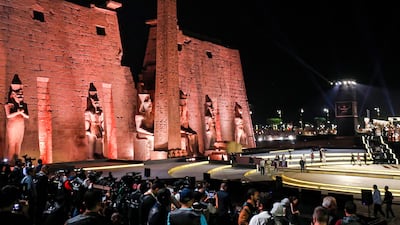
Journalists wait by the pylon and remaining obelisk at the entrance of the temple. AFP -
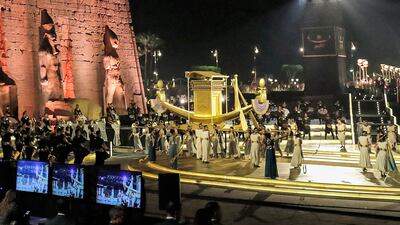
Egypt unveiled the sandstone-paved path lined with ram-headed statues and sphinxes dating back more than 3,000 years. AFP -

Thousands of actors, dancers and drummers participated in the parade. Getty Images -

Dancers take part in the performance, which featured songs composed specially for the occasion. Getty Images -
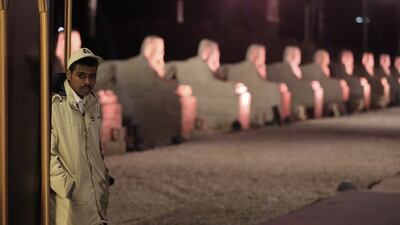
A guard stands at the restored Avenue of Sphinxes. EPA -

The grand ceremony marked the official reopening of the Avenue of Sphinxes. EPA -

A procession of hundreds of costumed performers set out from Luxor Temple to Karnak Temple. EPA -
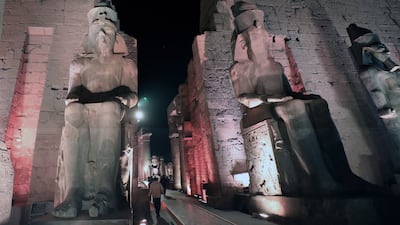
The procession winds its way between the two temples. EPA -
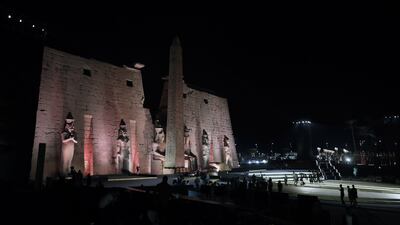
The avenue has been carefully restored in a bid to reinvigorate Egypt's tourism sector. EPA -
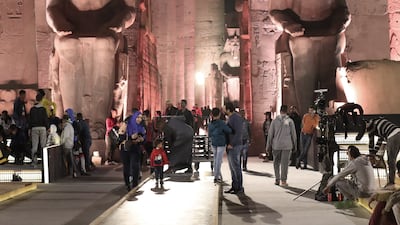
The avenue, as well as the two temples it connects, are set to be an open-air museum after years of excavation and restoration. EPA -

The day after the parade, the entire length of the avenue and all the temples it includes opened to visitors free of charge. EPA -

Luxor Temple before the start of the parade. Getty Images -

Sphinxes sit near Luxor Temple before the celebration. Getty Images -

The entrance of the Avenue of the Sphinxes. Getty Images -

Sphinxes line the 2,700-meter avenue. Getty Images



