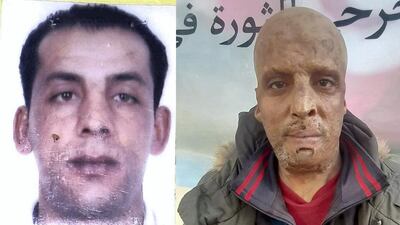
Hosni Qelieh has sustained third-degree burns that scarred his face and most of his body when he decided to commit suicide by fire in protest at police abuse.

Compassion fatigue: Tunisians numb to the horror of public self-immolation


Ahmed Maher
  • English
  • Arabic

In a small flat in the Tunisian city of Kasserine, there was a double tragedy.

Two brothers separately set themselves on fire in protest at deteriorating social conditions.

In 2011 one survived after onlookers saved him, although he was left with severe burns that scarred his face, hands, legs, neck and chest.

We don't care about such news anymore. Life goes on

The other died in 2015, shortly before his 35th birthday.

Hosni Qelieh, now 48, tried but could not get used to the change in his appearance over time.

"Every day I almost cry, ever since this fateful incident. Today I'm jobless, helpless and can't afford the treatment. I wish I had died," Mr Qelieh told The National. He was speaking while taking part in anti-government strikes this week in Tunis.

Among the protesters there were others who survived self-immolations, as well as victims of police violence during the revolution that ousted Zine El Abidine Ben Ali from the presidency a decade ago. Some of them were badly injured and now live with disabilities.

They were protesting against what they perceive as the failure of the state for leaving them without proper care or compensation for their injuries.

Years without hope

Mr Qalieh has been poor his whole life, growing up in the city of Kasserine.

The town is in a governorate remembered by some as the site of a well-known battle between US forces and the Germans during the Second World War.

But today, the troubled city has become a symbol of economic disparity between the interior and the coast, in a country of more than 11 million people.

In 1989, Mr Qalieh dropped out of high school and stayed jobless for most of his twenties. His contemporaries read news reports of rare cases of suicide by fire in his country. But few expected self-immolation to become common after 2011.

Globally, the World Health Organisation reports an average of 800,000 suicides a year, or one every 40 seconds.

In Tunisia after the revolution, suicides are not underreported because burials take place only after an autopsy of the body, as in many Arab countries. In the social media era, the very obvious cause of death happens in real time.

Unemployment and deplorable economic conditions are still the leading cause of suicide in Tunisia. Data on suicide and attempts in 2020 shows that out of 235 cases, 174 were men and 61 were women, in the 16 to 45-year-old age group, according to the latest report by the non-government Tunisian Social Observatory (OST).

Ettadhamen, an impoverished neighborhood in Tunis, Tunisia. Erin Clare Brown / The National

Unofficial statistics estimate that more than 2,000 Tunisians took their own life or attempted suicide since December 2010 when Mohamed Bouazizi set himself ablaze before the governorate building in Sidi Bouzid.

Bouazizi was protesting against police ill treatment, after he was singled out for being an illegal street vendor. Mr Bouazisi's self-immolation was broadly seen as a catalyst for the subsequent Arab uprisings.

The young Tunisian was soon imitated by other Tunisians, including Mr Qalieh, suicidal acts of protest over unemployment and police abuse.

“I copied the same mistake,” he said, recalling the fateful day in January, 2011. “I was humiliated, insulted and badly beaten by policemen in Sousse [south of Tunis] as I was protesting at their making fun at me as a security guard.

“I clashed with one of them who started it all, grabbed him as he insulted my mother but they overpowered me. I was so desperate and suffering from severe bouts of depression as my brother self-immolated himself when he was 35, after being refused work by many employers,” he said.

“Four days later, I actually decided to go to the police and set myself ablaze, as well as them, but they narrowly escaped as a passing truck shielded them from the fire.

"I survived after an ambulance moved me to the main burns hospital in the capital Tunis with third-degree burns,” he recalled.

A lost decade

Tunisia was hailed as the success story of the Arab uprisings for the progress it made in sustaining democracy and human rights, but it has struggled for the past 10 years to revive its economy and deal with a growing sense of frustration and alienation in the street. An unwieldy power-sharing arrangement has not helped the situation, and the government has been less than nimble pursuing reforms.

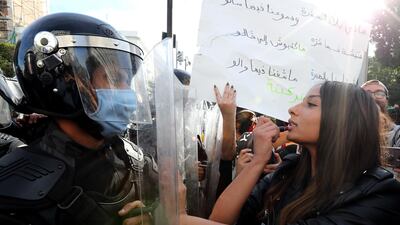
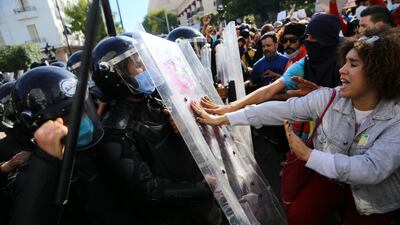
  • A Tunisian anti-government protester puts lipstick in front of anti-riot policemen during a demonstration in Tunis, Tunisia. EPA
    A Tunisian anti-government protester puts lipstick in front of anti-riot policemen during a demonstration in Tunis, Tunisia. EPA
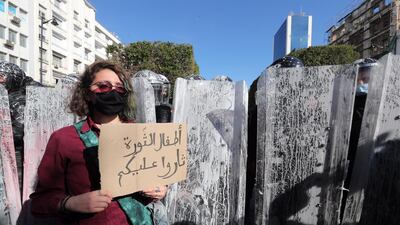
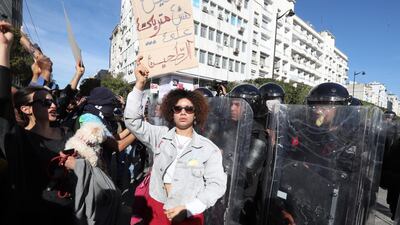
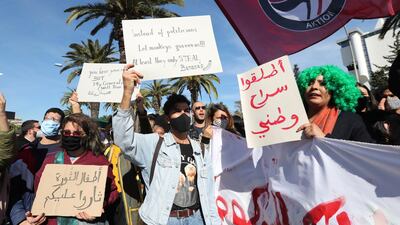
  • A protester holds a placard reading in Arabic 'Children of the revolution revolted against you' in front of anti-riot policemen during a demonstration in Tunis. EPA
    A protester holds a placard reading in Arabic 'Children of the revolution revolted against you' in front of anti-riot policemen during a demonstration in Tunis. EPA
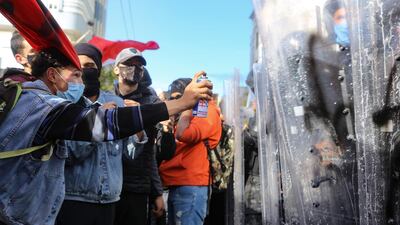
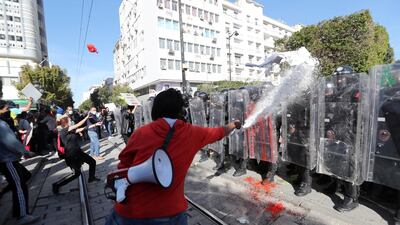
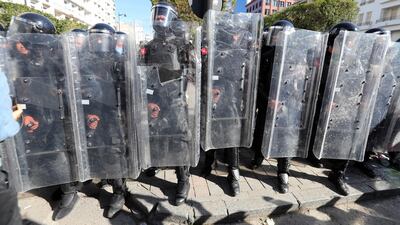
  • A Tunisian protester sprays liquid against the shields of police officers forming a human shield to block the access to demonstrators to the city centre. AFP
    A Tunisian protester sprays liquid against the shields of police officers forming a human shield to block the access to demonstrators to the city centre. AFP
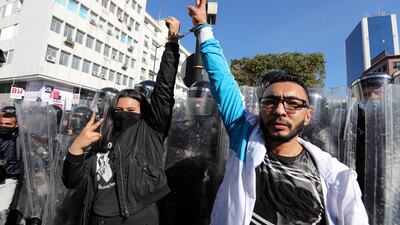
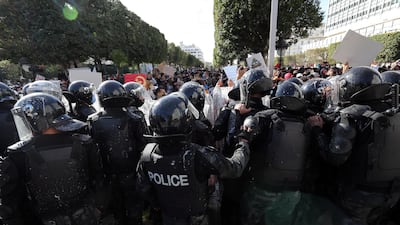
  • Tunisian protesters stand in front of anti-riot policemen during a demonstration in Tunis. EPA
    Tunisian protesters stand in front of anti-riot policemen during a demonstration in Tunis. EPA
  • Tunisian protesters confront police officers forming a human shield. AFP
    Tunisian protesters confront police officers forming a human shield. AFP
  • Tunisian anti-riot policemen block the way in front of protesters during a demonstration in Tunis. EPA
    Tunisian anti-riot policemen block the way in front of protesters during a demonstration in Tunis. EPA
  • A Tunisian woman reacts as she stand in front of police officers forming a human shield. AFP
    A Tunisian woman reacts as she stand in front of police officers forming a human shield. AFP
  • A Tunisian police officer's shield and helmet are covered with a liquid sprayed by protesters. AFP
    A Tunisian police officer's shield and helmet are covered with a liquid sprayed by protesters. AFP
  • Tunisian protesters clash with anti-riot policemen during a demonstration in Tunis. EPA
    Tunisian protesters clash with anti-riot policemen during a demonstration in Tunis. EPA
  • A protester holds a placard reading in Arabic "this generation was not raised on awkwardness" during a demonstration in Tunis. EPA
    A protester holds a placard reading in Arabic "this generation was not raised on awkwardness" during a demonstration in Tunis. EPA
  • Tunisian anti-riot policemen block the way in front of protesters during a demonstration in Tunis. EPA
    Tunisian anti-riot policemen block the way in front of protesters during a demonstration in Tunis. EPA
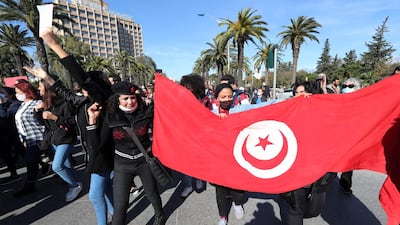
  • Tunisian anti-government protesters shout slogans during a demonstration in Tunis. EPA
    Tunisian anti-government protesters shout slogans during a demonstration in Tunis. EPA
  • Tunisian anti-government protesters shout slogans during a demonstration in Tunis. EPA
    Tunisian anti-government protesters shout slogans during a demonstration in Tunis. EPA

The country has been led by eight governments since the downfall of the country’s long-time leader Ben Ali, but the issues affecting a large section of society have barely changed.

The OST says the country's unemployment rate rose to 18 per cent by end of last year, mainly a result of the pandemic.

Protests and strikes are a fixture of daily life in impoverished cities like Kasserine, the birthplace of Mr Qalieh. In the capital Tunis, dozens of young men recently defied Covid-19 curfew orders at night to battle with police in some of the poorest neighbourhoods.

Hundreds were injured and arrested and at least one died in last month’s clashes. More disaffected young men have threatened to self-immolate on the 10th anniversary of Bouazizi’s death.

Tunisian protesters clash with anti-riot policemen during a demonstration in Tunis, Tunisia, 30 January 2021. People are protesting the high cost of living, increasing poverty and random arrests in the country. EPA photo

But hardly anyone is paying attention, Samah Mouzghi, 25, from Kasserine, told The National, echoing the opinions of many Tunisians.

Ms Mouzghi believes that many people suffer from compassion fatigue, leaving them too emotionally and mentally exhausted to empathise with those who set themselves alight.

“We are no longer shocked by such an act. We used to care and feel compassion for them in the early years of our revolution but I can’t for the life of me praise anyone as a hero after doing this to him or herself,” she said.

“We don’t care about such news any more. Life goes on,” Ms Nouzghi said, consumed by an endless search for a job, four years after her graduation from university.


MATCH INFO

South Africa 66 (Tries: De Allende, Nkosi, Reinach (3), Gelant, Steyn, Brits, Willemse; Cons: Jantjies 8) 

Canada 7 (Tries: Heaton; Cons: Nelson)

The%20specs
%3Cp%3E%3Cstrong%3EEngine%3A%3C%2Fstrong%3E%201.5-litre%204-cylinder%3Cbr%3E%3Cstrong%3ETransmission%3A%20%3C%2Fstrong%3ECVT%3Cbr%3E%3Cstrong%3EPower%3A%20%3C%2Fstrong%3E119bhp%3Cbr%3E%3Cstrong%3ETorque%3A%20%3C%2Fstrong%3E145Nm%3Cbr%3E%3Cstrong%3EPrice%3A%20%3C%2Fstrong%3EDh%2C89%2C900%20(%2424%2C230)%3Cbr%3E%3Cstrong%3EOn%20sale%3A%20%3C%2Fstrong%3Enow%3C%2Fp%3E%0A

Also on December 7 to 9, the third edition of the Gulf Car Festival (www.gulfcarfestival.com) will take over Dubai Festival City Mall, a new venue for the event. Last year's festival brought together about 900 cars worth more than Dh300 million from across the Emirates and wider Gulf region – and that first figure is set to swell by several hundred this time around, with between 1,000 and 1,200 cars expected. The first day is themed around American muscle; the second centres on supercars, exotics, European cars and classics; and the final day will major in JDM (Japanese domestic market) cars, tuned vehicles and trucks. Individuals and car clubs can register their vehicles, although the festival isn’t all static displays, with stunt drifting, a rev battle, car pulls and a burnout competition.

The biog

Born: Kuwait in 1986
Family: She is the youngest of seven siblings
Time in the UAE: 10 years
Hobbies: audiobooks and fitness: she works out every day, enjoying kickboxing and basketball

About Karol Nawrocki

• Supports military aid for Ukraine, unlike other eurosceptic leaders, but he will oppose its membership in western alliances.

• A nationalist, his campaign slogan was Poland First. "Let's help others, but let's take care of our own citizens first," he said on social media in April.

• Cultivates tough-guy image, posting videos of himself at shooting ranges and in boxing rings.

• Met Donald Trump at the White House and received his backing.

The burning issue

The internal combustion engine is facing a watershed moment – major manufacturer Volvo is to stop producing petroleum-powered vehicles by 2021 and countries in Europe, including the UK, have vowed to ban their sale before 2040. The National takes a look at the story of one of the most successful technologies of the last 100 years and how it has impacted life in the UAE. 

Read part four: an affection for classic cars lives on

Read part three: the age of the electric vehicle begins

Read part one: how cars came to the UAE


The burning issue

The internal combustion engine is facing a watershed moment – major manufacturer Volvo is to stop producing petroleum-powered vehicles by 2021 and countries in Europe, including the UK, have vowed to ban their sale before 2040. The National takes a look at the story of one of the most successful technologies of the last 100 years and how it has impacted life in the UAE.

Part three: an affection for classic cars lives on

Read part two: how climate change drove the race for an alternative 

Read part one: how cars came to the UAE

%3Cp%3E%3Cstrong%3EFixtures%3C%2Fstrong%3E%3Cbr%3E%3Cbr%3ESaturday%2C%20May%2028%2C%20United%20States%20v%20Scotland%3Cbr%3ESunday%2C%20May%2029%2C%20United%20States%20v%20Scotland%3Cbr%3ETuesday%2C%20May%2031%2C%20UAE%20v%20Scotland%3Cbr%3EWednesday%2C%20June%201%2C%20UAE%20v%20United%20States%3Cbr%3EFriday%2C%20June%203%2C%20UAE%20v%20Scotland%3Cbr%3ESaturday%2C%20June%204%2C%20UAE%20v%20United%20States%3Cbr%3E%3Cbr%3E%3Cstrong%3EUAE%20squad%3A%20%3C%2Fstrong%3EAhmed%20Raza%20(captain)%2C%20Chirag%20Suri%2C%20Muhammad%20Waseem%2C%20Vriitya%20Aravind%2C%20CP%20Rizwan%2C%20Basil%20Hameed%2C%20Rohan%20Mustafa%2C%20Kashif%20Daud%2C%20Karthik%20Meiyappan%2C%20Zahoor%20Khan%2C%20Junaid%20Siddique%2C%20Alishan%20Sharafu%2C%20Akif%20Raja%2C%20Rahul%20Bhatia%3Cbr%3E%3Cbr%3E%3Cstrong%3ETable%3C%2Fstrong%3E%3Cbr%3E1.%20Oman%2032%2019%2011%2040%20%2B0.156%3Cbr%3E2.%20Scotland%2016%2011%203%2024%20%2B0.574%3Cbr%3E3.%20UAE%2018%2010%206%2022%20%2B0.22%3Cbr%3E4.%20Namibia%2014%207%207%2014%20%2B0.096%3Cbr%3E5.%20United%20States%2016%207%209%2014%20-0.229%3Cbr%3E6.%20Nepal%2012%206%206%2012%20%2B0.113%3Cbr%3E7.%20Papua%20New%20Guinea%2020%201%2019%202%20-0.856%3C%2Fp%3E%0A
Lexus LX700h specs

Engine: 3.4-litre twin-turbo V6 plus supplementary electric motor

Power: 464hp at 5,200rpm

Torque: 790Nm from 2,000-3,600rpm

Transmission: 10-speed auto

Fuel consumption: 11.7L/100km

On sale: Now

Price: From Dh590,000