


Hundreds of Israeli women protested on Thursday in an ultra-Orthodox Jewish suburb of Tel Aviv against what they said was rising gender-based segregation, especially on public transport.
Recent media reports suggest that several bus drivers have forced women to either sit in the back or simply refused to take them on board.
One report earlier this month said the driver of a public bus told a group of teenage girls to sit in the back and cover up after they boarded dressed in tank tops and jeans.
“There is no such thing called democracy without equality,” the protesters chanted on Thursday, many holding placards that read: “We are equal.”
“We can sit wherever we want, we can wear whatever we want … we are free and we are equal to every (other) citizen in Israel,” said Kalanite Kain, 63, a writer who took part in the rally.
Many ultra-Orthodox Jewish residents of Bnei Brak looked on as the demonstrators passed by.
Ultra-Orthodox Jews account for more than 10 per cent of Israel's population.
Israelis protest against judicial overhaul – in pictures
-

Mass protests continue across Israel against the government's justice system reform plan. EPA -

Anti-government protesters march towards the Israeli Knesset in Jerusalem. EPA -
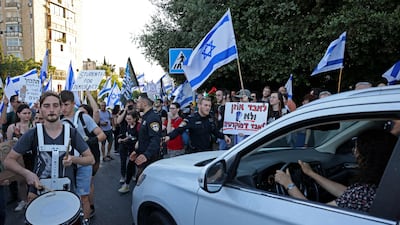
Protesters blocked roads across Israel, hours after parliament adopted a key clause of the government's judicial overhaul package, which opponents say threatens democracy. AFP -

A demonstrator in a dinosaur suit marches at Ben Gurion Airport near Lod. AFP -
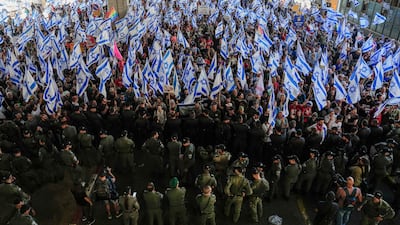
Israelis wave flags during a protest against plans by Prime Minister Benjamin Netanyahu's government to overhaul the judicial system. AP -

Israelis have taken to the streets en masse to protest against the government’s plans to weaken the power of judges. Bloomberg -

Mass protests continue across the country against the government's justice system reform plan. EPA -
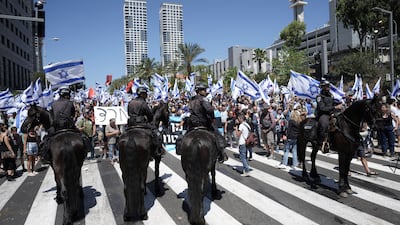
Mounted police in Tel Aviv, Israel, control protesters demonstrating against plans to overhaul the judicial system. AP -

Police and protesters clash on the 'Day of Disruption' opposing the judicial overhaul, in Tel Aviv. Reuters -
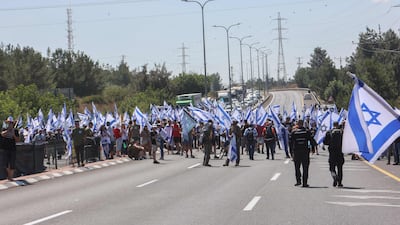
Israeli demonstrators wave flags as they block Highway 443 between Jerusalem and Tel Aviv, near Modiin. AFP -
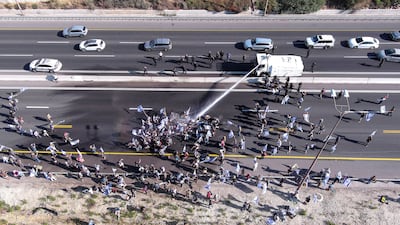
Israeli police use a water cannon against demonstrators at the Ein Hemed junction towards Jerusalem. Reuters -

Protesters set off a flare near Jerusalem as they oppose a bill to curb the Israeli Supreme Court's power to void government decisions. Reuters -

A confrontation in Tel Aviv, Israel, during protests against the move by Prime Minister Benjamin Netanyahu's coalition. Reuters -
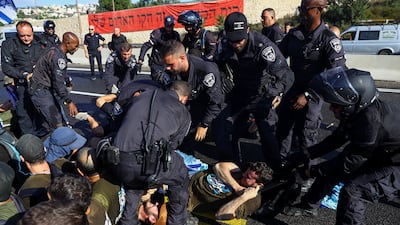
Members of the Israeli security forces remove demonstrators blocking a highway to Jerusalem. Reuters -
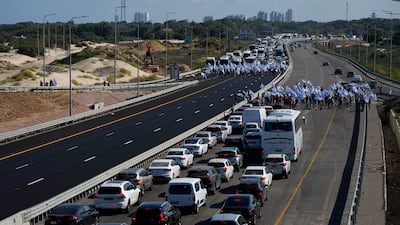
Israeli protesters block the Tel Aviv to Haifa highway near Beit Yanai, Israel. AP -
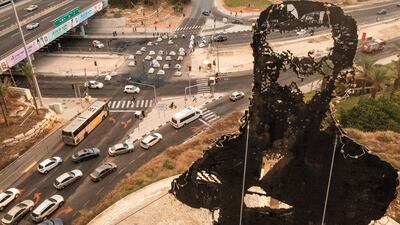
Demonstrators block a road with tents at the entrance to Herzliya, north of Tel Aviv, Israel. Reuters -
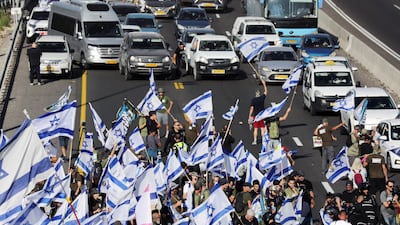
Israeli anti-government protesters block the entrance to Jerusalem, where some demonstrators entered the Knesset building. EPA


The issue of gender segregation is not new in Israel, where many observe religious practices that restrict mingling of the sexes.
But activists say that the discrimination against women has been rising in recent years.
“Just because some religious groups, ultra-Orthodox religious groups think that women are the source of all evil … doesn't mean that we should accept it,” Hila Mor-Zenhavi, a lawyer, told AFP before the rally.
“My motivation for going [to the protest] is mainly my 10-year-old daughter. I want her to grow up in a world where she will have every opportunity, where she won't be excluded for being a woman.”
Tel Aviv, the country's commercial hub, has also been the epicentre of protests against Prime Minister Benjamin Netanyahu's plans to overhaul Israel's judiciary.
Since his government unveiled the reform package in January, tens of thousands of Israelis have joined mass demonstrations in what has turned out to be the biggest protest movement in the country's history – one that has split the nation.
Opponents of the ambitious legislation see the overhaul as a threat to Israel's democracy.
Last month, the Israeli parliament voted on a key plank of the package that limits the so-called reasonableness law.
The new legislation curbs judicial review by Israel's top court of some government decisions, and critics fear it could pave the way to a more authoritarian government.
The amendment of the clause is the first major component of the reform package to become law.
Other proposed changes include allowing the government a greater say in the appointment of judges.
Mr Netanyahu's coalition government, which includes far-right and ultra-Orthodox Jewish parties, argues that the reforms are necessary to rebalance the relationship between elected officials and the judiciary.

