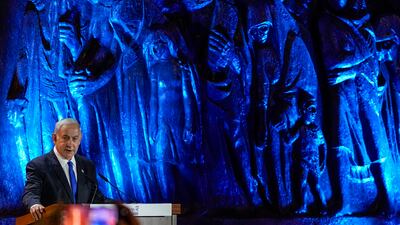
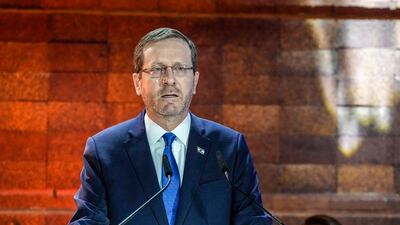
Israeli Prime Minister Benjamin Netanyahu at the Holocaust Remembrance Day ceremony, Yad Vashem, Jerusalem. Reuters

Netanyahu vows to keep up fight against Iran nuclear arms


  • English
  • Arabic

Prime Minister Benjamin Netanyahu vowed that Israel would continue its "fight" to prevent Tehran from developing nuclear weapons, during a Holocaust ceremony attended by Iran's exiled crown prince on Monday.

Recalling a recent visit to Berlin, Mr Netanyahu noted that since Nazi-era Germany "the world has changed, but the calls for our extermination have not ceased, and today come from the regime of horror in Tehran".

"We are fighting resolutely against any nuclear deal with Iran that will pave its way to nuclear arms," the Israeli premier said in a speech on the eve of Holocaust Remembrance Day.

"And for the same reason, we are fighting resolutely against Iran's terror proxies around us," he said at the Yad Vashem memorial in Jerusalem, warning of Israel's "crushing response" to any enemy approaches.

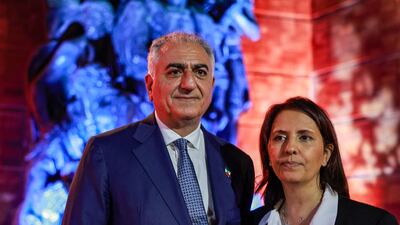
Attending the ceremony was former Iranian crown prince Reza Pahlavi, whose father was the shah overthrown in the 1979 Iranian Revolution.

Mr Pahlavi, who landed earlier on Monday for his first visit to Israel as the guest of Intelligence Minister Gila Gamliel, said ahead of the ceremony that the current Iranian regime did not represent the Iranian people.

"Today, when we have a regime that denies that the Holocaust ever occurred, it was my duty to be here representing my fellow compatriots, to honour the victims of the Holocaust and pay my respects," he told reporters.

  • Israeli Prime Minister Benjamin Netanyahu, centre, with his wife and officials at the opening of Holocaust Martyrs' and Heroes' Remembrance Day. EPA
    Israeli Prime Minister Benjamin Netanyahu, centre, with his wife and officials at the opening of Holocaust Martyrs' and Heroes' Remembrance Day. EPA
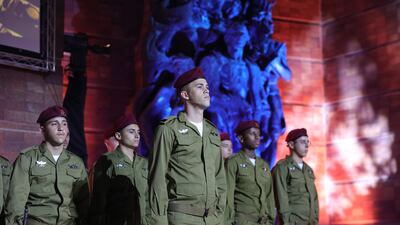
  • Israeli soldiers at the official state opening ceremony at the Yad Vashem Holocaust Memorial Museum in Jerusalem. EPA
    Israeli soldiers at the official state opening ceremony at the Yad Vashem Holocaust Memorial Museum in Jerusalem. EPA
  • Israel's Intelligence Minister Gila Gamliel, right, and Prince Reza Pahlavi, activist, advocate and oldest son of the last Shah of Iran, at a ceremony to mark Holocaust Remembrance Day. AFP
    Israel's Intelligence Minister Gila Gamliel, right, and Prince Reza Pahlavi, activist, advocate and oldest son of the last Shah of Iran, at a ceremony to mark Holocaust Remembrance Day. AFP
  • Benjamin Netanyahu at the opening ceremony of the Holocaust Martyrs and Heroes Remembrance Day at Yad Vashem Holocaust Museum in Jerusalem. AP
    Benjamin Netanyahu at the opening ceremony of the Holocaust Martyrs and Heroes Remembrance Day at Yad Vashem Holocaust Museum in Jerusalem. AP
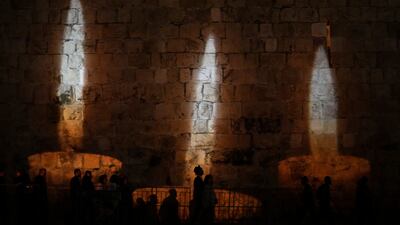
  • Images of memorial candles projected on the walls of Jerusalem's Old City on the eve of Holocaust Remembrance Day. AP
    Images of memorial candles projected on the walls of Jerusalem's Old City on the eve of Holocaust Remembrance Day. AP
  • Holocaust survivor Tova Gutstein, right, lights a torch with her daughter at the memorial museum in Jerusalem. EPA
    Holocaust survivor Tova Gutstein, right, lights a torch with her daughter at the memorial museum in Jerusalem. EPA
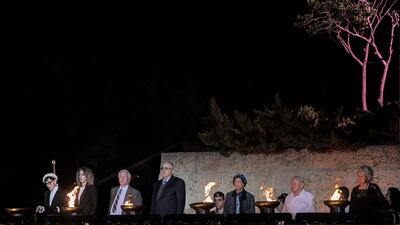
  • Holocaust survivors light six torches in memory of the six million Jews killed by Nazi Germany during the Second World War. AFP
    Holocaust survivors light six torches in memory of the six million Jews killed by Nazi Germany during the Second World War. AFP
  • Israel's President Isaac Herzog during the opening ceremony for the Holocaust Martyrs' and Heroes' Remembrance Day. AP
    Israel's President Isaac Herzog during the opening ceremony for the Holocaust Martyrs' and Heroes' Remembrance Day. AP
  • An image of a Star of David that reads 'Jude', German for Jew, resembling those Jews were forced to wear in Nazi Germany, projected on the walls of Jerusalem's Old City. AP
    An image of a Star of David that reads 'Jude', German for Jew, resembling those Jews were forced to wear in Nazi Germany, projected on the walls of Jerusalem's Old City. AP

On-off talks between Tehran and world powers to revive a 2015 landmark deal that sought to curb Iran's nuclear programme in exchange for sanctions relief have stalled since last year.

The deal Iran reached with Britain, China, France, Germany, Russia and the US collapsed after Washington's unilateral withdrawal in 2018 under then-president Donald Trump.

In February, the UN nuclear watchdog said it had detected particles of uranium enriched to 83.7 per cent in Iran, just under the 90 per cent needed to produce an atomic bomb.

Iran denies wanting to acquire atomic weapons and says it had made no attempt to enrich uranium beyond 60-per cent purity.


Managing the separation process

  • Choose your nursery carefully in the first place
  • Relax – and hopefully your child will follow suit
  • Inform the staff in advance of your child’s likes and dislikes.
  • If you need some extra time to talk to the teachers, make an appointment a few days in advance, rather than attempting to chat on your child’s first day
  • The longer you stay, the more upset your child will become. As difficult as it is, walk away. Say a proper goodbye and reassure your child that you will be back
  • Be patient. Your child might love it one day and hate it the next
  • Stick at it. Don’t give up after the first day or week. It takes time for children to settle into a new routine.And, finally, don’t feel guilty.  
Boston%20Strangler
%3Cp%3E%3Cstrong%3EDirector%3A%3C%2Fstrong%3E%20Matt%20Ruskin%3Cbr%3E%3Cstrong%3EStarring%3A%20%3C%2Fstrong%3EKeira%20Knightley%2C%20Carrie%20Coon%2C%20Alessandro%20Nivola%3Cbr%3E%3Cstrong%3ERating%3A%3C%2Fstrong%3E%203%2F5%3Cbr%3E%3C%2Fp%3E%0A
Emergency

Director: Kangana Ranaut

Stars: Kangana Ranaut, Anupam Kher, Shreyas Talpade, Milind Soman, Mahima Chaudhry 

Rating: 2/5

EVIL%20DEAD%20RISE
%3Cp%3E%3Cstrong%3EDirector%3A%20%3C%2Fstrong%3ELee%20Cronin%3Cbr%3E%3Cstrong%3EStars%3A%20%3C%2Fstrong%3EAlyssa%20Sutherland%2C%20Morgan%20Davies%2C%20Lily%20Sullivan%3Cbr%3E%3Cstrong%3ERating%3A%3C%2Fstrong%3E%205%2F5%3C%2Fp%3E%0A
AL%20BOOM
%3Cp%20style%3D%22text-align%3Ajustify%3B%22%3E%26nbsp%3B%26nbsp%3B%26nbsp%3BDirector%3AAssad%20Al%20Waslati%26nbsp%3B%3C%2Fp%3E%0A%3Cp%20style%3D%22text-align%3Ajustify%3B%22%3E%0DStarring%3A%20Omar%20Al%20Mulla%2C%20Badr%20Hakami%20and%20Rehab%20Al%20Attar%0D%3Cbr%3E%0D%3Cbr%3EStreaming%20on%3A%20ADtv%0D%3Cbr%3E%0D%3Cbr%3ERating%3A%203.5%2F5%0D%3Cbr%3E%0D%3Cbr%3E%3C%2Fp%3E%0A
The specs
Engine: 77.4kW all-wheel-drive dual motor
Power: 320bhp
Torque: 605Nm
Transmission: Single-speed automatic
Price: From Dh219,000
On sale: Now
Company profile

Name: Dukkantek 

Started: January 2021 

Founders: Sanad Yaghi, Ali Al Sayegh and Shadi Joulani 

Based: UAE 

Number of employees: 140 

Sector: B2B Vertical SaaS(software as a service) 

Investment: $5.2 million 

Funding stage: Seed round 

Investors: Global Founders Capital, Colle Capital Partners, Wamda Capital, Plug and Play, Comma Capital, Nowais Capital, Annex Investments and AMK Investment Office  

GAC GS8 Specs

Engine: 2.0-litre 4cyl turbo

Power: 248hp at 5,200rpm

Torque: 400Nm at 1,750-4,000rpm

Transmission: 8-speed auto

Fuel consumption: 9.1L/100km

On sale: Now

Price: From Dh149,900

MADAME%20WEB
%3Cp%3EDirector%3A%20S.J.%20Clarkson%3C%2Fp%3E%0A%3Cp%3EStarring%3A%20Dakota%20Johnson%2C%20Tahar%20Rahim%2C%20Sydney%20Sweeney%3C%2Fp%3E%0A%3Cp%3ERating%3A%203.5%2F5%3C%2Fp%3E%0A
THE%20STRANGERS'%20CASE
%3Cp%3E%3Cstrong%3EDirector%3C%2Fstrong%3E%3A%20Brandt%20Andersen%3Cbr%3E%3Cstrong%3EStarring%3A%20%3C%2Fstrong%3EOmar%20Sy%2C%20Jason%20Beghe%2C%20Angeliki%20Papoulia%3Cbr%3E%3Cstrong%3ERating%3A%3C%2Fstrong%3E%204%2F5%3C%2Fp%3E%0A

Mercer, the investment consulting arm of US services company Marsh & McLennan, expects its wealth division to at least double its assets under management (AUM) in the Middle East as wealth in the region continues to grow despite economic headwinds, a company official said.

Mercer Wealth, which globally has $160 billion in AUM, plans to boost its AUM in the region to $2-$3bn in the next 2-3 years from the present $1bn, said Yasir AbuShaban, a Dubai-based principal with Mercer Wealth.

Within the next two to three years, we are looking at reaching $2 to $3 billion as a conservative estimate and we do see an opportunity to do so,” said Mr AbuShaban.

Mercer does not directly make investments, but allocates clients’ money they have discretion to, to professional asset managers. They also provide advice to clients.

“We have buying power. We can negotiate on their (client’s) behalf with asset managers to provide them lower fees than they otherwise would have to get on their own,” he added.

Mercer Wealth’s clients include sovereign wealth funds, family offices, and insurance companies among others.

From its office in Dubai, Mercer also looks after Africa, India and Turkey, where they also see opportunity for growth.

Wealth creation in Middle East and Africa (MEA) grew 8.5 per cent to $8.1 trillion last year from $7.5tn in 2015, higher than last year’s global average of 6 per cent and the second-highest growth in a region after Asia-Pacific which grew 9.9 per cent, according to consultancy Boston Consulting Group (BCG). In the region, where wealth grew just 1.9 per cent in 2015 compared with 2014, a pickup in oil prices has helped in wealth generation.

BCG is forecasting MEA wealth will rise to $12tn by 2021, growing at an annual average of 8 per cent.

Drivers of wealth generation in the region will be split evenly between new wealth creation and growth of performance of existing assets, according to BCG.

Another general trend in the region is clients’ looking for a comprehensive approach to investing, according to Mr AbuShaban.

“Institutional investors or some of the families are seeing a slowdown in the available capital they have to invest and in that sense they are looking at optimizing the way they manage their portfolios and making sure they are not investing haphazardly and different parts of their investment are working together,” said Mr AbuShaban.

Some clients also have a higher appetite for risk, given the low interest-rate environment that does not provide enough yield for some institutional investors. These clients are keen to invest in illiquid assets, such as private equity and infrastructure.

“What we have seen is a desire for higher returns in what has been a low-return environment specifically in various fixed income or bonds,” he said.

“In this environment, we have seen a de facto increase in the risk that clients are taking in things like illiquid investments, private equity investments, infrastructure and private debt, those kind of investments were higher illiquidity results in incrementally higher returns.”

The Abu Dhabi Investment Authority, one of the largest sovereign wealth funds, said in its 2016 report that has gradually increased its exposure in direct private equity and private credit transactions, mainly in Asian markets and especially in China and India. The authority’s private equity department focused on structured equities owing to “their defensive characteristics.”

Updated: April 18, 2023, 6:36 AM