


US Vice President Kamala Harris has joined President Joe Biden in expressing concern about the political situation in Israel despite Prime Minister Benjamin Netanyahu's claim that he was confident of finding a compromise over controversial judicial reforms.
Speaking during a tour of several African states on Wednesday, Ms Harris said “we are watching” the situation in Israel after Mr Netanyahu on Monday shelved plans to reform the judiciary in the face of mass demonstrations and a general strike.
While the pause eased tensions and slowed the demonstrations, the Prime Minister plans to bring the bill back in the summer session that starts in April. The proposed reforms would bar the Supreme Court from striking down government and parliament-approved legislation and give cabinet powers to appoint and dismiss judges.
Critics argue that the move would erode democratic checks and balances in Israel and allow Mr Netanyahu, who is facing corruption charges, undue power over his own legal proceedings. The Prime Minister, however, insists the changes are proportional, justified and needed.
“We have a long and enduring relationship, the US and Israel based on a number of factors that include an intertwined history, but also that relate to shared principles in terms of the importance of democracy,” Ms Harris said when asked about the situation.
Her comments came a day after President Biden said Israel “can't continue down this road.”
US news site AXIOS reported that Mr Biden’s cautious public message had been preceded by a franker private note to Mr Netanyahu urging him to halt the reforms.
Mr Netanyahu on Wednesday pushed back on the Biden administration. “Israel is a sovereign country [that] makes its decisions by the will of its people and not based on pressures from abroad, including from the best of friends,” he said.
While Ms Harris’ comments echoed Mr Biden's stand, the public criticism and Mr Netanyahu’s pushback contrasted the positive tone on relations given by US Ambassador to Israel Tom Nides in interviews on Israeli networks before the US President’s comments earlier this week.
While Mr Nides on Tuesday said that Mr Netanyahu might soon be invited to the White House after acceding to the compromise talks, when asked by reporters about such a move Mr Biden said “No, not in the near term”.
Israel's centrist opposition leader, Yair Lapid, tweeted: “For decades Israel was the closest of US allies. The country's most extreme government ever ruined that in three months.”
Mr Biden has urged Mr Netanyahu to stop trying to fast-track the legislation and make changes to the proposal based on dialogue with all political factions.
Opposition and groups in the coalition government have begun consultations but few details have yet emerged.
Addressing the US-led Summit for Democracy, Mr Netanyahu said the negotiators will “try to achieve a broad national consensus to achieve both goals. And I believe this is possible. We're now engaged in exactly this conversation”.
In another signal of business as usual, Defence Minister Yoav Gallant — whose dissent on the pace of the judicial overhaul prompted Mr Netanyahu to fire him on Sunday, sparking a surge in the demonstrations and foreign alarm — oversaw the launch of a new Israeli spy satellite on Wednesday.
Mr Gallant then posted a picture of himself hosting the Foreign Minister of Azerbaijan, a major defence partner of Israel.
-

Israeli police disperse demonstrators blocking a road in Tel Aviv during a protest against plans by the government to overhaul the judicial system. AP -

Police arrest a protester in Tel Aviv. EPA -

Demonstrators set up a bonfire on a road. AP -

Israeli security forces use a water cannon to disperse protesters. AFP -
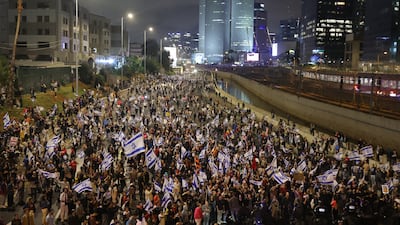
Thousands of protesters block the Ayalon main road. EPA -

The Tel Aviv protest swelled on Saturday to about 200,000 demonstrators, according to Israeli media estimates. AFP -

A roadblock placed by protesters on the Ayalon main road. EPA -

Demonstrations erupted in January after the coalition government announced its package of changes. AFP -

Israeli protesters dislodge a fence. AFP -

Police use a water cannon to disperse protesters. AP -

An aerial view of the protest. Reuters -

Plans to hand more control to politicians and diminish the role of the court have been questioned by Israel’s allies including the US. AFP -

Protesters with placards of Prime Minister Netanyahu saying 'We will not forget, we will not forgive'. EPA


Aides say Mr Gallant never got a formal dismissal letter from Mr Netanyahu and several members of the ruling coalition are reportedly lobbying for the Prime Minister to reinstate the Defence Minister.
Israeli media reported that he was open to apologising publicly for the timing of his comments over the reforms on Saturday while not walking back on the substance of his warning.
However, The Times of Israel reported that Mr Netanyahu had also met technology tycoon and former Jerusalem mayor Nir Barkat, who serves as Economy Minister but is seen as a potential replacement for Mr Gallant.
An aide to Mr Barkat said after the meeting that the tycoon would “take what the prime minister bestows upon him,” the report said.
Mr Gallant's dismissal and the fury it caused underlined the concern among many in Israel that the crisis around the judicial reforms was opening up social divisions that were posing a serious risk to the country's future.
While the reforms are paused, there is still growing criticism from within the Israeli establishment.
At a conference on Wednesday, former chief of Israel's Mossad intelligence agency Tamir Pardo said the government was “acting irrationally”. Ambiguity around Gallant's status exposed the country to “serious harm”, he added.
About 500 Israelis protested in Tel Aviv on Wednesday evening against an announcement to form a national guard under far-right National Security Minister Itamar Ben-Gvir, who was previously convicted of anti-Arab incitement and backing a group considered by Israel and the US to be a terrorist organisation.
The national guard was launched last year under former prime minister Naftali Bennett. But Mr Ben-Gvir this week said he had agreed to support Mr Netanyahu's pause of the judicial overhaul if the force is formed under his ministry — a move opponents criticise as giving him his own militia.
“We don't trust the government and certainly not the prime minister and his gang,” said 75-year-old Chanoch Lipperman in Tel Aviv.
“We have to keep on protesting.”
Now in his sixth term, Mr Netanyahu straddles a religious-nationalist coalition whose far-right members have stirred worry in the West for the future of long-stalled peacemaking with the Palestinians and the ability to co-ordinate strategies on Iran. - Additional reporting by Reuters

