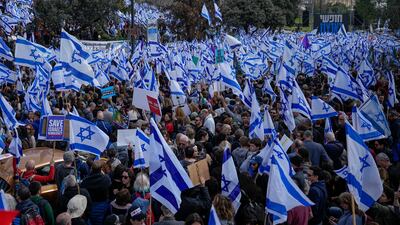
Benjamin Netanyahu addresses the annual Conference of Presidents of Major American Jewish Organisations, in Jerusalem. AP

Israel's Netanyahu calls for calm amid opposition to judicial reforms


Thomas Helm
  • English
  • Arabic

Israel's Prime Minister Benjamin Netanyahu on Sunday sought to allay mounting concern over a policy agenda that has divided Israelis and alarmed allies in the two months since his government was installed.

“We are one people, with one destiny, with one country, one faith … if you’re waiting for civil war, it ain’t going to happen,” Mr Netanyahu said in a speech at the annual Jerusalem gathering of the Conference of Presidents of Major American Jewish Organisations.

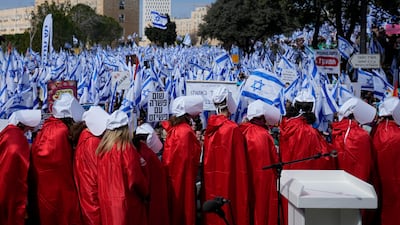
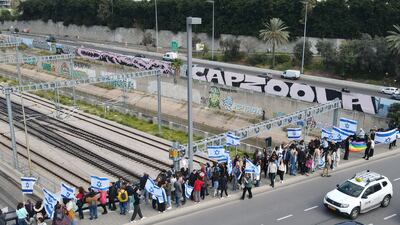
Israelis have staged weekly protests across the country to oppose his government's proposed reforms of the judicial system, which have also alarmed key allies including the US.

The overhaul includes a new “override clause” that would allow parliament to relegislate — by simple majority — laws that the Supreme Court rejects, and give the government control over the selection of judges.

  • Police hold back protesters at an anti-government rally outside the Israeli parliament in Jerusalem on February 13. EPA
    Police hold back protesters at an anti-government rally outside the Israeli parliament in Jerusalem on February 13. EPA
  • The Israeli activists are protesting against the newly formed government of Prime Minister Benjamin Netanyahu amid reports of its intention to reform the judicial system. EPA
    The Israeli activists are protesting against the newly formed government of Prime Minister Benjamin Netanyahu amid reports of its intention to reform the judicial system. EPA
  • Critics suggest such judicial upheaval would weaken the power of the Israeli Supreme Court. AP
    Critics suggest such judicial upheaval would weaken the power of the Israeli Supreme Court. AP
  • Some children attended a rally in Tel Aviv. AFP
    Some children attended a rally in Tel Aviv. AFP
  • Thousands took part in the protest outside parliament. AFP
    Thousands took part in the protest outside parliament. AFP
  • The rally took place before a preliminary vote on a bill that would give politicians greater power in appointing judges. AFP
    The rally took place before a preliminary vote on a bill that would give politicians greater power in appointing judges. AFP
  • A crowd gathers at the Knesset, Israel's parliament building, in Jerusalem. Reuters
    A crowd gathers at the Knesset, Israel's parliament building, in Jerusalem. Reuters
  • Israeli women join the demo. Reuters
    Israeli women join the demo. Reuters
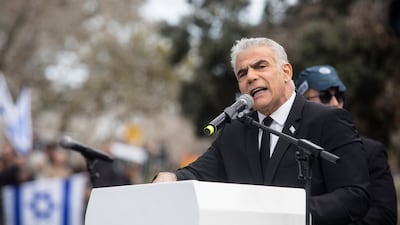
  • Former Israeli prime minister and current opposition leader Yair Lapid addresses the demonstrators. Getty Images
    Former Israeli prime minister and current opposition leader Yair Lapid addresses the demonstrators. Getty Images
  • Protesters out in force. Getty Images
    Protesters out in force. Getty Images
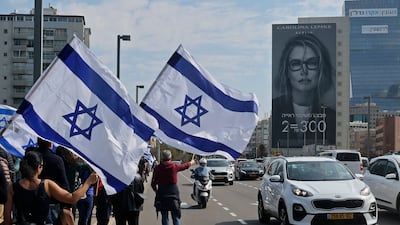
  • Israelis wave national flags at the rally in Jerusalem. AP
    Israelis wave national flags at the rally in Jerusalem. AP

On Thursday, US ambassador to Israel Tom Nides said the Biden administration had told Mr Netanyahu to “pump the brakes. Slow down, try to get a consensus, bring the parties together” on the reforms.

Members of Mr Netanyahu's government condemned the remarks, with Diaspora Minister Amichai Chikli telling the ambassador to “put the brakes on yourself and mind your own business”.

Mr Nides later clarified his comments, saying: “I didn’t say put the brakes on, I said pump the brakes … I’m not involved in how Israelis pick their Supreme Court.”

Mr Netanyahu adopted a more diplomatic tone in his speech on Sunday.

“Israel is a democracy and will remain a democracy, with majority rule and proper safeguards for civil liberties,” he said.

“All democracies should respect the will of other free peoples, just like we respect their democratic decisions.”

But a recent poll by Israel's Channel 12 found that only one in four Israelis supported the judicial reforms. And on Saturday, tens of thousands of Israelis turned out for a seventh consecutive weekend to protest against the move. A general strike called last Monday, when the legislation was tabled in parliament, was one of the biggest in the country’s history.

Thousands of protesters were expected to gather in Jerusalem's political district once again on Monday as the Knesset — Israel's parliament — convenes to vote on the plan.

President Isaac Herzog, who is attempting to mediate on the issue between the ruling right-wing coalition and opposition parties, issued another call for compromise on Sunday and suggested the matter could settled “in a matter of days”.

However, any compromise would embarrass the new government and further alienate extreme-right members of the cabinet, many of whom put judicial reform at the heart of their manifestos.

Mr Netanyahu on Sunday also reaffirmed other priorities for his time in office, saying that the government was working on a peace deal with Saudi Arabia, boosted by a series of vast infrastructure projects.

He described the potential deal as a “quantum leap ending Israeli-Arab, not Palestinian, conflict”.

He also spoke of his growing concern over Iran edging closer to making a nuclear weapon.

International Atomic Energy Agency inspectors in Sunday revealed that Tehran was just short of enriching uranium to the threshold needed for a nuclear bomb.


The bio

Favourite vegetable: Broccoli

Favourite food: Seafood

Favourite thing to cook: Duck l'orange

Favourite book: Give and Take by Adam Grant, one of his professors at University of Pennsylvania

Favourite place to travel: Home in Kuwait.

Favourite place in the UAE: Al Qudra lakes

SPECS
%3Cp%3EEngine%3A%20Supercharged%203.5-litre%20V6%0D%3Cbr%3EPower%3A%20400hp%0D%3Cbr%3ETorque%3A%20430Nm%0D%3Cbr%3EOn%20sale%3A%20Now%0D%3Cbr%3EPrice%3A%20From%20Dh450%2C000%0D%3Cbr%3E%3C%2Fp%3E%0A

Mercer, the investment consulting arm of US services company Marsh & McLennan, expects its wealth division to at least double its assets under management (AUM) in the Middle East as wealth in the region continues to grow despite economic headwinds, a company official said.

Mercer Wealth, which globally has $160 billion in AUM, plans to boost its AUM in the region to $2-$3bn in the next 2-3 years from the present $1bn, said Yasir AbuShaban, a Dubai-based principal with Mercer Wealth.

Within the next two to three years, we are looking at reaching $2 to $3 billion as a conservative estimate and we do see an opportunity to do so,” said Mr AbuShaban.

Mercer does not directly make investments, but allocates clients’ money they have discretion to, to professional asset managers. They also provide advice to clients.

“We have buying power. We can negotiate on their (client’s) behalf with asset managers to provide them lower fees than they otherwise would have to get on their own,” he added.

Mercer Wealth’s clients include sovereign wealth funds, family offices, and insurance companies among others.

From its office in Dubai, Mercer also looks after Africa, India and Turkey, where they also see opportunity for growth.

Wealth creation in Middle East and Africa (MEA) grew 8.5 per cent to $8.1 trillion last year from $7.5tn in 2015, higher than last year’s global average of 6 per cent and the second-highest growth in a region after Asia-Pacific which grew 9.9 per cent, according to consultancy Boston Consulting Group (BCG). In the region, where wealth grew just 1.9 per cent in 2015 compared with 2014, a pickup in oil prices has helped in wealth generation.

BCG is forecasting MEA wealth will rise to $12tn by 2021, growing at an annual average of 8 per cent.

Drivers of wealth generation in the region will be split evenly between new wealth creation and growth of performance of existing assets, according to BCG.

Another general trend in the region is clients’ looking for a comprehensive approach to investing, according to Mr AbuShaban.

“Institutional investors or some of the families are seeing a slowdown in the available capital they have to invest and in that sense they are looking at optimizing the way they manage their portfolios and making sure they are not investing haphazardly and different parts of their investment are working together,” said Mr AbuShaban.

Some clients also have a higher appetite for risk, given the low interest-rate environment that does not provide enough yield for some institutional investors. These clients are keen to invest in illiquid assets, such as private equity and infrastructure.

“What we have seen is a desire for higher returns in what has been a low-return environment specifically in various fixed income or bonds,” he said.

“In this environment, we have seen a de facto increase in the risk that clients are taking in things like illiquid investments, private equity investments, infrastructure and private debt, those kind of investments were higher illiquidity results in incrementally higher returns.”

The Abu Dhabi Investment Authority, one of the largest sovereign wealth funds, said in its 2016 report that has gradually increased its exposure in direct private equity and private credit transactions, mainly in Asian markets and especially in China and India. The authority’s private equity department focused on structured equities owing to “their defensive characteristics.”

The biog

First Job: Abu Dhabi Department of Petroleum in 1974  
Current role: Chairperson of Al Maskari Holding since 2008
Career high: Regularly cited on Forbes list of 100 most powerful Arab Businesswomen
Achievement: Helped establish Al Maskari Medical Centre in 1969 in Abu Dhabi’s Western Region
Future plan: Will now concentrate on her charitable work

Getting there

The flights

Flydubai operates up to seven flights a week to Helsinki. Return fares to Helsinki from Dubai start from Dh1,545 in Economy and Dh7,560 in Business Class.

The stay

Golden Crown Igloos in Levi offer stays from Dh1,215 per person per night for a superior igloo; www.leviniglut.net 

Panorama Hotel in Levi is conveniently located at the top of Levi fell, a short walk from the gondola. Stays start from Dh292 per night based on two people sharing; www. golevi.fi/en/accommodation/hotel-levi-panorama

Arctic Treehouse Hotel in Rovaniemi offers stays from Dh1,379 per night based on two people sharing; www.arctictreehousehotel.com

Specs

Engine: Dual-motor all-wheel-drive electric

Range: Up to 610km

Power: 905hp

Torque: 985Nm

Price: From Dh439,000

Available: Now

Updated: February 20, 2023, 9:04 AM