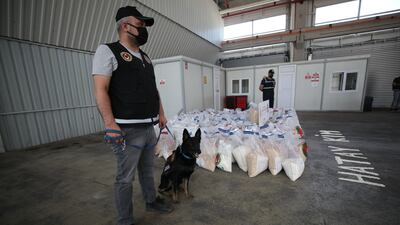
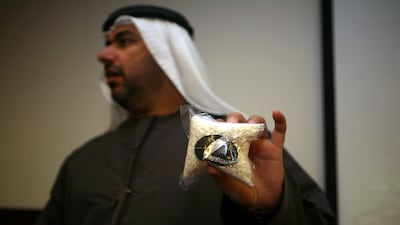
Jordanian security forces arrested 20 drug dealers across the kingdom in one day, a police spokesman said, as authorities increase efforts to curb a booming narcotics trade flowing mainly from southern Syria.
Border operations have been stepped up in the past few months to disrupt flows of the stimulant pill known as Captagon and other drugs from areas controlled by the Syrian military and pro-Iranian militias, and numerous arrests have been made to dismantle drug networks in Jordan.
“Anti-narcotics personnel mounted in the last 24 hours security operations against drug merchants and marketers,” an Internal Security Directorate spokesman said on Wednesday.
He said all 20 men who were arrested were referred to the State Security Court, a tribunal mostly comprising military judges, the official news agency reported. It deals with terrorism, political crimes and other threats deemed too grave or sensitive to be handled by Jordan's civil legal system.
In pictures: the Middle East's war on drugs
Regional security officials say Saudi Arabia is the main market for Captagon pills, which are mostly manufactured south of Damascus and smuggled across the 360km border between Jordan and Syria, with 10 to 20 per cent of the pills consumed in Jordan.
Hashish produced in Lebanon’s Bekaa Valley and crystal methamphetamine — a drug known to cause psychological problems and heart damage ― are also part of the drug flows.
But the most profitable contraband is Captagon, with a pill costing cents to produce then reportedly sold on the market for up to $15.
The spokesman said one of the 20 men was seized in the impoverished Zarqa area east of Amman and that he had been sentenced in absentia for a 15-year jail term on drug charges.
Another five were arrested in the northern Badia region and in the Mafraq governorate, which both border Syria. One was apprehended while he was on a drug run and 12,000 Captagon pills were found in the spare tyre of the car he was using, the spokesman said.
Weeks of “intelligence work” in the rural area of Ajloun, north-west of Amman, resulted in the arrest of a “dangerous suspect” wanted in 21 drug cases and for “terrorising citizens”.
“He resisted arrest and had upon him a firearm and a quantity of drugs,” the spokesman said.
Two traffickers were apprehended in central Amman. They were carrying four pouches of hashish and an unspecified quantity of “banned pills”.
Another man carrying “large quantities of drugs” was intercepted in the southern governorate of Karak.
In the nearby governorate of Aqaba, Jordan's only outlet to the sea, six traffickers were seized in a joint operation between the Jordanian gendarmerie, a security agency responsible for maintaining domestic order, and the police.
They were carrying “various quantities of these deadly substances, ready for sale,” the spokesman said.
Although some drugs flow into Jordan from Egypt through the Red Sea, the border with Syria has become the main conduit for trade since Syrian regime forces retook the area from rebels in 2018 after a deal between Russia, the US and Israel.
Jordan says pro-Iranian militias in southern Syria and the Syrian military are behind the rise in drug smuggling in the past four years.
The 2018 agreement was supposed to keep Lebanon's Hezbollah and other Iran-backed groups away from the border.
This week Jordanian border forces fired on armed infiltrators and were believed to have killed four of them as they were smuggling drugs from Syria.
A military official said one of the infiltrators was wounded and the rest “fled to the Syrian interior”.

Company info
Company name: Entrupy
Co-founders: Vidyuth Srinivasan, co-founder/chief executive, Ashlesh Sharma, co-founder/chief technology officer, Lakshmi Subramanian, co-founder/chief scientist
Based: New York, New York
Sector/About: Entrupy is a hardware-enabled SaaS company whose mission is to protect businesses, borders and consumers from transactions involving counterfeit goods.
Initial investment/Investors: Entrupy secured a $2.6m Series A funding round in 2017. The round was led by Tokyo-based Digital Garage and Daiwa Securities Group's jointly established venture arm, DG Lab Fund I Investment Limited Partnership, along with Zach Coelius.
Total customers: Entrupy’s customers include hundreds of secondary resellers, marketplaces and other retail organisations around the world. They are also testing with shipping companies as well as customs agencies to stop fake items from reaching the market in the first place.
Panipat
Director Ashutosh Gowariker
Produced Ashutosh Gowariker, Rohit Shelatkar, Reliance Entertainment
Cast Arjun Kapoor, Sanjay Dutt, Kriti Sanon, Mohnish Behl, Padmini Kolhapure, Zeenat Aman
Rating 3 /5 stars
The Sand Castle
Director: Matty Brown
Stars: Nadine Labaki, Ziad Bakri, Zain Al Rafeea, Riman Al Rafeea
Rating: 2.5/5
Match info
Manchester United 1
Fred (18')
Wolves 1
Moutinho (53')
Points Classification after Stage 1
1. Geraint Thomas (Britain / Team Sky) 20
2. Stefan Kueng (Switzerland / BMC Racing) 17
3. Vasil Kiryienka (Belarus / Team Sky) 15
4. Tony Martin (Germany / Katusha) 13
5. Matteo Trentin (Italy / Quick-Step) 11
6. Chris Froome (Britain / Team Sky) 10
7. Jos van Emden (Netherlands / LottoNL) 9
8. Michal Kwiatkowski (Poland / Team Sky) 8
9. Marcel Kittel (Germany / Quick-Step) 7
10. Edvald Boasson Hagen (Norway / Dimension Data) 6
%3Cp%3EMATA%0D%3Cbr%3EArtist%3A%20M.I.A%0D%3Cbr%3ELabel%3A%20Island%0D%3Cbr%3ERating%3A%203.5%2F5%3C%2Fp%3E%0A
Defence review at a glance
• Increase defence spending to 2.5% of GDP by 2027 but given “turbulent times it may be necessary to go faster”
• Prioritise a shift towards working with AI and autonomous systems
• Invest in the resilience of military space systems.
• Number of active reserves should be increased by 20%
• More F-35 fighter jets required in the next decade
• New “hybrid Navy” with AUKUS submarines and autonomous vessels
MATCH INFO
South Africa 66 (Tries: De Allende, Nkosi, Reinach (3), Gelant, Steyn, Brits, Willemse; Cons: Jantjies 8)
Canada 7 (Tries: Heaton; Cons: Nelson)
Director: Jon Favreau
Starring: Donald Glover, Seth Rogen, John Oliver
Rating: 2 out of 5 stars
Ten tax points to be aware of in 2026
1. Domestic VAT refund amendments: request your refund within five years
If a business does not apply for the refund on time, they lose their credit.
2. E-invoicing in the UAE
Businesses should continue preparing for the implementation of e-invoicing in the UAE, with 2026 a preparation and transition period ahead of phased mandatory adoption.
3. More tax audits
Tax authorities are increasingly using data already available across multiple filings to identify audit risks.
4. More beneficial VAT and excise tax penalty regime
Tax disputes are expected to become more frequent and more structured, with clearer administrative objection and appeal processes. The UAE has adopted a new penalty regime for VAT and excise disputes, which now mirrors the penalty regime for corporate tax.
5. Greater emphasis on statutory audit
There is a greater need for the accuracy of financial statements. The International Financial Reporting Standards standards need to be strictly adhered to and, as a result, the quality of the audits will need to increase.
6. Further transfer pricing enforcement
Transfer pricing enforcement, which refers to the practice of establishing prices for internal transactions between related entities, is expected to broaden in scope. The UAE will shortly open the possibility to negotiate advance pricing agreements, or essentially rulings for transfer pricing purposes.
7. Limited time periods for audits
Recent amendments also introduce a default five-year limitation period for tax audits and assessments, subject to specific statutory exceptions. While the standard audit and assessment period is five years, this may be extended to up to 15 years in cases involving fraud or tax evasion.
8. Pillar 2 implementation
Many multinational groups will begin to feel the practical effect of the Domestic Minimum Top-Up Tax (DMTT), the UAE's implementation of the OECD’s global minimum tax under Pillar 2. While the rules apply for financial years starting on or after January 1, 2025, it is 2026 that marks the transition to an operational phase.
9. Reduced compliance obligations for imported goods and services
Businesses that apply the reverse-charge mechanism for VAT purposes in the UAE may benefit from reduced compliance obligations.
10. Substance and CbC reporting focus
Tax authorities are expected to continue strengthening the enforcement of economic substance and Country-by-Country (CbC) reporting frameworks. In the UAE, these regimes are increasingly being used as risk-assessment tools, providing tax authorities with a comprehensive view of multinational groups’ global footprints and enabling them to assess whether profits are aligned with real economic activity.
Contributed by Thomas Vanhee and Hend Rashwan, Aurifer
What can victims do?
Always use only regulated platforms
Stop all transactions and communication on suspicion
Save all evidence (screenshots, chat logs, transaction IDs)
Report to local authorities
Warn others to prevent further harm
Courtesy: Crystal Intelligence
What can you do?
Document everything immediately; including dates, times, locations and witnesses
Seek professional advice from a legal expert
You can report an incident to HR or an immediate supervisor
You can use the Ministry of Human Resources and Emiratisation’s dedicated hotline
In criminal cases, you can contact the police for additional support
Labour dispute
The insured employee may still file an ILOE claim even if a labour dispute is ongoing post termination, but the insurer may suspend or reject payment, until the courts resolve the dispute, especially if the reason for termination is contested. The outcome of the labour court proceedings can directly affect eligibility.
- Abdullah Ishnaneh, Partner, BSA Law