


It is 8pm and the weekend is beginning at a cinema in West Jerusalem. A large group of teenagers sing, dance and wave glow sticks in the auditorium. But this is no ordinary Thursday-night party — it is a far-right political rally.
Many people are in their late teens and early twenties; some are too young to even have the vote. But whether they will or won't cast ballots in Tuesday’s elections, they are still full of excitement.
It all stems from what the man on stage is promising them. Much of it would have been taboo even a few years ago, but what Itamar Ben-Gvir says and does has now entered the mainstream of Israeli politics, and his young followers seem especially happy about it.
It might be calling on Israeli authorities to shoot Palestinians who are throwing stones at his rallies or bringing supporters into the compound of Al Aqsa Mosque, a Muslim holy site.

Whatever boundaries he pushes, the eagerness of far-right youths does not die.
“Young people are the energy of our movement and there are thousands of us,” says Benjamin Sipzner, 25, a supporter of Religious Zionism, the political list to which Mr Ben-Gvir's party, Otzma Yehudit, belongs.
Mr Sipzner says that these teenagers and young adults are eager to campaign.
“They are incredibly dedicated to the ideals of the party: a strong right, a strong Jewish identity for Israel and a right-wing approach to dealing with issues, particularly terrorism and foreign affairs.”
The group’s hardline message, mixed with a clarity of purpose, appeals to a generation of voters who have known nothing but a series of inconclusive elections that result in short-lasting and muddled coalitions.
They've lost faith in negotiating with the Palestinians and are increasingly politically conservative and religious.
Tough on terror?
The key issues of this election remain dealing with terrorism and bolstering internal security. As he stands blocking an entrance from crowds pushing to gain access to Mr Ben-Gvir, volunteer steward Yosef, 16, just about manages to shout over the din that “Itamar will stop the terrorists”, when asked what he respected most about the politician.
While opponents are keen to point out that Mr Ben-Gvir did not do his military service, he still manages to cast himself as a rare politician that is willing to make enemies and annoy liberals if it means sticking up for Israeli citizens at risk of terror attacks, particularly soldiers.
Many in the armed forces believe him. Having served in an elite combat division, Mr Sipzner is convinced that Religious Zionism knows best when it comes to protecting the lives of Israeli soldiers, primarily by loosening the current rules of engagement for personnel and “responding strongly” to terrorists.
-
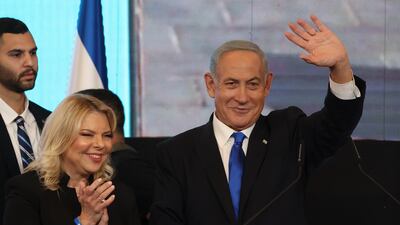
Former Israeli prime minister and leader of the Likud party Benjamin Netanyahu and his wife Sara greet supporters in Jerusalem as Israelis went to the polls on Tuesday. EPA -
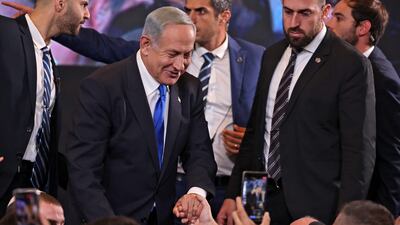
Mr Netanyahu greets supporters after the end of voting for the national elections. AFP -
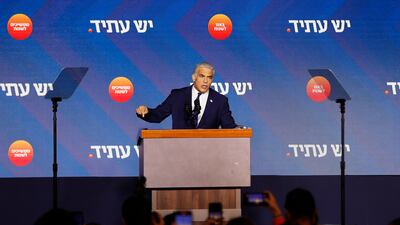
Prime Minister Yair Lapid addresses supporters at his campaign headquarters in Tel Aviv. EPA -
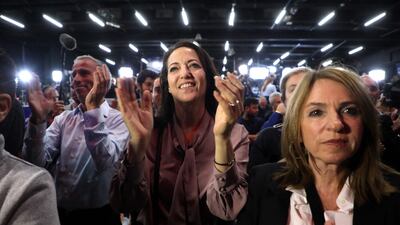
The prime minister's wife Lihi Lapid, centre, cheers her husband. AFP -

The leader of the Otzma Yehudit (Jewish Power) far-right party Itamar Ben Gvir at his party's campaign headquarters in Jerusalem. AFP -
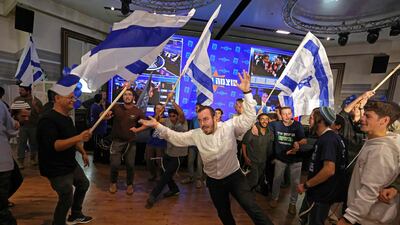
Otzma Yehudit party members in upbeat mood. AFP -
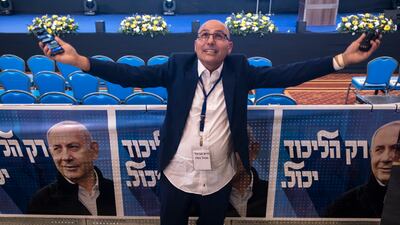
A Likud party supporter responds to favourable exit polls. Getty -
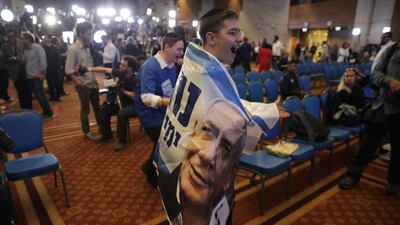
Supporters of Mr Netanyahu react as early exit polls suggest a comeback for the former leader. EPA -

An Ultra-Orthodox Jewish Israeli selects his ballot paper on the day of Israel's general election at a polling station in Jerusalem. Reuters -
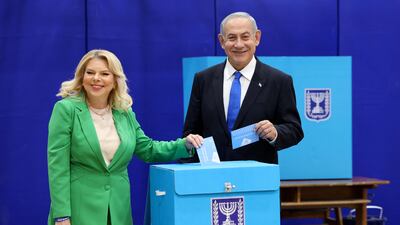
Mr Netanyahu and his wife Sara cast their ballot at a polling station in Jerusalem in the country's fifth election in less than four years. AFP -

A man kisses his dog after casting his ballot in Tel Aviv during the Israeli elections. AP -
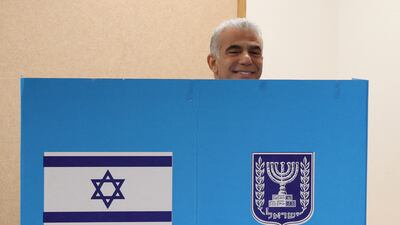
Israeli Prime Minister Yair Lapid smiles as he casts his vote at a polling station in Israel's coastal city of Tel Aviv. Mr Lapid urged the electorate to cast their ballot after voting in an election that might lead to veteran leader Benjamin Netanyahu making a comeback alongside far-right allies. Reuters -
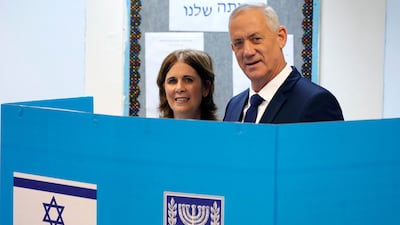
Israeli Defence Minister Benny Gantz, right, head of the new centre-right National Unity Party, and his wife Revital Gantz vote at a polling station in the city of Rosh Haayin in central Israel. AFP -

Ultra-Orthodox Jews watch their Rabbi Israel Hager vote during Israeli elections in Bnei Brak. AP -

An Ultra-Orthodox Jewish man votes in Israel's parliamentary election at a polling station in Bnei Brak. AP -
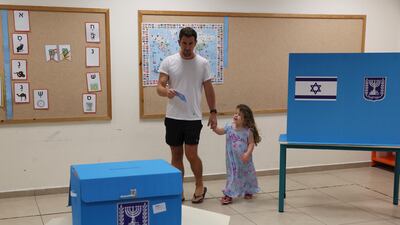
An Israeli man walks with a little girl towards the ballot box to cast his vote. AP -
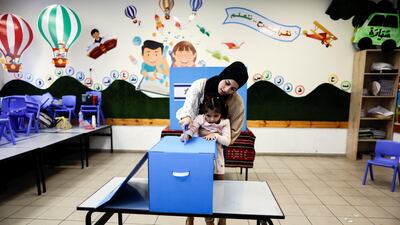
A little girl helps her mother cast her ballot on the day of Israel's general election at a polling station in Taibe, northern Israel. Reuters -

Israelis queue to cast their ballots on the day of Israel's general election at a polling station in Tel Aviv. Reuters -
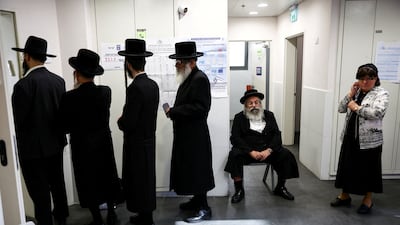
Ultra-Orthodox Jewish Israelis wait to cast their ballots at a polling station in Jerusalem. Reuters -
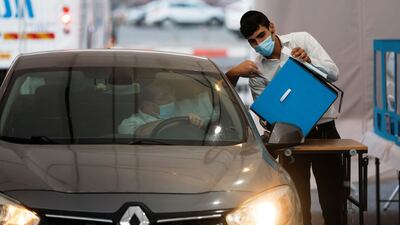
An Israeli man casts his ballot at a drive-through polling station for people quarantined as a result of Covid-19 in Jerusalem. Reuters


However fervent its support today, there is still uncertainty about how long the party’s honeymoon period with young voters will last. Israel has seen its fair share of right-wing firebrands in recent elections, many of whom enjoyed mass support only for it to crumble by the next vote.
But even as enthusiasm mounts, others on the young right are agonising about what more polarisation might do to the country.
“In Israel, campaign season is a very aggressive and divisive time. When it happens five times in three years, it is a disaster,” says David Menahem, 21, who votes for the ultraorthodox Shas party.
“Sadly, as we see today, older people fight verbally, but young people fight physically” — a reference to a recent rise in political violence among teenagers.
Jonathan Rynhold, a political scientist at Bar-Ilan University, says there is also a strong chance that the radical-right politics of today’s youth could calm down over time.
“In Israel, we’ve always seen that if older people tend to vote centre-left and centre-right, younger people vote more right and more left,” he says. “Much like any other democratic country, as voters get older they get more pragmatic.”
If and when Thursday’s revellers get at least slightly calmer with age, the dominance of the right in Israel is nonetheless here to stay.
Mr Rynhold stressed that Israelis tend to stay in the rough ideological bloc of their parents. Demographically, right-wing, conservative Israelis are simply having more children than their secular left-wing and centrist counterparts.
Back at the cinema, as animated crowds of teenagers queue to get into the Ben-Gvir rally, a few antiracism activists stand by the entrance holding signs and quietly challenging the mostly light-hearted jibes of the attendees.
Among the campaigners, a rabbi who came to Israel from Australia in the 1970s looks on in what seems like total despair.
“This is a generation who feel no hope in there ever being peace with Palestinians. I do not recognise today’s Israel. It is completely different to the one I moved to when I was a young adult,” he says.
The group he stands with numbers no more than a dozen and none are below the age of 60.
As many of Israel’s new generation of far-right voters stream past them, draped in flags and carrying party banners, the modest, likely hopeless stand that the rabbi and his fellow protesters are making can hardly be more symbolic of where politics is heading today.

