
Iran is pressing ahead with its roll-out of an upgrade to its advanced uranium enrichment programme, according to a report by the UN nuclear watchdog seen by Reuters.
It comes as the West awaits Iran's response to salvaging its 2015 nuclear deal.
The first of three cascades, or clusters, of advanced IR-6 centrifuges recently installed at the underground Fuel Enrichment Plant (FEP) at Natanz is now enriching, the report said on Monday.
Diplomats say the IR-6 is its most advanced model, far more efficient than the first-generation IR-1 — the only one the deal lets it use for enrichment.
For more than a year, Iran has been using IR-6 centrifuges to enrich uranium to up to 60 per cent purity, close to weapons-grade, at an above-ground plant in the central city of Natanz.
It has recently expanded its enrichment with IR-6 machines at other sites. Last month, a second IR-6 cascade at Fordow, a site buried inside a mountain, began enriching to up to 20 per cent.
In the confidential report to UN member states, the International Atomic Energy Agency wrote: "On 28 August 2022, the Agency verified at FEP that Iran was feeding UF6 enriched up to 2 per cent U-235 into the IR-6 cascade ... for the production of UF6 enriched up to 5 per cent U-235."
Uranium hexafluoride (UF6) is the gas centrifuges enrich.
-
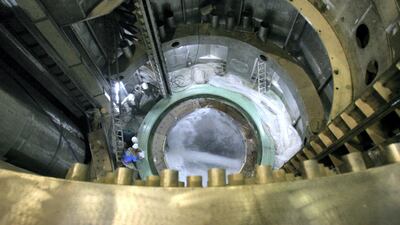
Russian contractors work at the Bushehr nuclear reactor site in 2007. The plant opened four years later. Bloomberg -
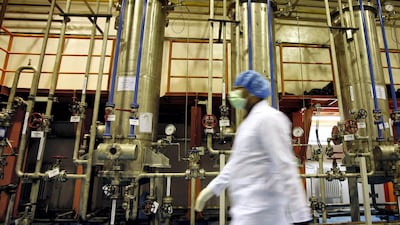
An Iranian technician at the International Atomic Energy Agency inspects the country's Isfahan plant in 2007. Tehran is no longer co-operating with the agency at nuclear sites across the country. EPA -

Workers wait to begin constructing a second reactor at the Bushehr nuclear power plant in 2019. AFP -
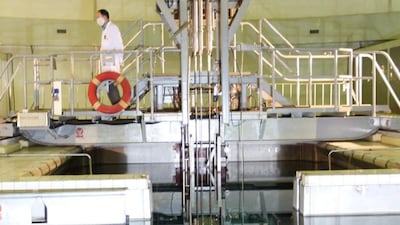
A metal-encased rod with 20 per cent enriched nuclear fuel is inserted into a reactor in Tehran in 2012. AFP -
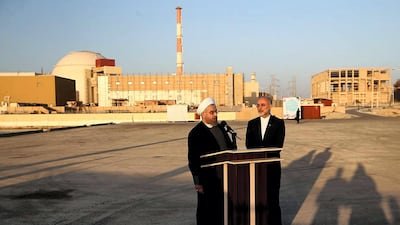
Fomer Iranian President Hassan Rouhani and the country's Atomic Energy Organisation chief Ali Akbar Salehi speak at the Bushehr nuclear site in 2015. AFP -
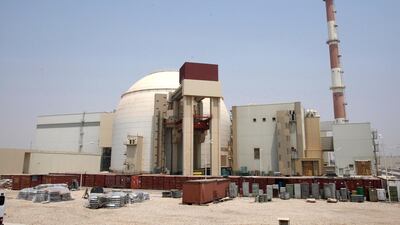
Iran's Bushehr nuclear plant has been restarted. EPA -
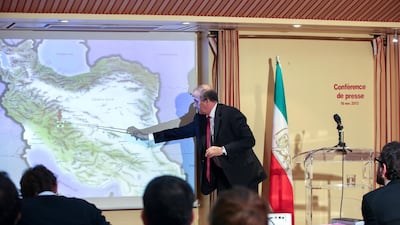
Mehdi Abrichamtchi, chairman of the Peace and Security Committee at the National Council of Resistance of Iran, shows journalists the location of a secret nuclear site in Iran in 2013. AFP -
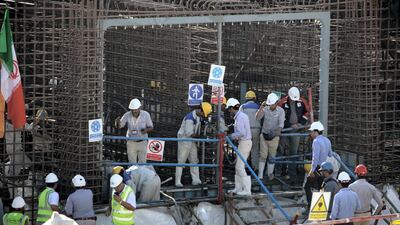
Workers prepare to begin the construction of a second reactor at the Bushehr site. AFP


Of the two other IR-6 cascades installed at the Natanz FEP, one was undergoing passivation with depleted UF6. This is process that is carried out before enrichment proper begins, and the other had yet to be fed with any nuclear material, the agency said.
Iran and the US appear to be inching towards an agreement to revive the 2015 deal, which placed restrictions on Iran's nuclear activities in exchange for lifting sanctions against Tehran.
That deal unravelled after a US withdrawal in 2018 prompted Iran to breach those restrictions one by one.
After more than a year of indirect talks, Iran has said it will soon respond to the latest US comments on a compromise text submitted by the EU, which is co-ordinating the talks.
A deal would involve undoing much of the enrichment work Iran has been carrying out, and capping its enrichment at 3.67 per cent purity.
Western powers worry that Iran is moving towards the ability to make nuclear bombs. Iran denies any such intention.

