

An Iraqi court on Tuesday overturned the conviction of a British man accused of stealing antiquities on a recent trip to Iraq.
Retired geologist James Fitton, 66, was on a tour organised by a small British company that specialises in visiting archaeological sites.
He was stopped at Baghdad International Airport in early June, where officials accused him and a German citizen, Volker Waldmann, who was also on the tour, of stealing antiquities. Mr Waldmann was acquitted at a trial in Baghdad on June 6, but Mr Fitton was sentenced to 15 years in jail.
Geoff Hann, an 85-year-old travel enthusiast who ran the tour company Hinterland Travel, which specialised in organising Iraq tours, died of a stroke in a Baghdad hospital, under police guard following the arrest.
Mr Fitton’s lawyer Thair Soud told The National that Iraq’s Court of Cassation had ordered the “immediate release” of his client due to lack of evidence. Mr Soud said Mr Fitton would soon be released.
According to the ruling, the Court of Cassation said it did not find that Mr Fitton had any criminal intent.
It said that Mr Fitton entered the country legally as part of a group travel tour with a tourist guide and accompanied by the Heritage and Antiquities Board's employees when visiting archaeological and religious sites. It added that he had picked up the pieces that were left unprotected in the open, and did not try to hide them when leaving the country.
Pottery shards can be found on the ground at various Iraqi archaeological sites, many of which were looted in the chaos following the 2003 US-led invasion. Some historians also say a wave of antiquities smuggling hit Iraq during the 1990s, when harsh international trade sanctions led to a collapse in funding for the antiquities ministry, which was unable to secure numerous remote sites.
-

Fareed Yasseen, left, Iraq's ambassador to the United States, with Steven Francis, executive associate director of homeland security investigations at the US Department of Homeland Security. In front of them are the Gilgamesh tablet and Sumerian ram at a repatriation ceremony in Washington, DC. EPA -
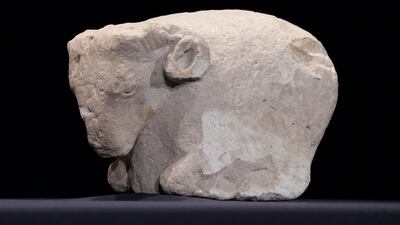
This Sumerian ram sculpture from approximately 3,000 BC is officially being returned to Iraq. EPA -
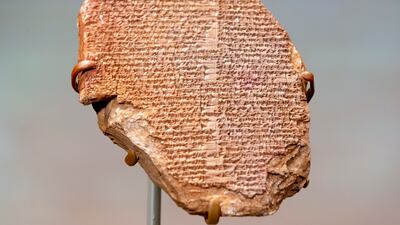
The 3,500-year-old Gilgamesh tablet from ancient Mesopotamia was smuggled into the United States and is being returned to Iraq after being forfeited by Hobby Lobby after being seized by federal authorities. EPA -

The Gilgamesh tablet is inscribed in the Akkadian language and details a dream sequence from the ancient epic. Reuters -

The artefact forfeiture is part of a sweeping effort to return about 17,000 archaeological objects looted during the decades of instability after the US-led invasion of Iraq. EPA -
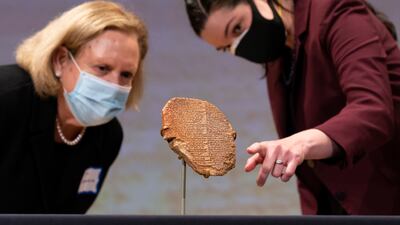
Cultural heritage preservation scholar Katharyn Hanson, right, and DePaul University professor Patty Gerstenblith with the Gilgamesh tablet at the Smithsonian Institution National Museum of the American Indian in Washington, DC. EPA


Iraq then passed a law against looting archaeological sites in 2002 that carried a maximum sentence of death for stealing artefacts.
More than a decade later, when ISIS took over about a third of Iraq in 2014, the extremist group smuggled antiquities out of the country to raise funds and destroyed priceless artefacts. As a result, the Iraqi government — and Iraqi public opinion — is highly sensitive to the issue of antiquities theft.
In the years following each crisis, Iraqi artefacts have appeared on sale to overseas collectors, leading to a massive effort by the international community and the Iraqi government to control the trade. In 2017, a US arts and crafts retailer was fined $3 million after a US court found the company to be in possession of several thousand artefacts.
Many of the priceless pieces, including a clay tablet inscribed with a verse of the ancient Sumerian poem The Epic of Gilgamesh, were returned to Iraq last year.
According to statements from customs officers and witnesses, Mr Fitton's baggage contained about a dozen stone fragments, pieces of pottery or ceramics.
When the judge in the original trial asked Mr Fitton why he had tried to take the artefacts out of Iraq, he cited his “hobby”. He said he did not mean to do anything illegal, but the judge concluded there was criminal intent.
The maximum penalty for the offence is death by hanging, but Mr Fitton was sentenced to 15 years because of his “advanced age”, the judge in the original trial said.
Mr Fitton's lawyer launched an appeal just over a month ago.
The case comes at a time when the war-ravaged country's tourism infrastructure is almost non-existent, as it tentatively opens to visitors.

