


Turkey is stepping up a pressure campaign and military activities in northern Syria ahead of plans to launch a fourth incursion into the region, an alliance of Kurdish-led forces said.
On Thursday, Syrian Democratic Forces (SDF) showed footage of what it said were Turkish drone and artillery strikes that targeted the strategic cities of Qamishli and Manbij.
Turkey has not officially commented on the latest SDF claims, but its drones and artillery have frequently struck areas close to its borders and controlled by Syrian Kurdish fighters, according to reports by Turkish media.
Turkish official media outlets said on Thursday that a military incursion into northern Syria was “imminent” and showed a photo of a military parade by its chief Syrian allies, the self-declared Syrian National Army (SNA) , a coalition of factions opposing the regime of Bashar Al Assad.
The military parade is part of the SNA preparations to support the Turkish army in the anticipated incursion, the Arabic service of the official news agency Anadolu said.
The SDF military council and its allies in Manbij vowed to battle Turkey along the entire border and thwart a potential invasion.
For years, the SDF forces have worked with US troops on the ground and a US-led coalition until in 2019 they announced the end to the control exercised by ISIS militants in Syria on the borders with Iraq.
Turkish President Recep Tayyip Erdogan said in recent speeches that his government is determined to push back Kurdish fighters who it sees as affiliates to the Kurdistan Workers Party, which is designated as a terrorist organisation by Turkey, the US and the EU.
He also announced a plan to relocate about a million Syrian refugees of the more than four million hosted by Turkey, who have fled the civil war since 2011, to what he described as a safe zone in Syria near the Turkish border.
Turkey and its allies among Syrian forces in the targeted region have launched at least three incursions against Kurdish fighters in Syria since 2016.
-
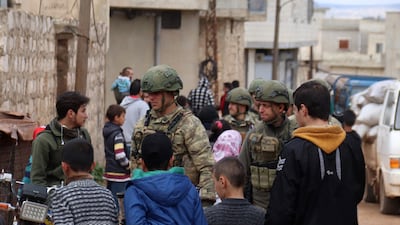
Turkish soldiers on patrol in the Syrian village of Ram Hamdan, north of the city of Idlib. All photos: AFP -
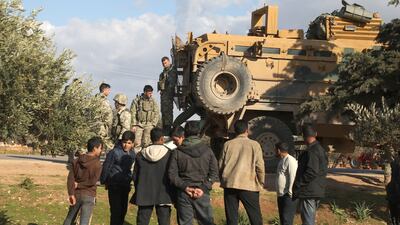
Displaced Syrian children watch Turkish soldiers near the town of Batabu on the road linking Idlib to the Syrian Bab al-Hawa border crossing with Turkey. -

Turkish soldiers keep watch as vehicles from a joint Russian-Turkish patrol pass through the outskirts of the rebel-held town of Ariha in Syria's north-west Idlib province. -
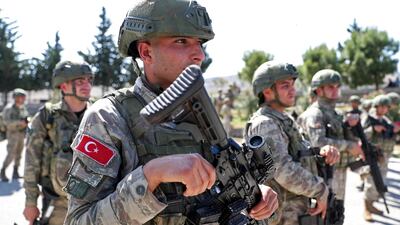
Turkish soldiers secure a section of the M4 motorway near Ariha in Idlib province. -
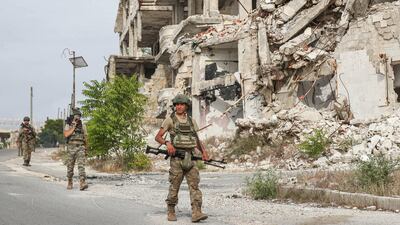
Turkish soldiers patrol on Arbaeen hill overlooking Ariha in the southern countryside of Idlib province, Syria. -
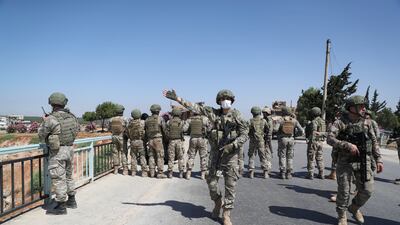
Turkish soldiers on guard on a bridge overlooking a section of the M4 motorway. -
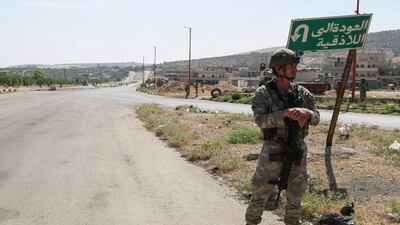
Turkish soldiers secure a section of the M4 to allow joint Russian-Turkish patrol to pass.


‘Popular resistance first’
The Syrian president said on Thursday that Syria would resist any Turkish invasion of its land, saying if there is an invasion, there will be “popular resistance” in the first stage.
“When military conditions allow for direct confrontation, we will do this thing,” Mr Assad told Russia Today Arabic in an interview.
“Two and a half years ago, a confrontation occurred between the Syrian and Turkish [armies], and the Syrian army was able to destroy some Turkish targets that entered Syrian territory. The situation will be the same according to what the military capabilities allow. In addition, there will be popular resistance,” Mr Al Assad said.
There have been deadly encounters in recent years, including a series of clashes between Syrian government forces and Turkish troops in northern Syria.
Ankara blamed the Syrian regime for a deadly shelling in March 2020, which killed 34 Turkish troops, and responded with heavy air attacks against Syrian forces using drones.
On Tuesday, Syria’s defence ministry released footage of its airforce conducting a joint drill with Russia, the first since that country’s invasion of Ukraine began more than three months ago.
The ministry said two Russian SU-35 fighter jets and six Syrian MiG-23 and MiG-29 aircraft simulated facing “hostile” warplanes and drones.
It is a common practice that the foreign countries involved in Syria’s multisided conflict ― chiefly Russia, Turkey and the US ― notify one another beforehand through hotlines to avoid accidents in the country’s crowded airspace.

‘Respecting our legitimate concerns’
Meanwhile, Mr Erdogan said on Thursday that he hoped Ankara's allies would "understand and respect" the new military operation.
“We hope that none of our real allies will object to our legitimate concerns," he said in a televised address.
"We expect our allies and friends to understand and respect our legitimate concerns."
The comments come a day after Turkey's Nato ally the United States renewed warnings against the operation, which it believes risks destabilising the region.
Assistant Secretary of State for Near Eastern Affairs Barbara Leaf said Washington was "deeply concerned by recent increased rhetoric", and that diplomatic engagement was under way to stop a possible offensive.
“We are completely unstinting in our efforts with the Turkish government to back them off on this ill-considered venture,” Ms Leaf told the Senate Foreign Relations Committee during a hearing on US policy on Syria.

