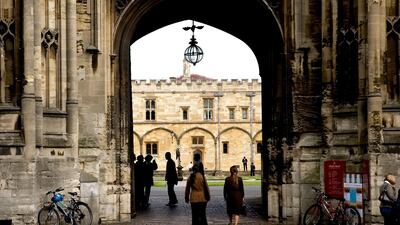
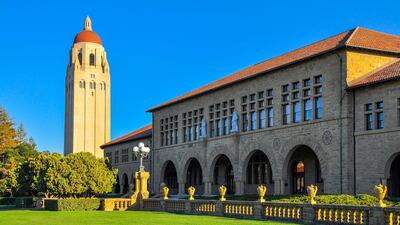
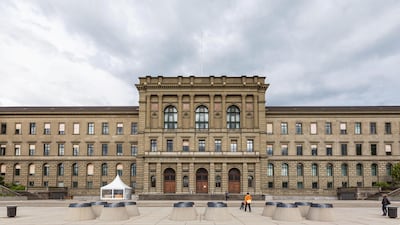
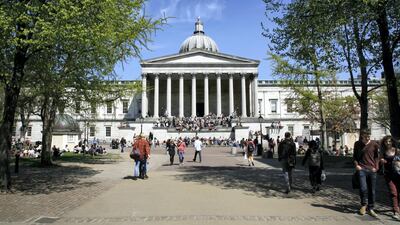
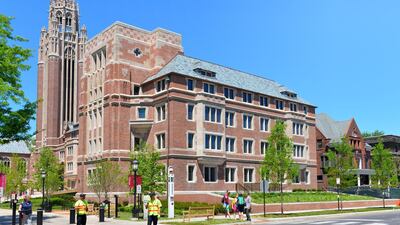
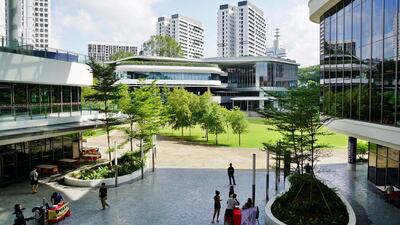
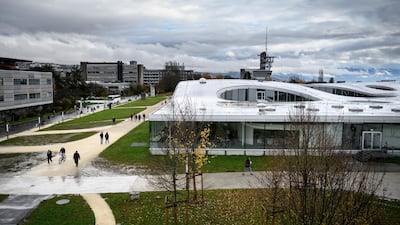
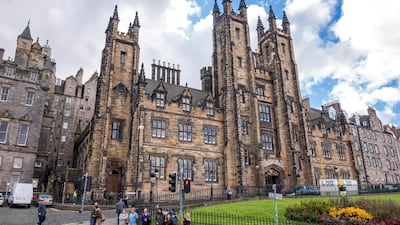
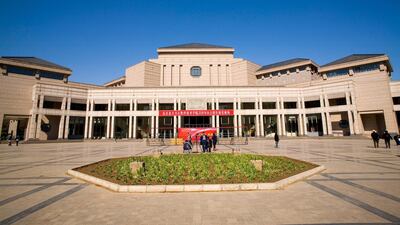
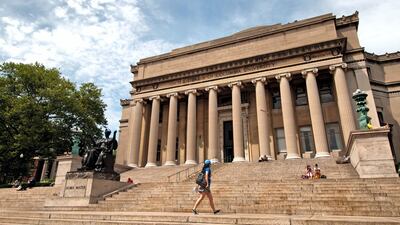
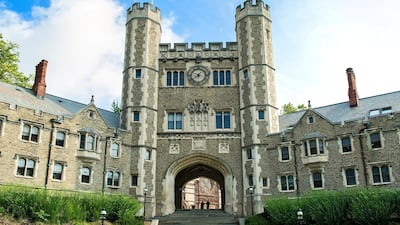
A study by the Majid Al Futtaim business group found that many students who go overseas never return to the region. Photo: PA

Higher education investment needed to halt Middle East's student 'brain drain'


Daniel Bardsley
  • English
  • Arabic

A shortage of top universities in the Middle East and North Africa, coupled with concerns about future employment prospects, is causing a "brain drain" of talent out of the region, a report has warned.

A study by the Majid Al Futtaim business group and McKinsey found that 8 per cent of the world's university students come from the Middle East, North Africa and Pakistan (Menap) — but only 1.5 per cent of the best universities are found there.

The relative scarcity of top facilities to meet the needs of the region's brightest has led to many "leaving to study abroad, and in many cases, not returning home”, according to the report.

Dr Frederic Schneider, an economist and lecturer at the University of Birmingham in Dubai who researchers issues related to education and population in the region, said some countries were moving to bolster their education systems to retain the workers of the future.

Countries like Algeria, Tunisia, Morocco, they still don’t have the funds and the capacity to educate all these people to a satisfying degree in their own countries
Dr Frederic Schneider,
University of Birmingham in Dubai

He said a transition to a knowledge-based economy in the UAE was “partly happening”, with the country having developed some high-quality universities.

However, he said progress was still to be made on creating the research-and-development infrastructure to encourage innovation and jobs.

“The limited availability of high-quality education domestically and the demand on the labour market for higher degrees and better education, that’s certainly driving a lot of this brain drain,” said Dr Schneider, who is not connected to the new report.

Increased funding in the UAE for federal higher education could also help to make the system more attractive to Emiratis and encourage more to stay in the country to study for a degree.

“You see a lot of spending on construction, more tourism-oriented projects; I wouldn’t be surprised if the focus shifts … towards research and quality higher education,” he said of the UAE.

Dr Schneider said that stronger universities were also developing in Saudi Arabia, but in Egypt, for example, young people felt there was a lack of opportunity under the current regime, while other North African nations did not have the higher education provision to keep their most talented young people.

“These countries like Algeria, Tunisia, Morocco, they still don’t have the funds and the capacity to educate all these people to a satisfying degree in their own countries,” he said.

He said that some GCC countries felt unemployment was becoming a concern, which acts as a factor “pushing” people to leave.

Long-standing focus on overseas studies

David Hawkins, founder and director of independent specialists The University Guys, which helps students choose and apply to colleges, said Middle Eastern students traditionally looked to English-speaking countries, particularly the US, UK, Canada and Australia, for higher education.

“There are some governments that have funded programmes. For example, Oman has a programme; Saudi has a programme to encourage students to study in other countries. [Going abroad] is almost baked into the system,” he said.

Mr Hawkins said his company was getting more interest from students in the region who wanted to go abroad, but added this may not reflect the overall picture.

In some other countries in the region, such as Lebanon and Syria, instability drives out people who want to work in a knowledge-based economy.

The report forecasts 55 per cent growth in the labour force in the region between 2020 and 2040, by which time 120 million young people will have entered the job market.

Changes in the labour market mean that people of working age will need more qualifications and skills in the years to come, according to the report.

“Driven by the emergence of new technologies, a higher share of jobs will require a university degree by 2030, and more work activities will require socio-economical and technological skills,” the report says.

“As a result of trends accelerated by the pandemic, more than half of low-wage workers in declining occupations globally may need to shift to occupations in higher wage brackets that require different skills.”

The report warned that automation could displace nearly 29 million jobs, or almost one fifth of the total labour market, by 2030.

Global search for skilled workers

While concerns have been raised about young people leaving the region, countries have plans in place to plug the gap from overseas.

The report says that some countries in the region “have made great progress on talent attraction from abroad”.

The UAE, for example, has targeted “highly skilled talent” and witnessed its population increase from 3.5 million in 2000 to nearly 10 million today.

“While this talent may have been perceived as transient in the past, alongside these efforts the UAE has introduced complementary initiatives, such as golden visas, to ensure that talent that comes to the UAE remains there for the long term,” the report says.

“At the same time, it is nurturing and upskilling home-grown talent and future leaders that will be key to unlocking a prosperous economic future for the region.”

In the region as a whole there is, however, “a pressing need for job creation” given, for example, the growing youth population and high unemployment rate, which, at 9.2 per cent in 2020, is significantly higher than the global average of 5.4 per cent.

As reported in The National, the report also calls for the free flow of people and goods in the region, arguing that this will boost economic growth.


What vitamins do we know are beneficial for living in the UAE

Vitamin D: Highly relevant in the UAE due to limited sun exposure; supports bone health, immunity and mood.Vitamin B12: Important for nerve health and energy production, especially for vegetarians, vegans and individuals with absorption issues.Iron: Useful only when deficiency or anaemia is confirmed; helps reduce fatigue and support immunity.Omega-3 (EPA/DHA): Supports heart health and reduces inflammation, especially for those who consume little fish.

Profile box

Company name: baraka
Started: July 2020
Founders: Feras Jalbout and Kunal Taneja
Based: Dubai and Bahrain
Sector: FinTech
Initial investment: $150,000
Current staff: 12
Stage: Pre-seed capital raising of $1 million
Investors: Class 5 Global, FJ Labs, IMO Ventures, The Community Fund, VentureSouq, Fox Ventures, Dr Abdulla Elyas (private investment)

A MINECRAFT MOVIE

Director: Jared Hess

Starring: Jack Black, Jennifer Coolidge, Jason Momoa

Rating: 3/5

Mercer, the investment consulting arm of US services company Marsh & McLennan, expects its wealth division to at least double its assets under management (AUM) in the Middle East as wealth in the region continues to grow despite economic headwinds, a company official said.

Mercer Wealth, which globally has $160 billion in AUM, plans to boost its AUM in the region to $2-$3bn in the next 2-3 years from the present $1bn, said Yasir AbuShaban, a Dubai-based principal with Mercer Wealth.

Within the next two to three years, we are looking at reaching $2 to $3 billion as a conservative estimate and we do see an opportunity to do so,” said Mr AbuShaban.

Mercer does not directly make investments, but allocates clients’ money they have discretion to, to professional asset managers. They also provide advice to clients.

“We have buying power. We can negotiate on their (client’s) behalf with asset managers to provide them lower fees than they otherwise would have to get on their own,” he added.

Mercer Wealth’s clients include sovereign wealth funds, family offices, and insurance companies among others.

From its office in Dubai, Mercer also looks after Africa, India and Turkey, where they also see opportunity for growth.

Wealth creation in Middle East and Africa (MEA) grew 8.5 per cent to $8.1 trillion last year from $7.5tn in 2015, higher than last year’s global average of 6 per cent and the second-highest growth in a region after Asia-Pacific which grew 9.9 per cent, according to consultancy Boston Consulting Group (BCG). In the region, where wealth grew just 1.9 per cent in 2015 compared with 2014, a pickup in oil prices has helped in wealth generation.

BCG is forecasting MEA wealth will rise to $12tn by 2021, growing at an annual average of 8 per cent.

Drivers of wealth generation in the region will be split evenly between new wealth creation and growth of performance of existing assets, according to BCG.

Another general trend in the region is clients’ looking for a comprehensive approach to investing, according to Mr AbuShaban.

“Institutional investors or some of the families are seeing a slowdown in the available capital they have to invest and in that sense they are looking at optimizing the way they manage their portfolios and making sure they are not investing haphazardly and different parts of their investment are working together,” said Mr AbuShaban.

Some clients also have a higher appetite for risk, given the low interest-rate environment that does not provide enough yield for some institutional investors. These clients are keen to invest in illiquid assets, such as private equity and infrastructure.

“What we have seen is a desire for higher returns in what has been a low-return environment specifically in various fixed income or bonds,” he said.

“In this environment, we have seen a de facto increase in the risk that clients are taking in things like illiquid investments, private equity investments, infrastructure and private debt, those kind of investments were higher illiquidity results in incrementally higher returns.”

The Abu Dhabi Investment Authority, one of the largest sovereign wealth funds, said in its 2016 report that has gradually increased its exposure in direct private equity and private credit transactions, mainly in Asian markets and especially in China and India. The authority’s private equity department focused on structured equities owing to “their defensive characteristics.”

Kandahar%20
%3Cp%3E%3Cstrong%3EDirector%3A%3C%2Fstrong%3E%20Ric%20Roman%20Waugh%3C%2Fp%3E%0A%3Cp%3E%3Cstrong%3EStars%3A%C2%A0%3C%2Fstrong%3EGerard%20Butler%2C%20Navid%20Negahban%2C%20Ali%20Fazal%3C%2Fp%3E%0A%3Cp%3E%3Cstrong%3ERating%3A%3C%2Fstrong%3E%202.5%2F5%3C%2Fp%3E%0A
Results:

5pm: Maiden (PA) Dh80,000 2,200m | Winner: AF Al Montaqem, Bernardo Pinheiro (jockey), Ernst Oertel (trainer)

5.30pm: Maiden (PA) Dh80,000 1,200m | Winner: Daber W’Rsan, Connor Beasley, Jaci Wickham

6pm: Handicap (PA) Dh85,000 1,600m | Winner: Bainoona, Fabrice Veron, Eric Lemartinel

6.30pm: Handicap (PA) Dh80,000 1,600m | Winner: AF Makerah, Antonio Fresu, Ernst Oertel

7pm: Wathba Stallions Cup Handicap (PA) Dh70,000 | Winner: AF Motaghatres, Antonio Fresu, Ernst Oertel

7.30pm: Handicap (TB) Dh90,000 1,600m | Winner: Tafakhor, Ronan Whelan, Ali Rashid Al Raihe

UAE currency: the story behind the money in your pockets
The Bio

Favourite vegetable: “I really like the taste of the beetroot, the potatoes and the eggplant we are producing.”

Holiday destination: “I like Paris very much, it’s a city very close to my heart.”

Book: “Das Kapital, by Karl Marx. I am not a communist, but there are a lot of lessons for the capitalist system, if you let it get out of control, and humanity.”

Musician: “I like very much Fairuz, the Lebanese singer, and the other is Umm Kulthum. Fairuz is for listening to in the morning, Umm Kulthum for the night.”

JOKE'S%20ON%20YOU
%3Cp%3EGoogle%20wasn't%20new%20to%20busting%20out%20April%20Fool's%20jokes%3A%20before%20the%20Gmail%20%22prank%22%2C%20it%20tricked%20users%20with%20%3Ca%20href%3D%22https%3A%2F%2Farchive.google%2Fmentalplex%2F%22%20target%3D%22_blank%22%3Emind-reading%20MentalPlex%20responses%3C%2Fa%3E%20and%20said%3Ca%20href%3D%22https%3A%2F%2Farchive.google%2Fpigeonrank%2F%22%20target%3D%22_blank%22%3E%20well-fed%20pigeons%20were%20running%20its%20search%20engine%20operations%3C%2Fa%3E%20.%3C%2Fp%3E%0A%3Cp%3EIn%20subsequent%20years%2C%20they%20announced%20home%20internet%20services%20through%20your%20toilet%20with%20its%20%22%3Ca%20href%3D%22https%3A%2F%2Farchive.google%2Ftisp%2Finstall.html%22%20target%3D%22_blank%22%3Epatented%20GFlush%20system%3C%2Fa%3E%22%2C%20made%20us%20believe%20the%20Moon's%20surface%20was%20made%20of%20cheese%20and%20unveiled%20a%20dating%20service%20in%20which%20they%20called%20founders%20Sergey%20Brin%20and%20Larry%20Page%20%22%3Ca%20href%3D%22https%3A%2F%2Farchive.google%2Fromance%2Fpress.html%22%20target%3D%22_blank%22%3EStanford%20PhD%20wannabes%3C%2Fa%3E%20%22.%3C%2Fp%3E%0A%3Cp%3EBut%20Gmail%20was%20all%20too%20real%2C%20purportedly%20inspired%20by%20one%20%E2%80%93%20a%20single%20%E2%80%93%20Google%20user%20complaining%20about%20the%20%22poor%20quality%20of%20existing%20email%20services%22%20and%20born%20%22%3Ca%20href%3D%22https%3A%2F%2Fgooglepress.blogspot.com%2F2004%2F04%2Fgoogle-gets-message-launches-gmail.html%22%20target%3D%22_blank%22%3Emillions%20of%20M%26amp%3BMs%20later%3C%2Fa%3E%22.%3C%2Fp%3E%0A
SPEC SHEET

Display: 10.9" Liquid Retina IPS, 2360 x 1640, 264ppi, wide colour, True Tone, Apple Pencil support

Chip: Apple M1, 8-core CPU, 8-core GPU, 16-core Neural Engine

Memory: 64/256GB storage; 8GB RAM

Main camera: 12MP wide, f/1.8, Smart HDR

Video: 4K @ 25/25/30/60fps, full HD @ 25/30/60fps, slo-mo @ 120/240fps

Front camera: 12MP ultra-wide, f/2.4, Smart HDR, Centre Stage; full HD @ 25/30/60fps

Audio: Stereo speakers

Biometrics: Touch ID

I/O: USB-C, smart connector (for folio/keyboard)

Battery: Up to 10 hours on Wi-Fi; up to 9 hours on cellular

Finish: Space grey, starlight, pink, purple, blue

Price: Wi-Fi – Dh2,499 (64GB) / Dh3,099 (256GB); cellular – Dh3,099 (64GB) / Dh3,699 (256GB)

Brave CF 27 fight card

Welterweight:
Abdoul Abdouraguimov (champion, FRA) v Jarrah Al Selawe (JOR)

Lightweight:
Anas Siraj Mounir (TUN) v Alex Martinez (CAN)

Welterweight:
Mzwandile Hlongwa (RSA) v Khamzat Chimaev (SWE)

Middleweight:
Tarek Suleiman (SYR) v Rustam Chsiev (RUS)
Mohammad Fakhreddine (LEB) v Christofer Silva (BRA)

Super lightweight:
Alex Nacfur (BRA) v Dwight Brooks (USA)

Bantamweight:
Jalal Al Daaja (JOR) v Tariq Ismail (CAN)
Chris Corton (PHI) v Zia Mashwani (PAK)

Featherweight:
Sulaiman (KUW) v Abdullatip (RUS)

Super lightweight:
Flavio Serafin (BRA) v Mohammad Al Katib (JOR)

Updated: June 08, 2022, 8:37 AM