


An army brigade arrived in West Darfur on Tuesday to restore security in the remote region after ethnic clashes there killed 201 people and wounded 103, said the local governor.
Khamis Abdullah Babekr said the troops arrived shortly before nightfall on Tuesday and that a company of tanks was expected to arrive later in the day.
His comments, posted online by his office, came a day after Sudan's Security and Defence Council, led by army chief Gen Abdel Fattah Al Burhan said it was sending reinforcements to West Darfur province to “separate the parties and contain the situation.”
Speaking after a meeting on Monday night, Defence Minister Gen Yassin Ibrahim Yassin, said the council had also commissioned a “sovereign” delegation to bring calm to West Darfur and another to deal with the humanitarian aftermath of the violence.
The latest violence in Darfur pitted suspected members of the mostly Arab Janjaweed tribesmen against members of the ethnic African Massalit tribe. The fighting began when the militiamen raided Massalit villages in the Krink area on Friday to avenge the killing the previous day of two Arab tribesmen.
The deadliest fighting happened on Sunday when hundreds of suspected Janjaweed militiamen raided the locality of Krink, killing residents and burning down homes. They also attacked the local hospital and government offices. The violence spread to the nearby city of El Geneina on Monday.
"The attacking party, backed by heavy arms and hardware, outnumbered by far the local garrison of troops, policemen and members of the (paramilitary) Rapid Support forces. The garrison withdrew, although there was no need or reason for it to do so," said Mr Babekr.
"They left behind and alone our unarmed citizens and the entire town was pillaged. We believe it is a crime against humanity, morals and the Muslim faith. The entire town has been destroyed."
Darfur, torn by a brutal civil war in the 2000s, has experienced an increase in violence in the six months since the military seized power. The conflict is rooted in disputes between Arab herdsmen and ethnic African farmers over land, water, livestock and grazing areas.
-
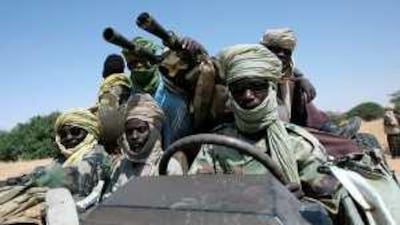
Fighters for Sudan's Justice and Equality Movement (JEM) travel through an area on the Sudan-Chad border in north-west Darfur. AFP -

UN peacekeepers on patrol during a visit by the High Commissioner for Refugees to Al Nimir camp, in Darfur. The UN confirmed on Saturday that a compound it had jointly used with the African Union in Sudan’s western region of Darfur was overrun and looted, as the country reels from a political crisis. AFP -
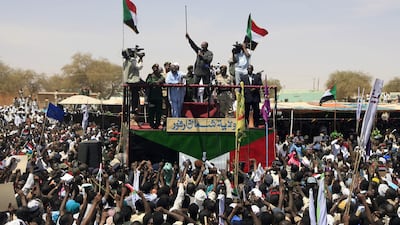
Then Sudanese president Omar Al Bashir addresses supporters during a visit to the North Darfur state capital of Al Fashir. Al Bashir, whose 29-year rule ended in April 2019, was indicted a decade ago by the International Criminal Court for crimes against humanity and genocide in Darfur. AFP -
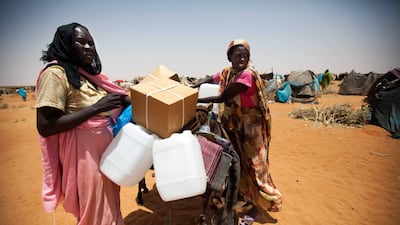
Woman carry relief supplies distributed by UN agencies at the new settlement in the Zam Zam camp for Internally Displaced Persons, in north Darfur. AFP -
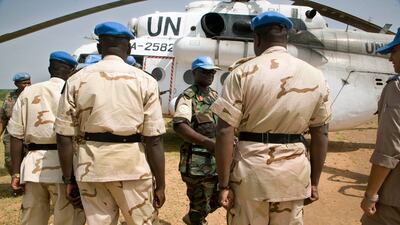
The commander of the UN Mission in Darfur's peacekeeping force, Gen Martin Luther Agwai, tours a base in Khor Abeche in Darfur. Photo: UNAMID -

Children stand next to a UN peacekeeper at the Abu Shok camp. AFP -

The UN says it is concerned about the safety of its staff in Darfur after the raid on the camp. AFP


Darfur’s civil war began when rebels took up arms to redress what they saw as discrimination by the Arab-influenced elite in northern Sudan.
The war led to 300,000 deaths and displaced 2.5 million, according to the UN, and deepened the ethnic divide when the Janjaweed joined the government in the fight against the rebels.
The latest violence is part of a wider breakdown in Sudan. Fighting has laid bare the inability of the ruling military to check the rapid security deterioration in many parts of the vast Afro-Arab nation.
It has also exposed the failure of peace accords signed between the government and some Darfur rebel groups in 2020.
The military-led administration in Khartoum made its first public statement on Monday evening, when a representative said the ruling, military-led Sovereign Council deeply regretted the violence and the loss of life.
UN Secretary General Antonio Guterres condemned the violence and called for rapid deployment of security forces.
His special envoy in Sudan, Volker Perthes, called for a transparent investigation into the violence.
In an implicit criticism of the military’s handling of the violence in Darfur, the US embassy in Khartoum called on security forces to “uphold their obligation to ensure the safety of those affected by these deplorable acts”.
The British Ambassador to Sudan said the latest violence was not an isolated incident.
Giles Lever called on authorities to “intensify efforts” to ensure the safety of civilians in Darfur.
“Darfur faces a long road to sustainable peace. Local peacebuilding, a unified security presence, access to justice, disarmament and land reform are just some of the essential steps that must be taken,” he said.

