Yair Lapid addresses journalists in Jerusalem on Sunday. AP

Al Aqsa Mosque: Israel committed to status quo, Yair Lapid says


  • English
  • Arabic

Israel is committed to maintaining the status quo that prevents Jews from praying at the flashpoint Al Aqsa Mosque compound, Foreign Minister Yair Lapid has said.

Mr Lapid's comments during a press briefing on Sunday came after more than a week of violence at the site in occupied East Jerusalem, which left more than 200 Palestinians injured by Israeli security forces.

“Muslims pray [there], non-Muslims only visit,” he said. The disputed site is considered the holiest place in Judaism and third-holiest in Islam.

“There is no change, there will be no change — we have no plans to divide the [site] between religions,” Mr Lapid told journalists.

Palestinian Muslims have been angered by an increase in the number of Jewish visits to the compound, where by long-standing convention Jews may visit but are not allowed to pray. Tensions over the visits have been heightened by the overlapping of the Muslim holy month of Ramadan and the week-long Jewish observance of the Passover, which ended on Saturday.

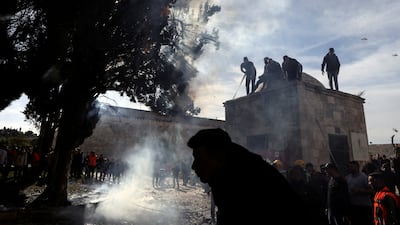
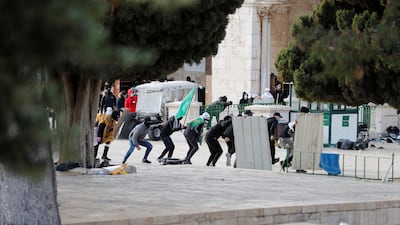
  • Palestinians put out a fire following violence between Israeli security forces and demonstrators at Al Aqsa Mosque compound in Jerusalem's Old City. Reuters
    Palestinians put out a fire following violence between Israeli security forces and demonstrators at Al Aqsa Mosque compound in Jerusalem's Old City. Reuters
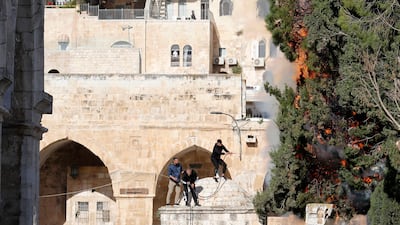
  • Palestinian members of the public help firefighters extinguish flames in woodland at Al Aqsa Mosque compound, following violence between protesters and Israeli security forces. AFP
    Palestinian members of the public help firefighters extinguish flames in woodland at Al Aqsa Mosque compound, following violence between protesters and Israeli security forces. AFP
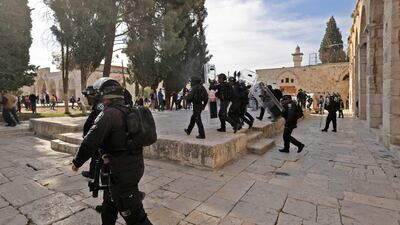
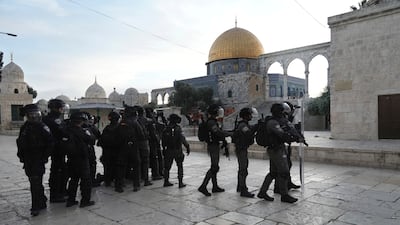
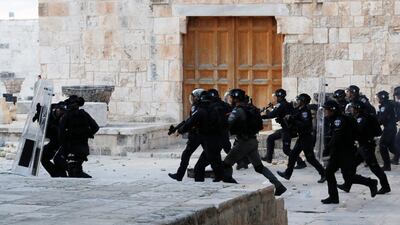
  • Israeli security forces inside Al Aqsa Mosque compound in Jerusalem's Old City, following clashes with Palestinian protesters. AFP
    Israeli security forces inside Al Aqsa Mosque compound in Jerusalem's Old City, following clashes with Palestinian protesters. AFP
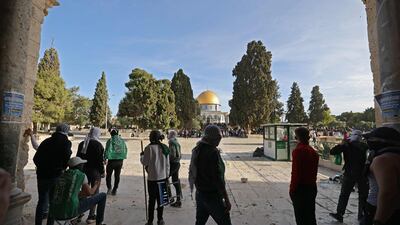
  • Palestinian demonstrators in Jerusalem's Al Aqsa Mosque compound, with the Dome of the Rock shrine in the background. AFP
    Palestinian demonstrators in Jerusalem's Al Aqsa Mosque compound, with the Dome of the Rock shrine in the background. AFP
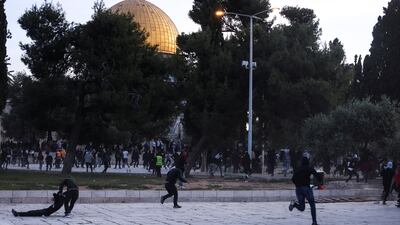
  • Palestinian protesters in Al Aqsa Mosque compound, in Jerusalem's Old City. Reuters
    Palestinian protesters in Al Aqsa Mosque compound, in Jerusalem's Old City. Reuters
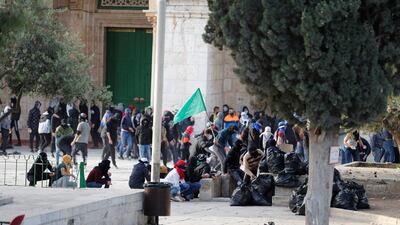
  • Protesters in Al Aqsa Mosque compound. Reuters
    Protesters in Al Aqsa Mosque compound. Reuters
  • Israeli police in riot gear enter the Al Aqsa Mosque compound. Officers fired rubber bullets and stun grenades at Palestinian protesters. AP
    Israeli police in riot gear enter the Al Aqsa Mosque compound. Officers fired rubber bullets and stun grenades at Palestinian protesters. AP
  • Palestinians gather at the compound after violence broke out on Friday. AFP
    Palestinians gather at the compound after violence broke out on Friday. AFP
  • Israeli police inside Al Aqsa Mosque compound - also known as Haram Al Sharif - the third holiest site in Islam. AFP
    Israeli police inside Al Aqsa Mosque compound - also known as Haram Al Sharif - the third holiest site in Islam. AFP
  • The violence comes after the killing of several people in Israel and the occupied West Bank in recent weeks. AFP
    The violence comes after the killing of several people in Israel and the occupied West Bank in recent weeks. AFP
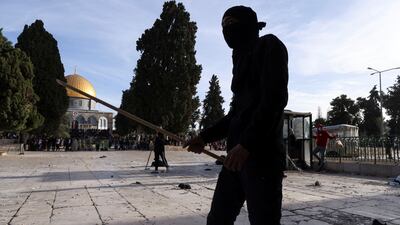
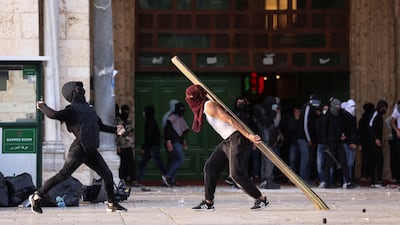
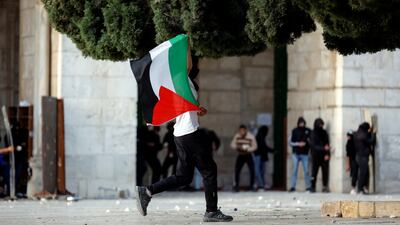
  • Palestinian youths hurl stones towards police at a gate to Al Aqsa Mosque compound. Reuters
    Palestinian youths hurl stones towards police at a gate to Al Aqsa Mosque compound. Reuters
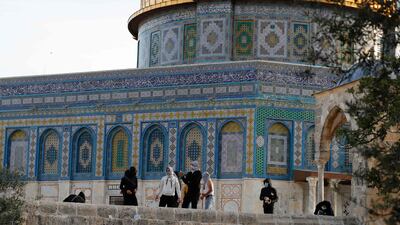
  • Protesters stand beside the Dome of the Rock shrine in Al Aqsa Mosque compound. AFP
    Protesters stand beside the Dome of the Rock shrine in Al Aqsa Mosque compound. AFP
  • AL Aqsa Mosque compound is a flashpoint in the Israeli-Palestinian conflict, sparking fears of a resumption of last year’s 11-day Gaza War. Reuters
    AL Aqsa Mosque compound is a flashpoint in the Israeli-Palestinian conflict, sparking fears of a resumption of last year’s 11-day Gaza War. Reuters

The violence in occupied East Jerusalem raised fears of another Israeli-Palestinian conflict, similar to the 11-day war last year between Israel and the militant group Hamas in the Gaza Strip, caused by similar unrest at Al Aqsa.

Israeli Prime Minister Naftali Bennett spoke with US President Joe Biden and “updated him on the efforts to stop the violence and incitement in Jerusalem”, his office said.

Mr Biden accepted a prior invitation by Mr Bennett to visit Israel and said during the call that he would do so in “the coming months”, it said.

Palestinian officials and militants have repeatedly accused Israel of seeking to divide Al Aqsa into Jewish and Muslim sections or visiting times, as with another sensitive holy site in nearby Hebron.

They have voiced anger at repeated incursions by Israeli security forces into the mosque compound.

But Mr Lapid blamed renewed tensions at the site on “terrorists” trying to incite violence.

“Terrorist organisations have been trying to hijack the Al Aqsa Mosque in order to create an outbreak of violence in Jerusalem and from there a violent conflict across the country,” he said.

He accused Hamas, which rules Gaza, and Islamic Jihad, another militant group in the Palestinian enclave, of sending “extremists” with weapons and explosives to use the Al Aqsa compound “as a base to incite violent riots".

“They have done this to create a provocation, to force the Israeli police to enter the mosque and remove them,” he said.

“The only reason police have entered the mosque in recent weeks is to remove them.”

Israel on Saturday announced an indefinite closure of its only civilian crossing from the Gaza Strip in response to rockets fired from Gaza. The crossing is used by about 12,000 Palestinians in Gaza who have permits to work in Israel.


Mercer, the investment consulting arm of US services company Marsh & McLennan, expects its wealth division to at least double its assets under management (AUM) in the Middle East as wealth in the region continues to grow despite economic headwinds, a company official said.

Mercer Wealth, which globally has $160 billion in AUM, plans to boost its AUM in the region to $2-$3bn in the next 2-3 years from the present $1bn, said Yasir AbuShaban, a Dubai-based principal with Mercer Wealth.

Within the next two to three years, we are looking at reaching $2 to $3 billion as a conservative estimate and we do see an opportunity to do so,” said Mr AbuShaban.

Mercer does not directly make investments, but allocates clients’ money they have discretion to, to professional asset managers. They also provide advice to clients.

“We have buying power. We can negotiate on their (client’s) behalf with asset managers to provide them lower fees than they otherwise would have to get on their own,” he added.

Mercer Wealth’s clients include sovereign wealth funds, family offices, and insurance companies among others.

From its office in Dubai, Mercer also looks after Africa, India and Turkey, where they also see opportunity for growth.

Wealth creation in Middle East and Africa (MEA) grew 8.5 per cent to $8.1 trillion last year from $7.5tn in 2015, higher than last year’s global average of 6 per cent and the second-highest growth in a region after Asia-Pacific which grew 9.9 per cent, according to consultancy Boston Consulting Group (BCG). In the region, where wealth grew just 1.9 per cent in 2015 compared with 2014, a pickup in oil prices has helped in wealth generation.

BCG is forecasting MEA wealth will rise to $12tn by 2021, growing at an annual average of 8 per cent.

Drivers of wealth generation in the region will be split evenly between new wealth creation and growth of performance of existing assets, according to BCG.

Another general trend in the region is clients’ looking for a comprehensive approach to investing, according to Mr AbuShaban.

“Institutional investors or some of the families are seeing a slowdown in the available capital they have to invest and in that sense they are looking at optimizing the way they manage their portfolios and making sure they are not investing haphazardly and different parts of their investment are working together,” said Mr AbuShaban.

Some clients also have a higher appetite for risk, given the low interest-rate environment that does not provide enough yield for some institutional investors. These clients are keen to invest in illiquid assets, such as private equity and infrastructure.

“What we have seen is a desire for higher returns in what has been a low-return environment specifically in various fixed income or bonds,” he said.

“In this environment, we have seen a de facto increase in the risk that clients are taking in things like illiquid investments, private equity investments, infrastructure and private debt, those kind of investments were higher illiquidity results in incrementally higher returns.”

The Abu Dhabi Investment Authority, one of the largest sovereign wealth funds, said in its 2016 report that has gradually increased its exposure in direct private equity and private credit transactions, mainly in Asian markets and especially in China and India. The authority’s private equity department focused on structured equities owing to “their defensive characteristics.”

The specs: 2019 Audi A8

Price From Dh390,000

Engine 3.0L V6 turbo

Gearbox Eight-speed automatic

Power 345hp @ 5,000rpm

Torque 500Nm @ 1,370rpm

Fuel economy, combined 7.5L / 100km

Updated: April 25, 2022, 7:44 AM