The Izmir Platform of the Confederation of Public Employees Unions protested against the high inflation rate in Turkey and burnt their payslips to highlight the financial difficulties caused by the price of electricity, natural gas, fuel, transport and food. Pacific Press
The Izmir Platform of the Confederation of Public Employees Unions protested against the high inflation rate in Turkey and burnt their payslips to highlight the financial difficulties caused by the pr

Turkey electricity crisis brings thousands on to the streets


Andrew Wilks
  • English
  • Arabic

Thousands of people took to the streets of cities across Turkey in recent days to protest against electricity prices that shot up by as much as 125 per cent at the start of the year.

From the Mediterranean resorts of Fethiye and Marmaris to Agri on the mountainous eastern border, people rebelled against crippling bills that were raised in January.

Under the nationwide changes, electricity companies boosted prices by 50 per cent for low-level users, rising to 125 per cent for large-scale business consumers.

In the southern city of Mardin, police used tear gas and arrested several protesters on Sunday after the crowd called for the resignation of President Recep Tayyip Erdogan and chanted against the region’s electricity supplier.

“These electricity price increases are the latest blow for us after inflation that has left us unable to feed ourselves properly,” said Rifat Gencay, a jobless 39-year-old from Istanbul’s Atasehir neighbourhood.

“Some people are being forced to choose between buying food or paying their gas and electricity bills, they don’t have enough money for both.”

Housewife Esra Yuksel, 45, said her family had lowered the heating and wore extra clothing at home to keep bills down. “I still don’t know if we will be able to pay the bills next month,” she said.

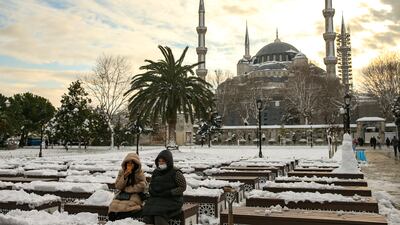
  • People sit in a snow-covered park with the Blue Mosque in the background in Istanbul after a massive cold front and snowstorms hit much of Turkey and Greece. AP
    People sit in a snow-covered park with the Blue Mosque in the background in Istanbul after a massive cold front and snowstorms hit much of Turkey and Greece. AP
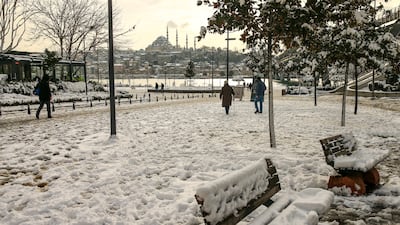
  • People stand near the Golden Horn in Istanbul. AP
    People stand near the Golden Horn in Istanbul. AP
  • Rescue crews in Istanbul and Athens on Tuesday cleared roads that had come to a standstill after the snowstorms. AP
    Rescue crews in Istanbul and Athens on Tuesday cleared roads that had come to a standstill after the snowstorms. AP
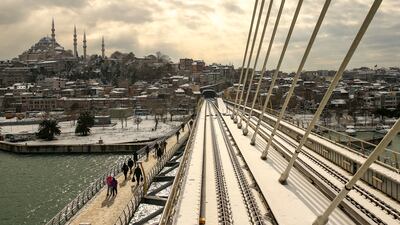
  • People walk over the Golden Horn with Suleymaniye Mosque in the background in Istanbul. AP
    People walk over the Golden Horn with Suleymaniye Mosque in the background in Istanbul. AP
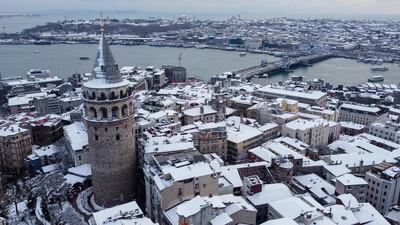
  • Galata Tower and the Golden Horn during heavy snowfall in Istanbul. Reuters
    Galata Tower and the Golden Horn during heavy snowfall in Istanbul. Reuters
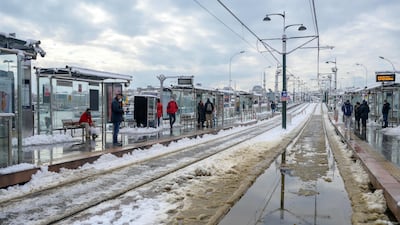
  • Commuters wait for a tram in Istanbul, where roads were blocked and flights and intercity transport cancelled due to snow. AFP
    Commuters wait for a tram in Istanbul, where roads were blocked and flights and intercity transport cancelled due to snow. AFP
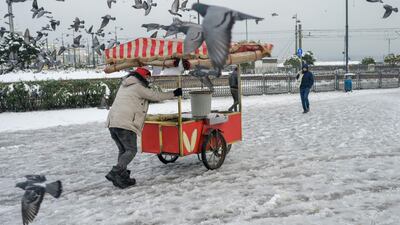
  • A vendor pulls his cart in the Eminonu district of Istanbul after a snowstorm. AFP
    A vendor pulls his cart in the Eminonu district of Istanbul after a snowstorm. AFP
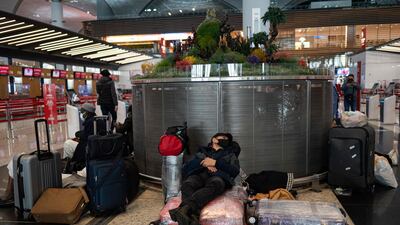
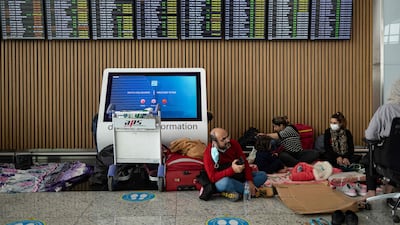
  • Stranded passengers wait at Istanbul Airport, where flights were cancelled due to a blizzard. AFP
    Stranded passengers wait at Istanbul Airport, where flights were cancelled due to a blizzard. AFP
  • Europe's busiest airport in Istanbul delayed its reopening and Greece declared a public holiday as the Mediterranean neighbours began digging themselves out following a rare snowstorm. AFP
    Europe's busiest airport in Istanbul delayed its reopening and Greece declared a public holiday as the Mediterranean neighbours began digging themselves out following a rare snowstorm. AFP
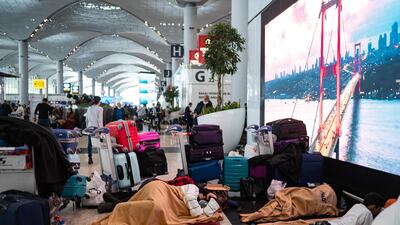
  • Stranded passengers wait at Istanbul Airport following heavy snowfall. AFP
    Stranded passengers wait at Istanbul Airport following heavy snowfall. AFP
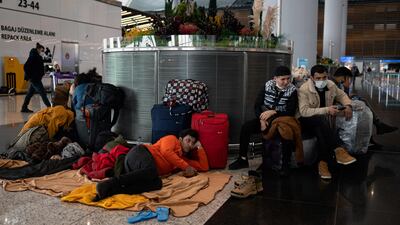
  • Passengers wait in Istanbul Airport on January 25, 2022, after flights were cancelled due to a blizzard. AFP
    Passengers wait in Istanbul Airport on January 25, 2022, after flights were cancelled due to a blizzard. AFP
  • Stranded passengers wait at Istanbul Airport. AFP
    Stranded passengers wait at Istanbul Airport. AFP

Turkey’s economic crisis led to the official rate of inflation hitting nearly 49 per cent in January, up from 36 per cent the previous month.

Independent economists, however, put the annual rate at more than 115 per cent, a figure many shoppers facing daily price rises believe to be more accurate.

Many increases are caused by the fall of the Turkish lira, which lost 44 per cent of its value against the dollar last year in Turkey’s import-reliant economy. However, the government’s refusal to raise interest rates – the usual method of tackling inflation – has also fuelled the dilemma.

These electricity price increases are the latest blow for us after inflation that has left us unable to feed ourselves properly
Rifat Gencay,
resident of Istanbul

Crowds that gathered at the weekend called for the energy price increases – natural gas also went up 25 per cent – to be reversed and for the renationalisation of Turkey’s jigsaw of power companies.

“We don’t want to pay the price for the economic and political instability in our country,” protesters in the western city of Mugla said in a statement.

Meanwhile, the main opposition Republican People’s Party (CHP) applied to the courts for the increases to be suspended.

Cemil Kocatepe, chairman of the Istanbul Chamber of Electrical Engineers, described the increase as one that “shocks us all” and said electricity customers were “being robbed”.

He blamed privatisation for creating a system that “produces and will continue to produce [price] increases”.

“The most important reason for today’s hikes is the energy, production and sales system established by the AKP,” Mr Kocatepe said, referring to Mr Erdogan’s Justice and Development Party. “In the coming months, we are afraid that this system will bring a raise again.”

Businesses that are shouldering the higher price increase are also calling for changes and say they could be forced to close.

Shopkeepers in Istanbul have taken to posting their monthly electricity bills in their windows as a display of their desperate situation.

A seller and client in a gold shop next to a currency exchange at the Grand Bazaar in Istanbul, Turkey. AP

“A special tariff should be applied to tradesmen,” said Bendevi Palandoken, chairman of the Confederation of Turkish Tradesmen and Craftsmen.

“Unfortunately, increasing the level to 210 kilowatts in the gradual tariff did not benefit our tradesmen, since our tradesmen consume at least 800 kilowatts of electricity.”

He was referring to Mr Erdogan’s announcement last week that the upper limit of the 50 per cent increase would be raised from 150 kilowatts to 210 kilowatts of monthly use.

Mr Erdogan said the new tariffs were introduced to “ensure sustainability in energy markets”. Meanwhile, his spokesman Ibrahim Kalin on Sunday promised changes to ease customers' burdens.

“A new regulation on electricity bills will come very soon. Improvements will continue,” he told broadcaster AHaber. “We will not crush our citizens with inflation.”

The tourism sector, which accounts for 13 per cent of the Turkish economy and is a valuable source of foreign currency, also said that rising power bills could damage efforts for economic recovery.

“While electricity bills in Germany are between 2 per cent and 5 per cent of restaurant turnover, it’s reached 10 per cent to 15 per cent in our country,” said Zeki Ozen, chairman of the Antalya Gastronomy Investors and Operators Association.

Many restaurants and cafes now face monthly electricity bills higher than their rent, he said. Meanwhile, cash-strapped customers are cutting down on their nights out.

Hoteliers, who run energy-guzzling air conditioners during the peak summer months, say they are being forced to raise their room prices by up to 50 per cent.

“Hotel operators can’t even imagine how much they will pay when the air conditioners are working when temperatures rise,” said Serdar Karcilioglu, chairman of the Bodrum Professional Hotel Managers’ Association.

While the weak lira seems likely to maintain Turkey’s reputation as an inexpensive summer destination for European visitors, the locals who provide hotels with custom during the off-season are likely to stay away.

“With the new prices, I think that the purchasing power of domestic tourists will decrease by 75 per cent to 80 per cent. We have to save this year with foreign tourists,” Mr Karcilioglu said.


Company%C2%A0profile
%3Cp%3E%3Cstrong%3ECompany%20name%3A%20%3C%2Fstrong%3EOutsized%0D%3Cbr%3E%3Cstrong%3EStarted%3A%20%3C%2Fstrong%3E2016%0D%3Cbr%3E%3Cstrong%3EFounders%3A%20%3C%2Fstrong%3EAzeem%20Zainulbhai%2C%20Niclas%20Thelander%2C%20Anurag%20Bhalla%20and%20Johann%20van%20Niekerk%20%0D%3Cbr%3E%3Cstrong%3EBased%3A%20%3C%2Fstrong%3EIndia%2C%20South%20Africa%2C%20South-East%20Asia%2C%20Mena%0D%3Cbr%3E%3Cstrong%3ESector%3A%3C%2Fstrong%3E%20Recruitment%0D%3Cbr%3E%3Cstrong%3EInvestment%20raised%3A%3C%2Fstrong%3E%20%241%20million%0D%3Cbr%3E%3Cstrong%3ECurrent%20staff%20count%3A%3C%2Fstrong%3E%2040%0D%3Cbr%3E%3Cstrong%3EInvestors%3A%20%3C%2Fstrong%3ESeed%20and%20angel%20investors%0D%3Cbr%3E%3C%2Fp%3E%0A
Vidaamuyarchi

Director: Magizh Thirumeni

Stars: Ajith Kumar, Arjun Sarja, Trisha Krishnan, Regina Cassandra

Rating: 4/5


Mercer, the investment consulting arm of US services company Marsh & McLennan, expects its wealth division to at least double its assets under management (AUM) in the Middle East as wealth in the region continues to grow despite economic headwinds, a company official said.

Mercer Wealth, which globally has $160 billion in AUM, plans to boost its AUM in the region to $2-$3bn in the next 2-3 years from the present $1bn, said Yasir AbuShaban, a Dubai-based principal with Mercer Wealth.

Within the next two to three years, we are looking at reaching $2 to $3 billion as a conservative estimate and we do see an opportunity to do so,” said Mr AbuShaban.

Mercer does not directly make investments, but allocates clients’ money they have discretion to, to professional asset managers. They also provide advice to clients.

“We have buying power. We can negotiate on their (client’s) behalf with asset managers to provide them lower fees than they otherwise would have to get on their own,” he added.

Mercer Wealth’s clients include sovereign wealth funds, family offices, and insurance companies among others.

From its office in Dubai, Mercer also looks after Africa, India and Turkey, where they also see opportunity for growth.

Wealth creation in Middle East and Africa (MEA) grew 8.5 per cent to $8.1 trillion last year from $7.5tn in 2015, higher than last year’s global average of 6 per cent and the second-highest growth in a region after Asia-Pacific which grew 9.9 per cent, according to consultancy Boston Consulting Group (BCG). In the region, where wealth grew just 1.9 per cent in 2015 compared with 2014, a pickup in oil prices has helped in wealth generation.

BCG is forecasting MEA wealth will rise to $12tn by 2021, growing at an annual average of 8 per cent.

Drivers of wealth generation in the region will be split evenly between new wealth creation and growth of performance of existing assets, according to BCG.

Another general trend in the region is clients’ looking for a comprehensive approach to investing, according to Mr AbuShaban.

“Institutional investors or some of the families are seeing a slowdown in the available capital they have to invest and in that sense they are looking at optimizing the way they manage their portfolios and making sure they are not investing haphazardly and different parts of their investment are working together,” said Mr AbuShaban.

Some clients also have a higher appetite for risk, given the low interest-rate environment that does not provide enough yield for some institutional investors. These clients are keen to invest in illiquid assets, such as private equity and infrastructure.

“What we have seen is a desire for higher returns in what has been a low-return environment specifically in various fixed income or bonds,” he said.

“In this environment, we have seen a de facto increase in the risk that clients are taking in things like illiquid investments, private equity investments, infrastructure and private debt, those kind of investments were higher illiquidity results in incrementally higher returns.”

The Abu Dhabi Investment Authority, one of the largest sovereign wealth funds, said in its 2016 report that has gradually increased its exposure in direct private equity and private credit transactions, mainly in Asian markets and especially in China and India. The authority’s private equity department focused on structured equities owing to “their defensive characteristics.”

Three ways to boost your credit score

Marwan Lutfi says the core fundamentals that drive better payment behaviour and can improve your credit score are:

1. Make sure you make your payments on time;

2. Limit the number of products you borrow on: the more loans and credit cards you have, the more it will affect your credit score;

3. Don't max out all your debts: how much you maximise those credit facilities will have an impact. If you have five credit cards and utilise 90 per cent of that credit, it will negatively affect your score.

F1 The Movie

Starring: Brad Pitt, Damson Idris, Kerry Condon, Javier Bardem

Director: Joseph Kosinski

Rating: 4/5

Specs%20
%3Cp%3E%3Cstrong%3EPower%20train%3A%20%3C%2Fstrong%3E4.0-litre%20twin-turbo%20V8%20and%20synchronous%20electric%20motor%3Cbr%3E%3Cstrong%3EMax%20power%3A%20%3C%2Fstrong%3E800hp%3Cbr%3E%3Cstrong%3EMax%20torque%3A%20%3C%2Fstrong%3E950Nm%3Cbr%3E%3Cstrong%3ETransmission%3A%20%3C%2Fstrong%3EEight-speed%20auto%3Cbr%3E%3Cstrong%3EBattery%3A%20%3C%2Fstrong%3E25.7kWh%20lithium-ion%3Cbr%3E0-100km%2Fh%3A%203.4sec%3Cbr%3E0-200km%2Fh%3A%2011.4sec%3Cbr%3E%3Cstrong%3ETop%20speed%3A%20%3C%2Fstrong%3E312km%2Fh%3Cbr%3E%3Cstrong%3EMax%20electric-only%20range%3A%3C%2Fstrong%3E%2060km%20(claimed)%3Cbr%3E%3Cstrong%3EOn%20sale%3A%3C%2Fstrong%3E%20Q3%3Cbr%3E%3Cstrong%3EPrice%3A%20%3C%2Fstrong%3EFrom%20Dh1.2m%20(estimate)%3Cbr%3E%3Cbr%3E%3C%2Fp%3E%0A
The years Ramadan fell in May

1987

1954

1921

1888

The specs
 
Engine: 3.0-litre six-cylinder turbo
Power: 398hp from 5,250rpm
Torque: 580Nm at 1,900-4,800rpm
Transmission: Eight-speed auto
Fuel economy, combined: 6.5L/100km
On sale: December
Price: From Dh330,000 (estimate)
SPEC%20SHEET%3A%20SAMSUNG%20GALAXY%20Z%20FOLD5
%3Cp%3E%3Cstrong%3EMain%20display%3A%3C%2Fstrong%3E%207.6%22%20QXGA%2B%20Dynamic%20Amoled%202X%2C%20Infinity%20Flex%2C%202176%20x%201812%2C%2021.6%3A18%2C%20374ppi%2C%20HDR10%2B%2C%20up%20to%20120Hz%3C%2Fp%3E%0A%3Cp%3E%3Cstrong%3ECover%20display%3A%3C%2Fstrong%3E%206.2%22%20HD%2B%20Dynamic%20Amoled%202X%2C%202316%20x%20904%2C%2023.1%3A9%2C%20402ppi%2C%20up%20to%20120Hz%3C%2Fp%3E%0A%3Cp%3E%3Cstrong%3EProcessor%3A%3C%2Fstrong%3E%20Qualcomm%20Snapdragon%208%20Gen%202%2C%204nm%2C%20octa-core%3B%20Adreno%20740%20GPU%3C%2Fp%3E%0A%3Cp%3E%3Cstrong%3EMemory%3A%3C%2Fstrong%3E%2012GB%3C%2Fp%3E%0A%3Cp%3E%3Cstrong%3ECapacity%3A%3C%2Fstrong%3E%20256%2F512GB%20%2F%201TB%20(online%20exclusive)%3C%2Fp%3E%0A%3Cp%3E%3Cstrong%3EPlatform%3A%3C%2Fstrong%3E%20Android%2013%2C%20One%20UI%205.1.1%3C%2Fp%3E%0A%3Cp%3E%3Cstrong%3EMain%20camera%3A%3C%2Fstrong%3E%20Triple%2012MP%20ultra-wide%20(f%2F2.2)%20%2B%2050MP%20wide%20(f%2F1.8)%20%2B%2010MP%20telephoto%20(f%2F2.4)%2C%20dual%20OIS%2C%203x%20optical%20zoom%2C%2030x%20Space%20Zoom%2C%20portrait%2C%20super%20slo-mo%3C%2Fp%3E%0A%3Cp%3E%3Cstrong%3EVideo%3A%3C%2Fstrong%3E%208K%4024fps%2C%204K%4060fps%2C%20full-HD%4060%2F240fps%2C%20HD%40960fps%3B%20slo-mo%4060%2F240%2F960fps%3B%20HDR10%2B%3C%2Fp%3E%0A%3Cp%3E%3Cstrong%3ECover%20camera%3A%3C%2Fstrong%3E%2010MP%20(f%2F2.2)%3C%2Fp%3E%0A%3Cp%3E%3Cstrong%3EInner%20front%20camera%3A%3C%2Fstrong%3E%20Under-display%204MP%20(f%2F1.8)%3C%2Fp%3E%0A%3Cp%3E%3Cstrong%3EBattery%3A%3C%2Fstrong%3E%204400mAh%2C%2025W%20fast%20charging%2C%2015W%20wireless%2C%204.5W%20reverse%20wireless%3C%2Fp%3E%0A%3Cp%3E%3Cstrong%3EConnectivity%3A%3C%2Fstrong%3E%205G%3B%20Wi-Fi%2C%20Bluetooth%205.3%2C%20NFC%20(Samsung%20Pay)%3C%2Fp%3E%0A%3Cp%3E%3Cstrong%3EI%2FO%3A%3C%2Fstrong%3E%20USB-C%3C%2Fp%3E%0A%3Cp%3E%3Cstrong%3ECards%3A%3C%2Fstrong%3E%20Nano-SIM%20%2B%20eSIM%3B%20dual%20nano-SIMs%20%2B%20eSIM%3C%2Fp%3E%0A%3Cp%3E%3Cstrong%3EColours%3A%3C%2Fstrong%3E%20Cream%2C%20icy%20blue%2C%20phantom%20black%3B%20online%20exclusives%20%E2%80%93%20blue%2C%20grey%3C%2Fp%3E%0A%3Cp%3E%3Cstrong%3EIn%20the%20box%3A%3C%2Fstrong%3E%20Fold5%2C%20USB-C-to-USB-C%20cable%3C%2Fp%3E%0A%3Cp%3E%3Cstrong%3EPrice%3A%3C%2Fstrong%3E%20Dh6%2C799%20%2F%20Dh7%2C249%20%2F%20Dh8%2C149%3C%2Fp%3E%0A

Veil (Object Lessons)
Rafia Zakaria
​​​​​​​Bloomsbury Academic

Results

4.30pm Jebel Jais – Maiden (PA) Dh60,000 (Turf) 1,000m; Winner: MM Al Balqaa, Bernardo Pinheiro (jockey), Qaiss Aboud (trainer)

5pm: Jabel Faya – Maiden (PA) Dh60,000 (T) 1,000m; Winner: AF Rasam, Tadhg O’Shea, Ernst Oertel

5.30pm: Al Wathba Stallions Cup – Handicap (PA) Dh70,000 (T) 2,200m; Winner: AF Mukhrej, Tadhg O’Shea, Ernst Oertel

6pm: The President’s Cup Prep – Conditions (PA) Dh100,000 (T) 2,200m; Winner: Mujeeb, Richard Mullen, Salem Al Ketbi

6.30pm: Abu Dhabi Equestrian Club – Prestige (PA) Dh125,000 (T) 1,600m; Winner: Jawal Al Reef, Antonio Fresu, Abubakar Daud

7pm: Al Ruwais – Group 3 (PA) Dh300,000 (T) 1,200m; Winner: Ashton Tourettes, Pat Dobbs, Ibrahim Aseel

7.30pm: Jebel Hafeet – Maiden (TB) Dh80,000 (T) 1,400m; Winner: Nibraas, Richard Mullen, Nicholas Bachalard

What went into the film

25 visual effects (VFX) studios

2,150 VFX shots in a film with 2,500 shots

1,000 VFX artists

3,000 technicians

10 Concept artists, 25 3D designers

New sound technology, named 4D SRL


The five pillars of Islam

1. Fasting 

2. Prayer 

3. Hajj 

4. Shahada 

5. Zakat 

ANDROID%20VERSION%20NAMES%2C%20IN%20ORDER
%3Cp%3EAndroid%20Alpha%3C%2Fp%3E%0A%3Cp%3EAndroid%20Beta%3C%2Fp%3E%0A%3Cp%3EAndroid%20Cupcake%3C%2Fp%3E%0A%3Cp%3EAndroid%20Donut%3C%2Fp%3E%0A%3Cp%3EAndroid%20Eclair%3C%2Fp%3E%0A%3Cp%3EAndroid%20Froyo%3C%2Fp%3E%0A%3Cp%3EAndroid%20Gingerbread%3C%2Fp%3E%0A%3Cp%3EAndroid%20Honeycomb%3C%2Fp%3E%0A%3Cp%3EAndroid%20Ice%20Cream%20Sandwich%3C%2Fp%3E%0A%3Cp%3EAndroid%20Jelly%20Bean%3C%2Fp%3E%0A%3Cp%3EAndroid%20KitKat%3C%2Fp%3E%0A%3Cp%3EAndroid%20Lollipop%3C%2Fp%3E%0A%3Cp%3EAndroid%20Marshmallow%3C%2Fp%3E%0A%3Cp%3EAndroid%20Nougat%3C%2Fp%3E%0A%3Cp%3EAndroid%20Oreo%3C%2Fp%3E%0A%3Cp%3EAndroid%20Pie%3C%2Fp%3E%0A%3Cp%3EAndroid%2010%20(Quince%20Tart*)%3C%2Fp%3E%0A%3Cp%3EAndroid%2011%20(Red%20Velvet%20Cake*)%3C%2Fp%3E%0A%3Cp%3EAndroid%2012%20(Snow%20Cone*)%3C%2Fp%3E%0A%3Cp%3EAndroid%2013%20(Tiramisu*)%3C%2Fp%3E%0A%3Cp%3EAndroid%2014%20(Upside%20Down%20Cake*)%3C%2Fp%3E%0A%3Cp%3EAndroid%2015%20(Vanilla%20Ice%20Cream*)%3C%2Fp%3E%0A%3Cp%3E%3Cem%3E*%20internal%20codenames%3C%2Fem%3E%3C%2Fp%3E%0A
Our family matters legal consultant

Name: Hassan Mohsen Elhais

Position: legal consultant with Al Rowaad Advocates and Legal Consultants.

Top 10 most polluted cities
  1. Bhiwadi, India
  2. Ghaziabad, India
  3. Hotan, China
  4. Delhi, India
  5. Jaunpur, India
  6. Faisalabad, Pakistan
  7. Noida, India
  8. Bahawalpur, Pakistan
  9. Peshawar, Pakistan
  10. Bagpat, India
Updated: June 14, 2023, 6:41 AM