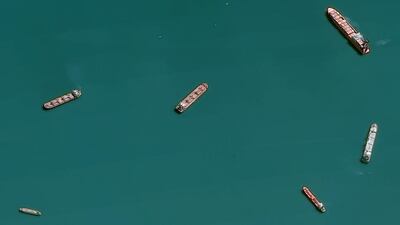
About 20,694 ships used the Suez Canal in 2021, more than 56 vessels a day. Reuters

Suez Canal revenue hit record $6.3bn in 2021


Nada El Sawy
  • English
  • Arabic

Revenue from Egypt’s Suez Canal hit a record $6.3 billion last year.

It was an increase of nearly 13 per cent compared with $5.6bn in 2020, the canal authority said.

The vital waterway, through which at least 10 per cent of global trade passes, also posted record cargo volumes in 2021.

The records coincide with an increase in global shipping demand during the Covid-19 pandemic over the past couple of years.

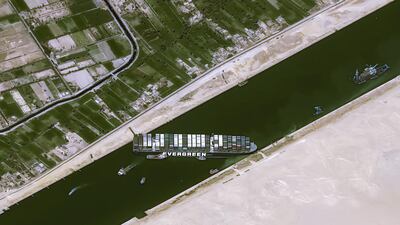
They also come despite the six-day blockage of the canal in March, when the giant Ever Given container ship ran aground in a sandstorm and stopped global trade.

Almost 1.57 billion tonnes of cargo was shipped through the canal last year, compared with 1.17 billion tonnes in 2020, an 8.5 per cent increase.

Authorities said 20,694 ships transited the canal in 2021 – up from 18,830 in 2020 – or more than 56 vessels a day.

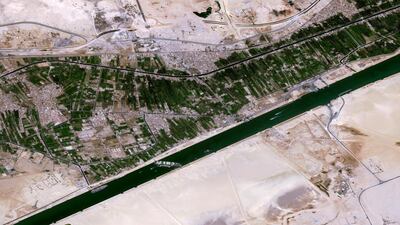
  • Satellite image shows the Suez Canal, a global trade way, blocked by the Ever Given vessel. Airbus Space
    Satellite image shows the Suez Canal, a global trade way, blocked by the Ever Given vessel. Airbus Space
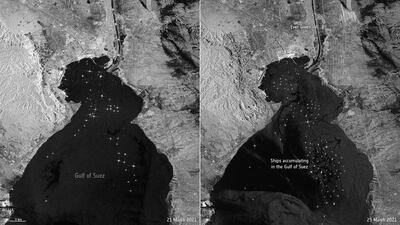
  • The image on the right shows regular traffic flow on the Suez Canal and the left one shows cargo pile up after Ever Given ran aground. European Space Agency
    The image on the right shows regular traffic flow on the Suez Canal and the left one shows cargo pile up after Ever Given ran aground. European Space Agency
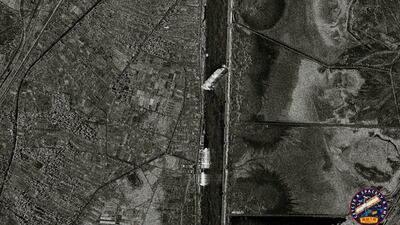
  • Satellite imagery shows the Suez Canal blocked after the Ever Given vessel ran aground. Airbus Space
    Satellite imagery shows the Suez Canal blocked after the Ever Given vessel ran aground. Airbus Space
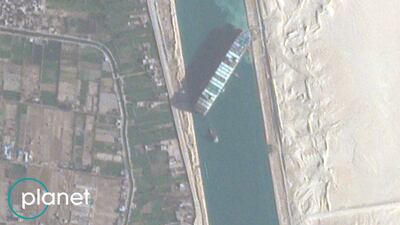
  • Around 10 per cent of global trade goes through the canal. Planet Labs
    Around 10 per cent of global trade goes through the canal. Planet Labs
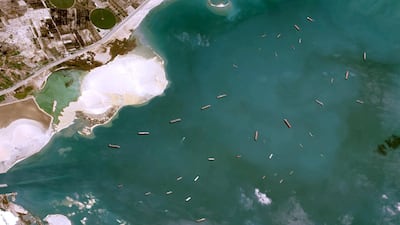
  • Cargo ships queued up in the canal while it was blocked. Airbus Space
    Cargo ships queued up in the canal while it was blocked. Airbus Space
  • A massive effort eventually refloated the stricken vessel. Research Institute of China Electronics Technology Group Corporation
    A massive effort eventually refloated the stricken vessel. Research Institute of China Electronics Technology Group Corporation
  • Satellite imagery capture the traffic jam at the Suez Canal caused by the 'Ever Given' container running aground. Airbus Space
    Satellite imagery capture the traffic jam at the Suez Canal caused by the 'Ever Given' container running aground. Airbus Space

The authority may have lost up to $95 million in fees during the six days, said Ranjith Raja, oil research manager at Refinitiv.

The incident also resulted in the loss of billions in global trade, highlighting the waterway’s importance. Last year it accounted for about 15.7 per cent of the world’s total seaborne trade, the authority said.

“One of the things that Ever Given did more than anything else is it really showcased the importance of global trade and how vital shipping, the Suez Canal and the seaways are for everyone’s daily life,” Salvatore Mercogliano, a maritime historian at Campbell University in North Carolina, told The National.

In the 152 years since it opened in November 1869 to November 2021, 1.4 million ships carrying 24.7 billion tonnes of cargo have navigated the waterway, paying more than $147bn in fees.

The authority said it will increase transit fees by 6 per cent starting in February, but cruise ships and vessels carrying liquefied natural gas will be exempt.

When the authority announced the decision in November, it said demand for maritime transport was expected to increase by up to 6.7 per cent in 2022, according to projections from the International Monetary Fund and the World Trade Organisation.

The increased fees will help the authority to develop the waterway as part of its $10bn plan to widen and deepen the southern single-lane portion.

It comes after a major expansion in northern sections that was completed in 2015 and has helped to increase the number of ships a day that can transit the channel.

By 2023, expected annual revenue will hit $13.2bn with an average of 97 vessels a day.

Stamp duty timeline

December 2014: Former UK finance minister George Osbourne reforms stamp duty, replacing the slab system with a blended rate scheme, with the top rate increasing to 12 per cent from 10 per cent:
Up to £125,000 - 0%; £125,000 to £250,000 – 2%; £250,000 to £925,000 – 5%; £925,000 to £1.5m: 10%; Over £1.5m – 12%

April 2016: New 3% surcharge applied to any buy-to-let properties or additional homes purchased.

July 2020: Rishi Sunak unveils SDLT holiday, with no tax to pay on the first £500,000, with buyers saving up to £15,000.

March 2021: Mr Sunak decides the fate of SDLT holiday at his March 3 budget, with expectations he will extend the perk unti June.

April 2021: 2% SDLT surcharge added to property transactions made by overseas buyers.

The five pillars of Islam

1. Fasting

2. Prayer

3. Hajj

4. Shahada

5. Zakat 

WHAT ARE NFTs?


Non-fungible tokens (NFTs) are tokens that represent ownership of unique items. They allow the tokenisation of things such as art, collectibles and even real estate.


An NFT can have only one official owner at one time. And since they're minted and secured on the Ethereum blockchain, no one can modify the record of ownership, not even copy-paste it into a new one.


This means NFTs are not interchangeable and cannot be exchanged with other items. In contrast, fungible items, such as fiat currencies, can be exchanged because their value defines them rather than their unique properties.

 
Key findings of Jenkins report
  • Founder of the Muslim Brotherhood, Hassan al Banna, "accepted the political utility of violence"
  • Views of key Muslim Brotherhood ideologue, Sayyid Qutb, have “consistently been understood” as permitting “the use of extreme violence in the pursuit of the perfect Islamic society” and “never been institutionally disowned” by the movement.
  • Muslim Brotherhood at all levels has repeatedly defended Hamas attacks against Israel, including the use of suicide bombers and the killing of civilians.
  • Laying out the report in the House of Commons, David Cameron told MPs: "The main findings of the review support the conclusion that membership of, association with, or influence by the Muslim Brotherhood should be considered as a possible indicator of extremism."
Updated: June 19, 2023, 1:14 PM