

In a factory overlooking the Mediterranean coast, a petite model glances over her shoulder as a camera shutter clicks away.
After holding her pose for a moment, a team of designers rushes in to fix the swimsuit she is wearing, brushing off the faintest blemishes.
Scenes like this were once common in the Lebanese capital. But the five-star hotels have closed and the high-rise apartments that straddle Beirut’s Corniche no longer provide the backdrop for music videos.
Lebanon’s glamorous past life barely exists outside of memories.
As a punishing economic crisis continues to push people into poverty, a handful of businesses are trying to get ahead of the curve. Amid the turmoil, Lebanon has become a very cheap place to manufacture luxury clothing.
“You will be astonished how many factories are opening now in Lebanon,” says Elie Hourani, CEO of Diamony Group, one of the country’s biggest fashion houses.
“The trade deficit for years was $17 billion or $18bn. Now, it’s down to $10bn or $11bn. Within two or three years, there will be no deficit,” he says.
The godfather of Lebanese lingerie
If you were to label one man the godfather of Lebanon’s lingerie industry, it would be Mr Hourani.
“I started selling lingerie by mistake,” he jokes, recalling how he bought a discounted batch of lingerie at the height of the country’s fifteen-year civil war, and then found himself in the fashion business.
“I did a law degree in 1977, but there was war and no law back then,” he says, with a wry smile.
Within a few years, he was sponsoring the annual Miss Lebanon beauty pageant. Diamony manufactured the winners’ tiara — the brand name was, quite literally, stitched on to the country’s fashion scene.

The financial crisis is forcing the country to wean itself off an unhealthy reliance on imports and become more independent.
As the economy has collapsed, foreign goods have become unaffordable.
Major brands from Coca Cola to Victoria's Secret are abandoning the market, but there is also opportunity.
For years, Diamony Group has imported fashion brands to Lebanon, now, it is producing for them.
In 2017, Mr Hourani’s daughter Carol founded Room 24, a high-end fashion label with outlets in London and Rome. She began producing lingerie, loungewear and swimwear from a factory in Italy, but rising production costs forced a rethink and, in the summer of 2019, just months before popular protests erupted, they moved production to Lebanon.
-
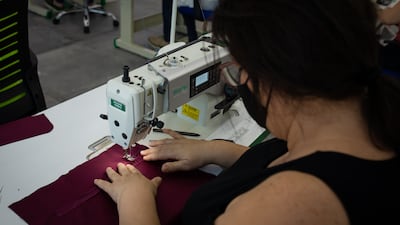
Rosette works a sewing machine in the academy area of the Diamony Group factory floor in Kaslik, Lebanon. Woman attended the academy course before deciding whether or not they want to work at the company. All photos: Oliver Marsden for The National -
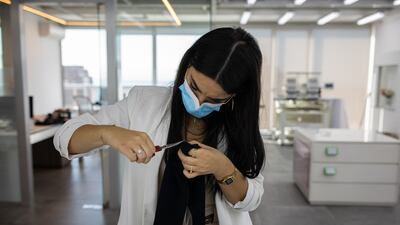
Stephanie Rizk carries out some quality control on a pair of trousers. -
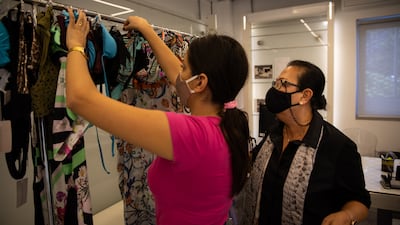
Diamony Group president Raja Hourani, wife of Elie and mother of Carol, inspects outfits during a photoshoot for Room 24. -
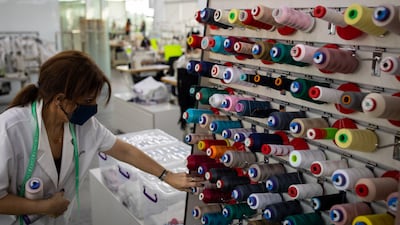
A seamstress looks for thread among the spools on the factory floor. -
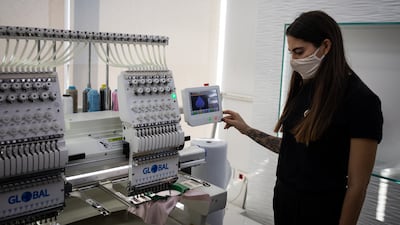
An employee of the Diamony Group operates the embroidery machine. -
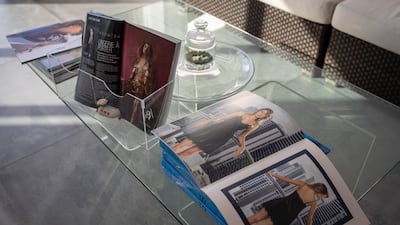
Magazines and books displaying Room 24 lingerie sit on a coffee table in a Diamony Group office in Kaslik. -
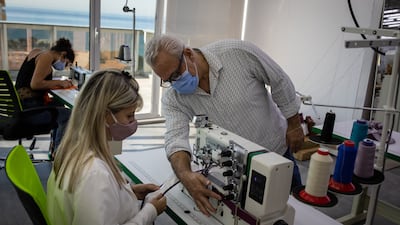
The Diamony Group Academy teacher, Pierre, shows a student the workings of a sewing machine. -
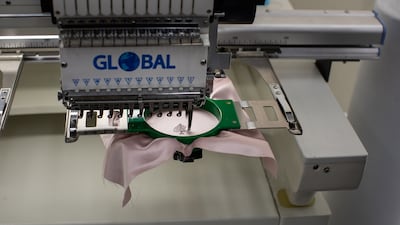
The embroidery machine is put to work on the factory floor at Diamony. -
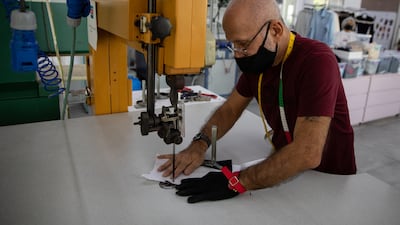
A technician cuts out stencils for silk gloves. -
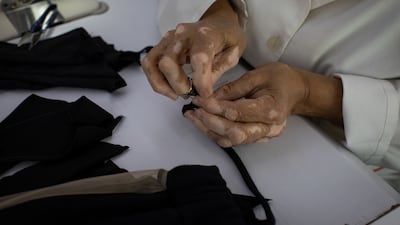
Laure Bassil manually sews a piece of fabric. Diamony Group produces up to 3,000 garments a month. -
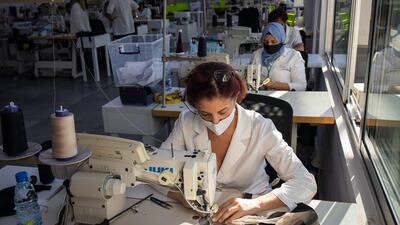
Employees feed garments through the sewing machines. -
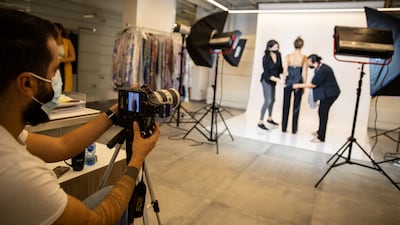
Photographer Jean Saad from Parazar productions reviews images on his camera as stylists attend to a model during a Room 24 shoot at the Diamony Group. -
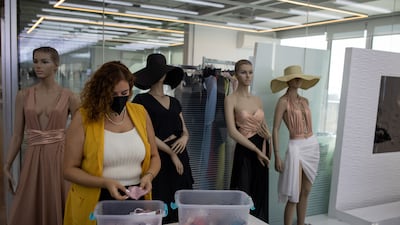
Chief operating officer Christine El Kik organises the Covid-19 masks made from offcuts of silk. The company is keen to avoid as much material waste as possible.


“Economically, as a business, it just made sense,” she says.
“It is super beneficial to the economy to create something locally, which we can export, it's good for the reputation of the country, you are supporting the local economy by supporting local families.”
With the backing of her father, she opened a factory in Kaslik, from which they can now produce up to 3,000 garments a month — and plans to produce for other brands are also in the works.
The swimsuits retail online for anything upwards of $200, and with exports flying out to more than 15 countries across Europe and to the US — the demand for Lebanese lingerie is booming.
A new workforce
They are training hundreds of seamstresses in Lebanon, developing a whole new workforce.
All their operators are women, and salaries are raised every month to address the lira’s continuing devaluation.
Beyond the cheap manufacturing costs, there are other factors enticing businesses to set up shop here. There are no customs fees on imports of goods and machinery for industry.
One company recently brought in $6 million dollars worth of pasta-making machinery for a factory in Jbeil.

Significant challenges remain, however.
As the fuel crisis peaked in the summer, staff were often unable to make it to work.
Meanwhile, with the banking sector largely insolvent, those who need to pay for imports must have a bank account abroad. Exporting or importing without one is practically impossible.
Recent weeks have further demonstrated just how precarious exporting from Lebanon can be.
Last month Saudi Arabia banned all imports from Lebanon following comments by Information Minister George Kordahi.
Fortunately, the country’s lingerie exports are not entirely reliant on the market in the kingdom, yet the threat to any business is obvious.
Exporting lingerie will not solve Lebanon’s economic crisis, but for Carol, a future of manufacturing is imperative for the country.
“We need to come to terms with the situation. We are not a service economy any more. We cannot rely on tourism any more,” she said.
“We need to pivot to a manufacturing-exports economy. That, I think, is the only way out of this mess.”

