Smoke billows from a warehouse after shelling of the north-west Syrian town of Sarmada. Photo: AFP

Commercial centre of Syria’s Idlib province comes under regime attack


Khaled Yacoub Oweis
  • English
  • Arabic

Residents of Sarmada in north-west Syria were cleaning up rubble on Sunday after heavy bombing by the regime of President Bashar Al Assad, witnesses have said.

It was the first attack on the town, a vital commercial hub near the Bab Al Hawa border crossing with Turkey, since fighting between groups in the region backed by Turkey and Russia intensified last month.

.
.

The two countries almost came into direct conflict in north-west Syria early last year, with each state seeking to expand its sphere of influence before reaching a tentative truce in March 2020.

The bombing in Sarmada killed at least four people at the weekend, Idlib residents and opposition monitoring groups said.

Ahmad Al Hani, a gold trader who was in the town on Sunday morning for business, said regime artillery and rocket fire hit a commercial road running between the town and the border crossing.

“Many shops were damaged,” he told The National. “Their owners are cleaning up to reopen. But they are afraid that they will be hit again.”

Turkey considers Sarmada, the rest of Idlib and adjacent regions in Aleppo governorate held by its forces to be vital for its security.

Ankara has said that millions of refugees in these areas could push toward its border if the regime’s forces and pro-Iran Shiite militia groups based around the city of Aleppo advance.

After eastern Aleppo fell to the regime in late 2016 after intensive Russian air bombing, Sarmada became the financial and trading centre of the territory outside the control of the Syrian regime in the north-west.

About 500,000 people, including refugees, now live in and around Sarmada, compared with only a few thousand before the civil war began.

Smoke billows from a warehouse in Sarmada in Idlib province. AFP

Turkey has responded to regime attacks and Russian air bombing of areas held by rebel forces in the north-west by shelling regime positions and pouring troops into Idlib and Aleppo.

Opposition activist Rami Al Sayyed said the bombing of Sarmada was a major expansion of the regime’s campaign to capture the north-west.

Loyalist forces and the Russian air force have mostly stayed away from bombing areas that close to the border with Turkey, which are densely populated by displaced Syrians, he said.

“If the regime keeps bombing Sarmada it is inevitable that the refugees [internally displaced people] would head to Turkey,” Mr Al Sayyed said.

Like most parts of Idlib not held by the regime, Sarmada is controlled by Al Qaeda offshoot Hayat Tahrir Al Sham.

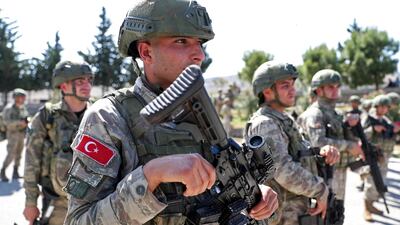
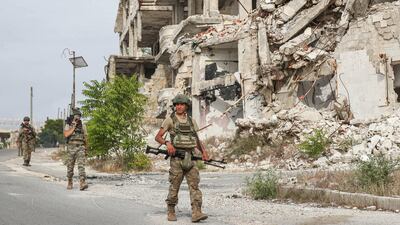
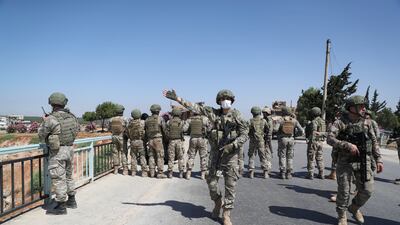
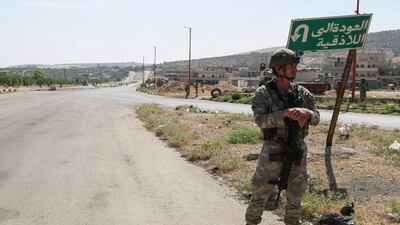
  • Turkish soldiers on patrol in the Syrian village of Ram Hamdan, north of the city of Idlib. All photos: AFP
    Turkish soldiers on patrol in the Syrian village of Ram Hamdan, north of the city of Idlib. All photos: AFP
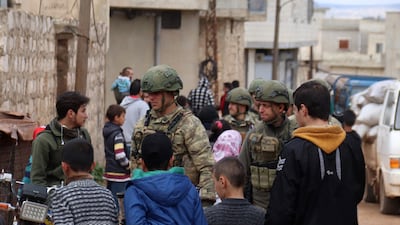
  • Displaced Syrian children watch Turkish soldiers near the town of Batabu on the road linking Idlib to the Syrian Bab al-Hawa border crossing with Turkey.
    Displaced Syrian children watch Turkish soldiers near the town of Batabu on the road linking Idlib to the Syrian Bab al-Hawa border crossing with Turkey.
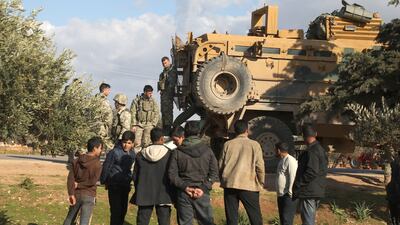
  • Turkish soldiers keep watch as vehicles from a joint Russian-Turkish patrol pass through the outskirts of the rebel-held town of Ariha in Syria's north-west Idlib province.
    Turkish soldiers keep watch as vehicles from a joint Russian-Turkish patrol pass through the outskirts of the rebel-held town of Ariha in Syria's north-west Idlib province.
  • Turkish soldiers secure a section of the M4 motorway near Ariha in Idlib province.
    Turkish soldiers secure a section of the M4 motorway near Ariha in Idlib province.
  • Turkish soldiers patrol on Arbaeen hill overlooking Ariha in the southern countryside of Idlib province, Syria.
    Turkish soldiers patrol on Arbaeen hill overlooking Ariha in the southern countryside of Idlib province, Syria.
  • Turkish soldiers on guard on a bridge overlooking a section of the M4 motorway.
    Turkish soldiers on guard on a bridge overlooking a section of the M4 motorway.
  • Turkish soldiers secure a section of the M4 to allow joint Russian-Turkish patrol to pass.
    Turkish soldiers secure a section of the M4 to allow joint Russian-Turkish patrol to pass.

The Syrian National Army, a Turkey-backed force comprising Syrian rebels, controls nearby areas in northern Aleppo governorate, near the border with Turkey.

The rebels, as well as Turkish troops, have been exchanging attacks with the Kurdish People’s Protection Units (YPG) militia, which controls the pocket of Tal Rifat, near the city of Aleppo.

With Russian air support, the YPG overran and depopulated Tal Rifat, a mostly Sunni area, five years ago. The takeover added to the territory captured by the YPG in the past decade.

But in 2018, Turkey and its allied forces captured Afrin, a Kurdish enclave in Aleppo.

The fall of Afrin, which required the tacit approval of Moscow, ended YPG hopes of holding on to uninterrupted territory along the border.

While there has been speculation among the Syrian opposition that Turkey would be willing to give up areas in Idlib in exchange for Tal Rifat, Mr Al Sayyed said there was always room for miscalculation.

“We have usually seen that whenever the regime advances in the north-west, Turkey takes areas that had been captured by Kurdish militias,” he said.


Company%C2%A0profile
%3Cp%3E%3Cstrong%3ECompany%20name%3A%20%3C%2Fstrong%3ETuhoon%0D%3Cbr%3E%3Cstrong%3EYear%20started%3A%20%3C%2Fstrong%3EJune%202021%0D%3Cbr%3E%3Cstrong%3ECo-founders%3A%20%3C%2Fstrong%3EFares%20Ghandour%2C%20Dr%20Naif%20Almutawa%2C%20Aymane%20Sennoussi%0D%3Cbr%3E%3Cstrong%3EBased%3A%20%3C%2Fstrong%3ERiyadh%0D%3Cbr%3E%3Cstrong%3ESector%3A%20%3C%2Fstrong%3Ehealth%20care%0D%3Cbr%3E%3Cstrong%3ESize%3A%20%3C%2Fstrong%3E15%20employees%2C%20%24250%2C000%20in%20revenue%0D%3Cbr%3EI%3Cstrong%3Envestment%20stage%3A%20s%3C%2Fstrong%3Eeed%0D%3Cbr%3E%3Cstrong%3EInvestors%3A%20%3C%2Fstrong%3EWamda%20Capital%2C%20Nuwa%20Capital%2C%20angel%20investors%3C%2Fp%3E%0A
Company%20profile
%3Cp%3E%3Cstrong%3ECompany%20name%3A%3C%2Fstrong%3E%20Fasset%0D%3Cbr%3E%3Cstrong%3EStarted%3A%20%3C%2Fstrong%3E2019%0D%3Cbr%3E%3Cstrong%3EFounders%3A%3C%2Fstrong%3E%20Mohammad%20Raafi%20Hossain%2C%20Daniel%20Ahmed%0D%3Cbr%3E%3Cstrong%3EBased%3A%3C%2Fstrong%3E%20Dubai%0D%3Cbr%3E%3Cstrong%3ESector%3A%20%3C%2Fstrong%3EFinTech%0D%3Cbr%3E%3Cstrong%3EInitial%20investment%3A%3C%2Fstrong%3E%20%242.45%20million%0D%3Cbr%3E%3Cstrong%3ECurrent%20number%20of%20staff%3A%3C%2Fstrong%3E%2086%0D%3Cbr%3E%3Cstrong%3EInvestment%20stage%3A%3C%2Fstrong%3E%20Pre-series%20B%0D%3Cbr%3E%3Cstrong%3EInvestors%3A%3C%2Fstrong%3E%20Investcorp%2C%20Liberty%20City%20Ventures%2C%20Fatima%20Gobi%20Ventures%2C%20Primal%20Capital%2C%20Wealthwell%20Ventures%2C%20FHS%20Capital%2C%20VN2%20Capital%2C%20local%20family%20offices%3C%2Fp%3E%0A
Teri%20Baaton%20Mein%20Aisa%20Uljha%20Jiya
%3Cp%3E%3Cstrong%3EDirectors%3A%3C%2Fstrong%3E%20Amit%20Joshi%20and%20Aradhana%20Sah%3C%2Fp%3E%0A%3Cp%3E%3Cstrong%3ECast%3A%3C%2Fstrong%3E%20Shahid%20Kapoor%2C%20Kriti%20Sanon%2C%20Dharmendra%2C%20Dimple%20Kapadia%2C%20Rakesh%20Bedi%3C%2Fp%3E%0A%3Cp%3E%3Cstrong%3ERating%3A%3C%2Fstrong%3E%204%2F5%3C%2Fp%3E%0A
In numbers

Number of Chinese tourists coming to UAE in 2017 was... 1.3m

Alibaba’s new ‘Tech Town’  in Dubai is worth... $600m

China’s investment in the MIddle East in 2016 was... $29.5bn

The world’s most valuable start-up in 2018, TikTok, is valued at... $75bn

Boost to the UAE economy of 5G connectivity will be... $269bn 

The President's Cake

Director: Hasan Hadi

Starring: Baneen Ahmad Nayyef, Waheed Thabet Khreibat, Sajad Mohamad Qasem 

Rating: 4/5

THE LIGHT

Director: Tom Tykwer

Starring: Tala Al Deen, Nicolette Krebitz, Lars Eidinger

Rating: 3/5

Benefits of first-time home buyers' scheme
  • Priority access to new homes from participating developers
  • Discounts on sales price of off-plan units
  • Flexible payment plans from developers
  • Mortgages with better interest rates, faster approval times and reduced fees
  • DLD registration fee can be paid through banks or credit cards at zero interest rates
Ten tax points to be aware of in 2026

1. Domestic VAT refund amendments: request your refund within five years

If a business does not apply for the refund on time, they lose their credit.

2. E-invoicing in the UAE

Businesses should continue preparing for the implementation of e-invoicing in the UAE, with 2026 a preparation and transition period ahead of phased mandatory adoption. 

3. More tax audits

Tax authorities are increasingly using data already available across multiple filings to identify audit risks. 

4. More beneficial VAT and excise tax penalty regime

Tax disputes are expected to become more frequent and more structured, with clearer administrative objection and appeal processes. The UAE has adopted a new penalty regime for VAT and excise disputes, which now mirrors the penalty regime for corporate tax.

5. Greater emphasis on statutory audit

There is a greater need for the accuracy of financial statements. The International Financial Reporting Standards standards need to be strictly adhered to and, as a result, the quality of the audits will need to increase.

6. Further transfer pricing enforcement

Transfer pricing enforcement, which refers to the practice of establishing prices for internal transactions between related entities, is expected to broaden in scope. The UAE will shortly open the possibility to negotiate advance pricing agreements, or essentially rulings for transfer pricing purposes. 

7. Limited time periods for audits

Recent amendments also introduce a default five-year limitation period for tax audits and assessments, subject to specific statutory exceptions. While the standard audit and assessment period is five years, this may be extended to up to 15 years in cases involving fraud or tax evasion. 

8. Pillar 2 implementation 

Many multinational groups will begin to feel the practical effect of the Domestic Minimum Top-Up Tax (DMTT), the UAE's implementation of the OECD’s global minimum tax under Pillar 2. While the rules apply for financial years starting on or after January 1, 2025, it is 2026 that marks the transition to an operational phase.

9. Reduced compliance obligations for imported goods and services

Businesses that apply the reverse-charge mechanism for VAT purposes in the UAE may benefit from reduced compliance obligations. 

10. Substance and CbC reporting focus

Tax authorities are expected to continue strengthening the enforcement of economic substance and Country-by-Country (CbC) reporting frameworks. In the UAE, these regimes are increasingly being used as risk-assessment tools, providing tax authorities with a comprehensive view of multinational groups’ global footprints and enabling them to assess whether profits are aligned with real economic activity. 

Contributed by Thomas Vanhee and Hend Rashwan, Aurifer

Our family matters legal consultant

Name: Hassan Mohsen Elhais

Position: legal consultant with Al Rowaad Advocates and Legal Consultants.

Updated: October 18, 2021, 1:27 PM