Beirut shooting: Day of mourning declared for six killed in protest clashes


  • English
  • Arabic

Lebanon will observe a day of mourning on Friday for six people who died during clashes in Beirut on Thursday, Prime Minister Najib Mikati said.

"Lebanon is going through a difficult phase," Mr Mikati said. "We are like a patient in front of the emergency room.

"We have a lot of stages after that to complete recovery."

Unknown assailants killed six people and injured at least 32 others, Lebanon’s Health Ministry said, when shootings began before a Hezbollah-led protest near the Justice Palace to demand the removal of the judge investigating last year's port blast.

A woman who was struck by a stray bullet in her home in south-east Beirut was among the victims.

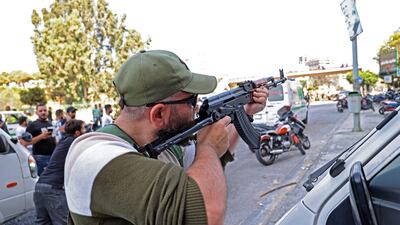
The clashes involved snipers, pistols, Kalashnikovs, hand grenades and rocket-propelled grenades.

By evening, calm had largely fallen.

Lebanon's Iran-backed Hezbollah and its ally, the Amal movement, accused the Christian Lebanese Forces (LF) party of carrying out the attacks on their supporters.

The violence signals growing unrest in Lebanon after powerful politicians spent the past year fighting judges investigating the Beirut blast probe amid a severe economic meltdown.

The LF denounced the accusation and demanded a thorough investigation into the incident, the state-run National News Agency reported.

The protesters "were subjected to an armed assault by groups from the Lebanese Forces party" stationed on nearby rooftops, Hezbollah and Amal said. Snipers were used to deliberately kill, they said.

Lebanese Forces' leader Samir Geagea denounced the incident and blamed it on the proliferation of weapons in the country.

“The main reason behind these events is the uncontrolled and widespread weapons that threaten citizens at all times and places,” he said. "I call on the president, the prime minister and the interior and defence ministries to launch thorough and accurate investigations to identify who's responsible for what happened today in the capital."

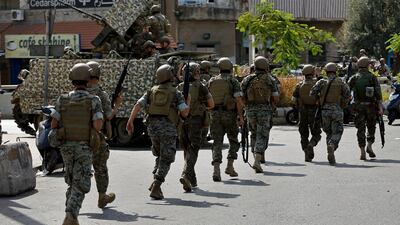
The Lebanese army was out in numbers in Tayouneh, Badaro, Cheyah and Ain al Remaneh districts in an attempt to restore calm and order to the streets. However, the clashes continued for hours until they stopped in the early evening.

Interior Minister Bassam Mawlawi confirmed that snipers were active at the site of the clashes.

"The first shots fired at the protesters were by snipers since they were aimed at the heads," he said. "This is a very dangerous sign. All the martyrs may be from one side and this might lead to possible reactions. I see it as an attack on the nation."

President Michel Aoun said the violence was a "painful and unacceptable scene, regardless of the causes and culprits," and said the events raised chilling memories of the deadly civil war from 1975-1990.

The conflict killed an estimated 150,000 and left thousands more missing. The militias involved then still play a major role in Lebanese public life today.

“It is not acceptable for weapons to return as a means of communication between Lebanese parties, because we have all agreed to turn over this dark page in our history," Mr Aoun told the nation in televised comments. He promised an investigation into the violence.

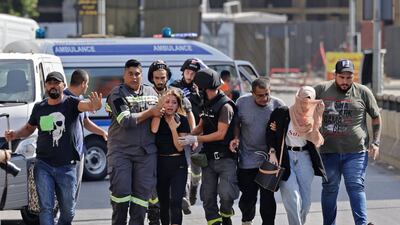
  • Lebanese medics help evacuate civilians during clashes in the area of Tayouneh. AFP
    Lebanese medics help evacuate civilians during clashes in the area of Tayouneh. AFP
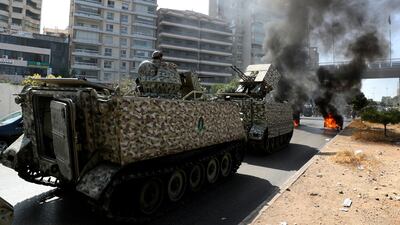
  • Lebanese soldiers stand guard as supporters of the Shiite Hezbollah and Amal groups burn rubbish containers to block a road during a protest in Beirut. AP
    Lebanese soldiers stand guard as supporters of the Shiite Hezbollah and Amal groups burn rubbish containers to block a road during a protest in Beirut. AP
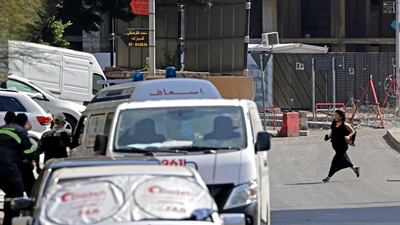
  • A woman crosses the road towards Lebanese medics during the clashes. AFP
    A woman crosses the road towards Lebanese medics during the clashes. AFP
  • A man runs to take cover as supporters of a Shiite group allied with Hezbollah help injured men. AP
    A man runs to take cover as supporters of a Shiite group allied with Hezbollah help injured men. AP
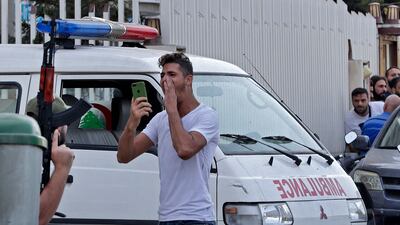
  • A man yells during the clashes. AFP
    A man yells during the clashes. AFP
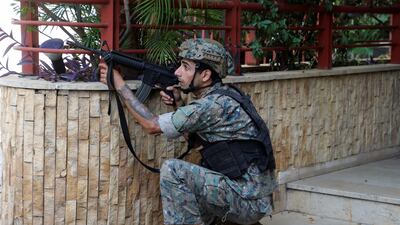
  • A fighter from the Amal movement takes aim during the armed clashes in Tayouneh. AFP
    A fighter from the Amal movement takes aim during the armed clashes in Tayouneh. AFP
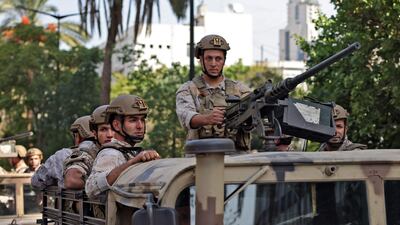
  • Lebanese soldiers attending the protest. AP
    Lebanese soldiers attending the protest. AP
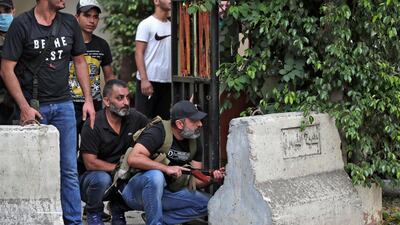
  • Fighters from the Amal movement. AFP
    Fighters from the Amal movement. AFP
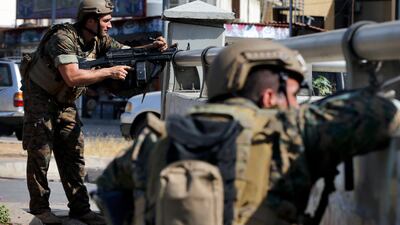
  • Lebanese security forces react to gunfire.
    Lebanese security forces react to gunfire.
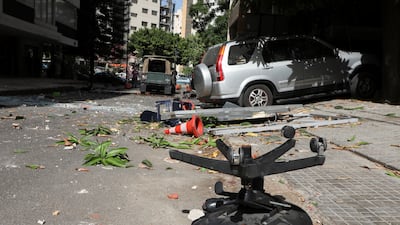
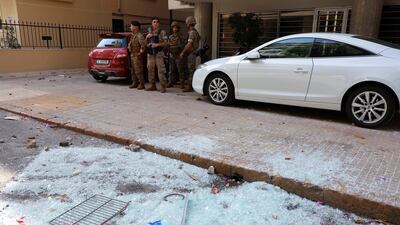
  • Shattered glass and debris near the protest against Judge Tarek Bitar, who is investigating last year's Beirut port explosion. Reuters
    Shattered glass and debris near the protest against Judge Tarek Bitar, who is investigating last year's Beirut port explosion. Reuters
  • Gunfire killed at least two people and wounded several others at the rally organised by the Shiite Hezbollah and Amal movements to demand the dismissal of the Beirut blast lead investigator. AFP
    Gunfire killed at least two people and wounded several others at the rally organised by the Shiite Hezbollah and Amal movements to demand the dismissal of the Beirut blast lead investigator. AFP
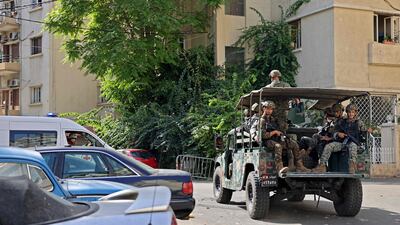
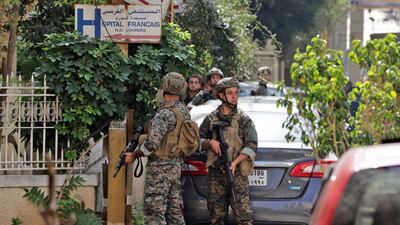
  • Lebanese soldiers. AFP
    Lebanese soldiers. AFP
  • A Lebanese soldier takes position. Reuters
    A Lebanese soldier takes position. Reuters
  • Shattered glass on floor as soldiers are deployed. Reuters
    Shattered glass on floor as soldiers are deployed. Reuters
  • Lebanese soldiers at the scene. AFP
    Lebanese soldiers at the scene. AFP
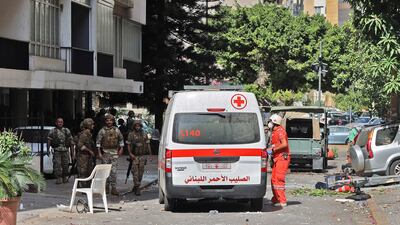
  • Lebanese soldiers and medics gather in the area. AFP
    Lebanese soldiers and medics gather in the area. AFP
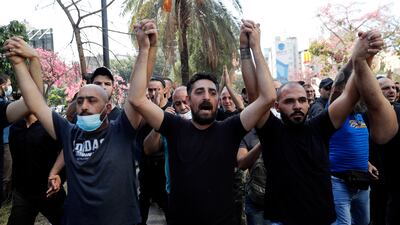
  • Demonstrators chant slogans against Judge Tarek Bitar, who is investigating last year's deadly Beirut port blast. AP
    Demonstrators chant slogans against Judge Tarek Bitar, who is investigating last year's deadly Beirut port blast. AP
  • The Lebanese Army stand guard near the Palais de Justice as supporters of the Shiite Hezbollah and Amal groups protest against Mr Bitar.
    The Lebanese Army stand guard near the Palais de Justice as supporters of the Shiite Hezbollah and Amal groups protest against Mr Bitar.
  • Protesters at the demonstration. Reuters
    Protesters at the demonstration. Reuters

In the past week, Hezbollah and its allies have intensified a campaign for the removal of Judge Tarek Bitar from the investigation into the Beirut blast after he issued a warrant for the arrest of Ali Hassan Khalil, a former Amal finance minister, who failed to appear after a summons this week.

Men mostly dressed in black burned images of Mr Bitar in the streets, while a pick-up truck blasted chants calling the judge an “American traitor” after he summoned several politicians who are aligned with the group for interrogation.

“Sure they may be corrupt, but I am sure they have nothing to do with the Beirut blast,” Ihab Hamie, 32, told The National as he waved a banner condemning Mr Bitar.

People ran for cover and students in nearby schools hid under their chairs as shots and ambulance sirens could be heard in a live broadcast by Lebanon's Al Jadeed TV.

A resident of the Ain el Remmene district, close to the area where the clashes happened, said he and his family were “very scared”.

After two hours of hearing the exchange of gunfire, Marc, 37, decided to leave his apartment with his parents and his sister.

He said most people had also left the area.

“We decided to leave because my sister had a panic attack,” he told The National. "We were very scared."

A court earlier on Thursday ruled that Mr Bitar could resume his investigation into the August explosion that killed more than 200 people.

The Tayouneh area is located on the border between Christian and Shiite districts of Beirut, and was a front line in the civil war.

It is on the way from the predominantly Shiite southern suburbs of Beirut to the Justice Palace, where the protest was due to take place.

Hezbollah has accused Mr Bitar of conducting a politicised probe focused only on politicians close to the group.


'The National' reporter caught in crossfire in Beirut

UK%20record%20temperature
%3Cp%3E38.7C%20(101.7F)%20set%20in%20Cambridge%20in%202019%3C%2Fp%3E%0A
The%C2%A0specs%20
%3Cp%3E%3Cstrong%3EEngine%3A%20%3C%2Fstrong%3E4.4-litre%2C%20twin-turbo%20V8%0D%3Cbr%3E%3Cstrong%3ETransmission%3A%20%3C%2Fstrong%3Eeight-speed%20auto%0D%3Cbr%3E%3Cstrong%3EPower%3A%20%3C%2Fstrong%3E617hp%0D%3Cbr%3E%3Cstrong%3ETorque%3A%20%3C%2Fstrong%3E750Nm%0D%3Cbr%3E%3Cstrong%3EPrice%3A%20%3C%2Fstrong%3Efrom%20Dh630%2C000%0D%3Cbr%3E%3Cstrong%3EOn%20sale%3A%20%3C%2Fstrong%3Enow%3C%2Fp%3E%0A
Email sent to Uber team from chief executive Dara Khosrowshahi

From: Dara

To: Team@

Date: March 25, 2019 at 11:45pm PT

Subj: Accelerating in the Middle East

Five years ago, Uber launched in the Middle East. It was the start of an incredible journey, with millions of riders and drivers finding new ways to move and work in a dynamic region that’s become so important to Uber. Now Pakistan is one of our fastest-growing markets in the world, women are driving with Uber across Saudi Arabia, and we chose Cairo to launch our first Uber Bus product late last year.

Today we are taking the next step in this journey—well, it’s more like a leap, and a big one: in a few minutes, we’ll announce that we’ve agreed to acquire Careem. Importantly, we intend to operate Careem independently, under the leadership of co-founder and current CEO Mudassir Sheikha. I’ve gotten to know both co-founders, Mudassir and Magnus Olsson, and what they have built is truly extraordinary. They are first-class entrepreneurs who share our platform vision and, like us, have launched a wide range of products—from digital payments to food delivery—to serve consumers.

I expect many of you will ask how we arrived at this structure, meaning allowing Careem to maintain an independent brand and operate separately. After careful consideration, we decided that this framework has the advantage of letting us build new products and try new ideas across not one, but two, strong brands, with strong operators within each. Over time, by integrating parts of our networks, we can operate more efficiently, achieve even lower wait times, expand new products like high-capacity vehicles and payments, and quicken the already remarkable pace of innovation in the region.

This acquisition is subject to regulatory approval in various countries, which we don’t expect before Q1 2020. Until then, nothing changes. And since both companies will continue to largely operate separately after the acquisition, very little will change in either teams’ day-to-day operations post-close. Today’s news is a testament to the incredible business our team has worked so hard to build.

It’s a great day for the Middle East, for the region’s thriving tech sector, for Careem, and for Uber.

Uber on,

Dara

Milestones on the road to union

1970

October 26: Bahrain withdraws from a proposal to create a federation of nine with the seven Trucial States and Qatar. 

December: Ahmed Al Suwaidi visits New York to discuss potential UN membership.

1971

March 1:  Alex Douglas Hume, Conservative foreign secretary confirms that Britain will leave the Gulf and “strongly supports” the creation of a Union of Arab Emirates.

July 12: Historic meeting at which Sheikh Zayed and Sheikh Rashid make a binding agreement to create what will become the UAE.

July 18: It is announced that the UAE will be formed from six emirates, with a proposed constitution signed. RAK is not yet part of the agreement.

August 6:  The fifth anniversary of Sheikh Zayed becoming Ruler of Abu Dhabi, with official celebrations deferred until later in the year.

August 15: Bahrain becomes independent.

September 3: Qatar becomes independent.

November 23-25: Meeting with Sheikh Zayed and Sheikh Rashid and senior British officials to fix December 2 as date of creation of the UAE.

November 29:  At 5.30pm Iranian forces seize the Greater and Lesser Tunbs by force.

November 30: Despite  a power sharing agreement, Tehran takes full control of Abu Musa. 

November 31: UK officials visit all six participating Emirates to formally end the Trucial States treaties

December 2: 11am, Dubai. New Supreme Council formally elects Sheikh Zayed as President. Treaty of Friendship signed with the UK. 11.30am. Flag raising ceremony at Union House and Al Manhal Palace in Abu Dhabi witnessed by Sheikh Khalifa, then Crown Prince of Abu Dhabi.

December 6: Arab League formally admits the UAE. The first British Ambassador presents his credentials to Sheikh Zayed.

December 9: UAE joins the United Nations.

Frankenstein in Baghdad
Ahmed Saadawi
​​​​​​​Penguin Press

The specs

Common to all models unless otherwise stated

Engine: 4-cylinder 2-litre T-GDi

0-100kph: 5.3 seconds (Elantra); 5.5 seconds (Kona); 6.1 seconds (Veloster)

Power: 276hp

Torque: 392Nm

Transmission: 6-Speed Manual/ 8-Speed Dual Clutch FWD

Price: TBC

Conflict, drought, famine

Estimates of the number of deaths caused by the famine range from 400,000 to 1 million, according to a document prepared for the UK House of Lords in 2024.
It has been claimed that the policies of the Ethiopian government, which took control after deposing Emperor Haile Selassie in a military-led revolution in 1974, contributed to the scale of the famine.
Dr Miriam Bradley, senior lecturer in humanitarian studies at the University of Manchester, has argued that, by the early 1980s, “several government policies combined to cause, rather than prevent, a famine which lasted from 1983 to 1985. Mengistu’s government imposed Stalinist-model agricultural policies involving forced collectivisation and villagisation [relocation of communities into planned villages].
The West became aware of the catastrophe through a series of BBC News reports by journalist Michael Buerk in October 1984 describing a “biblical famine” and containing graphic images of thousands of people, including children, facing starvation.

Band Aid

Bob Geldof, singer with the Irish rock group The Boomtown Rats, formed Band Aid in response to the horrific images shown in the news broadcasts.
With Midge Ure of the band Ultravox, he wrote the hit charity single Do They Know it’s Christmas in December 1984, featuring a string of high-profile musicians.
Following the single’s success, the idea to stage a rock concert evolved.
Live Aid was a series of simultaneous concerts that took place at Wembley Stadium in London, John F Kennedy Stadium in Philadelphia, the US, and at various other venues across the world.
The combined event was broadcast to an estimated worldwide audience of 1.5 billion.

The specs
  • Engine: 3.9-litre twin-turbo V8
  • Power: 640hp
  • Torque: 760nm
  • On sale: 2026
  • Price: Not announced yet
Friday’s fixture

6.15pm: Al Wahda v Hatta

6.15pm: Al Dhafra v Ajman

9pm: Al Wasl v Baniyas

9pm: Fujairah v Sharjah

.

In-demand jobs and monthly salaries
  • Technology expert in robotics and automation: Dh20,000 to Dh40,000 
  • Energy engineer: Dh25,000 to Dh30,000 
  • Production engineer: Dh30,000 to Dh40,000 
  • Data-driven supply chain management professional: Dh30,000 to Dh50,000 
  • HR leader: Dh40,000 to Dh60,000 
  • Engineering leader: Dh30,000 to Dh55,000 
  • Project manager: Dh55,000 to Dh65,000 
  • Senior reservoir engineer: Dh40,000 to Dh55,000 
  • Senior drilling engineer: Dh38,000 to Dh46,000 
  • Senior process engineer: Dh28,000 to Dh38,000 
  • Senior maintenance engineer: Dh22,000 to Dh34,000 
  • Field engineer: Dh6,500 to Dh7,500
  • Field supervisor: Dh9,000 to Dh12,000
  • Field operator: Dh5,000 to Dh7,000
Dubai World Cup factbox

Most wins by a trainer: Godolphin’s Saeed bin Suroor(9)

Most wins by a jockey: Jerry Bailey(4)

Most wins by an owner: Godolphin(9)

Most wins by a horse: Godolphin’s Thunder Snow(2)

THREE
%3Cp%3EDirector%3A%20Nayla%20Al%20Khaja%3C%2Fp%3E%0A%3Cp%3EStarring%3A%20Jefferson%20Hall%2C%20Faten%20Ahmed%2C%20Noura%20Alabed%2C%20Saud%20Alzarooni%3C%2Fp%3E%0A%3Cp%3ERating%3A%203.5%2F5%3C%2Fp%3E%0A
Updated: October 15, 2021, 6:32 AM