


Cyclone Shaheen hit south-eastern Iran's Chabahar port in the impoverished Sistan and Baluchestan province overnight.
Schools in the main cities of Chabahar, Konarak and Dashtiari were closed before the storm hit.
Cyclone Shaheen was formed from the remnants of Cyclone Gulab, which hit on September 26. the local authorities expected it would move west-northwest, skirting the Makran coastal region during the next 24 hours.
After Gulab, the region's fishermen were warned against going to sea until told otherwise. Officials also ordered residents living in high-risk areas to leave their homes.
Cyclone Shaheen made landfall close to the port of Pasabander Dashtiari, where it sank two fishing boats. The high winds also damaged electricity poles, leaving about 20 villages without power.
Fifty-two people in Sistan and Baluchestan were referred to medical centres. Five fishermen were also missing, according Iranian Emergency Organisation spokesman Mojtaba Khaledi.
He told Iranian news agency Isna that none of the injured were in a serious condition and that all were discharged after receiving treatment.
-
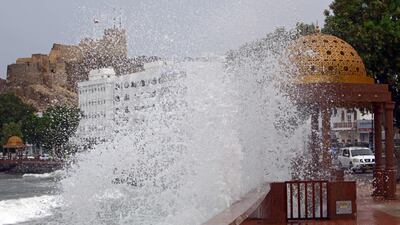
High waves break on a seaside promenade in Muscat as Cyclone Shaheen hits Oman. Rescue teams had to help dozens of people leave their homes in some coastal areas. All photos: AFP -

Women take pictures of high waves breaking on the seaside promenade in the Omani capital. -
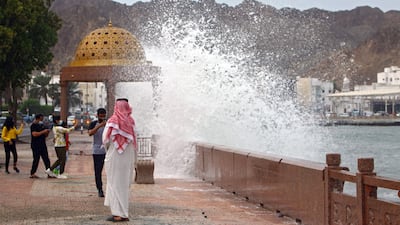
High waves break on the seaside promenade in Muscat. Oman declared a two-day national holiday on Sunday and Monday, urging people to stay indoors. -
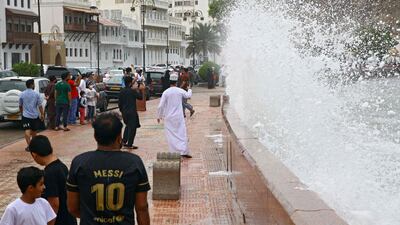
High waves break in Muscat. Some waves to hit the Omani coast were 12 metres high. -
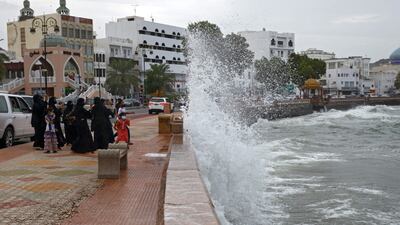
Some of the cyclone's winds reached 120 kilometres an hour. -
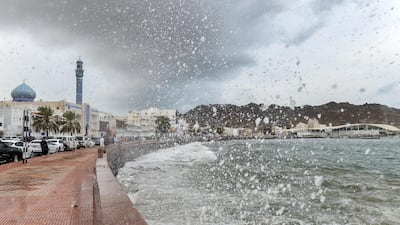
High waves break on the Mutrah seaside promenade in Muscat. -

High waves break on the Mutrah promenade in the Omani capital. -
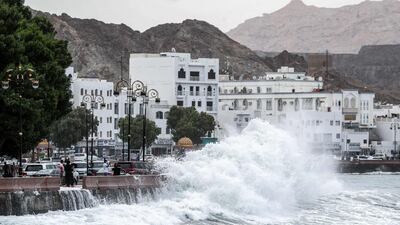
The popular seafront area of Mutrah is one of the worst-hit parts of Oman so far. -
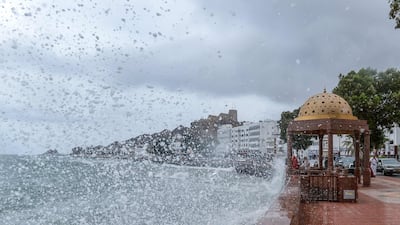
High waves break on the Mutrah seaside promenade in Muscat.


The Iranian Red Crescent Society had mobilised its teams to the cities of Chabahar, Dashtiari, Konarak, Qasr-e Qand, Nikshahr, Sarbaz, Fanuj and Pelan.
Nearly 580 people have already left villages in the region, which are at high risk from tropical storms, a representative of the Sistan and Baluchestan Red Crescent told local news outlets.
He said that emergency accommodation was being provided in Konarak city.
Iranian officials are expecting heavy rainfall to continue in the Sistan and Baluchestan region for the next few days and also warned residents of neighbouring Hormozgan province to expect similar amounts of rainfall.

