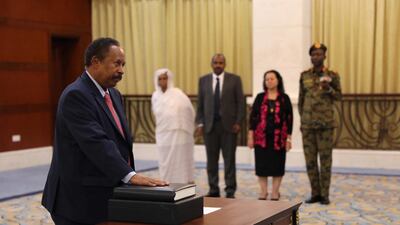
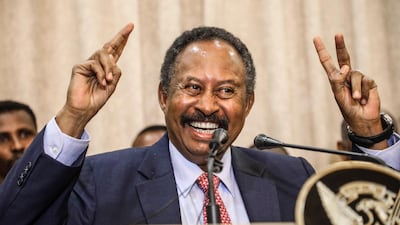
Sudan's Prime Minister Prime Minister Abdalla Hamdok. Photo: AFP

Sudan's political transition dented by fallout from failed coup


Hamza Hendawi
  • English
  • Arabic

Not long ago, Sudan’s pro-democracy politicians and army generals had nothing but mutual praise for their partnership in the post-Omar Al Bashir transition to democratic rule.

Even as tensions grew and distrust deepened with time, the two sides continued to tout their alliance as an inspiring example for the rest of Africa.

Then came last week’s failed military coup.

  • Sudanese protesters run for cover from tear gas canisters fired by police outside the military headquarters in the capital Khartoum on April 6, 2019. AFP
    Sudanese protesters run for cover from tear gas canisters fired by police outside the military headquarters in the capital Khartoum on April 6, 2019. AFP
  • Sudanese protesters rally in front of the military headquarters in the capital Khartoum on April 8, 2019. AFP
    Sudanese protesters rally in front of the military headquarters in the capital Khartoum on April 8, 2019. AFP
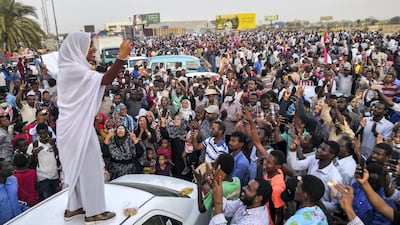
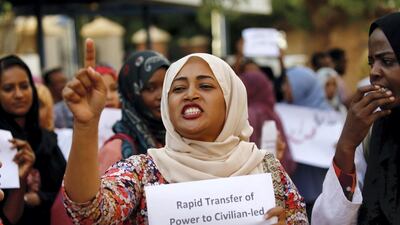
  • Alaa Salah, a Sudanese woman propelled to internet fame earlier this week after clips went viral of her leading powerful protest chants against President Omar Al Bashir, addresses protesters during a demonstration in front of the military headquarters in the capital Khartoum on April 10, 2019. AFP
    Alaa Salah, a Sudanese woman propelled to internet fame earlier this week after clips went viral of her leading powerful protest chants against President Omar Al Bashir, addresses protesters during a demonstration in front of the military headquarters in the capital Khartoum on April 10, 2019. AFP
  • Sudanese judges, dressed in their robes, gather for a "million-strong" march outside the army headquarters in the capital Khartoum on April 25, 2019. AFP
    Sudanese judges, dressed in their robes, gather for a "million-strong" march outside the army headquarters in the capital Khartoum on April 25, 2019. AFP
  • A Sudanese anti-regime protester kisses a soldier on the head during protests on April 11, 2019 in the area around the army headquarters in Sudan's capital Khartoum. AFP
    A Sudanese anti-regime protester kisses a soldier on the head during protests on April 11, 2019 in the area around the army headquarters in Sudan's capital Khartoum. AFP
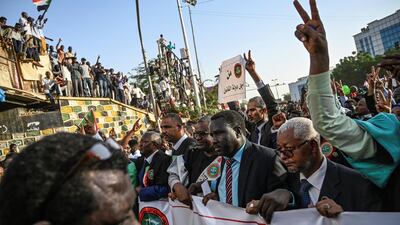
  • Sudanese demonstrators march with national flags as they gather during a rally demanding a civilian body to lead the transition to democracy. AFP
    Sudanese demonstrators march with national flags as they gather during a rally demanding a civilian body to lead the transition to democracy. AFP
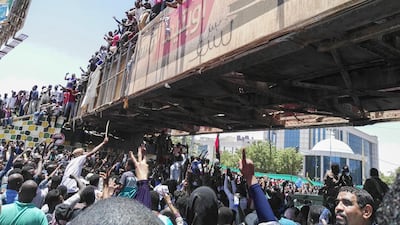
  • Protesters massed outside the army complex in central Khartoum on April 6, initially to demand the overthrow of longtime leader Omar Al Bashir. AFP
    Protesters massed outside the army complex in central Khartoum on April 6, initially to demand the overthrow of longtime leader Omar Al Bashir. AFP
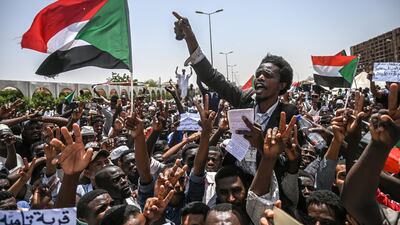
  • Sudanese protesters gather outside the army headquarters in Khartoum on May 6, 2019. AFP
    Sudanese protesters gather outside the army headquarters in Khartoum on May 6, 2019. AFP
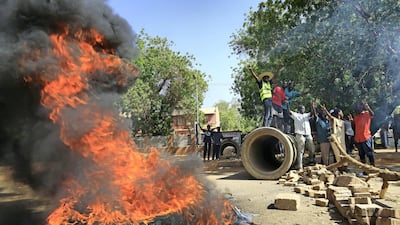
  • Sudanese protesters burn tyres as they block Nile Street for the second consecutive day during continuing protests in Sudan's capital Khartoum on May 13, 2019. AFP
    Sudanese protesters burn tyres as they block Nile Street for the second consecutive day during continuing protests in Sudan's capital Khartoum on May 13, 2019. AFP
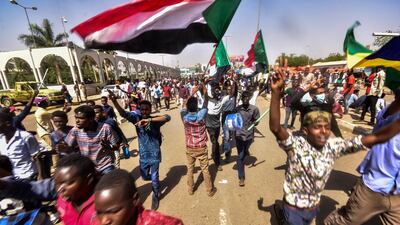
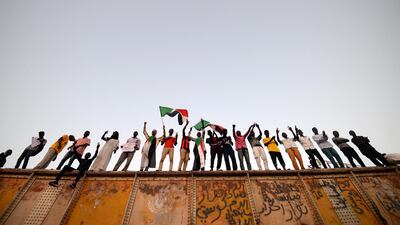
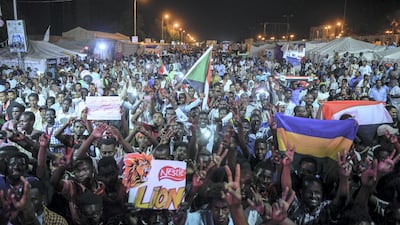
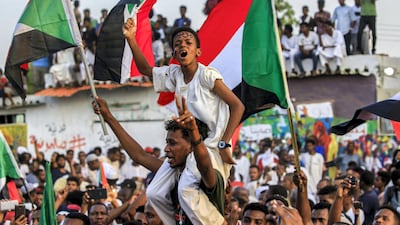
  • Sudanese protesters wave flags and flash victory signs as they gather for a sit-in outside the military headquarters in Khartoum on May 19, 2019. AFP
    Sudanese protesters wave flags and flash victory signs as they gather for a sit-in outside the military headquarters in Khartoum on May 19, 2019. AFP
  • A Sudanese health worker carries a placard as scores of medics hold a rally in front of a hospital in the capital Khartoum on May 23, 2019. AFP
    A Sudanese health worker carries a placard as scores of medics hold a rally in front of a hospital in the capital Khartoum on May 23, 2019. AFP
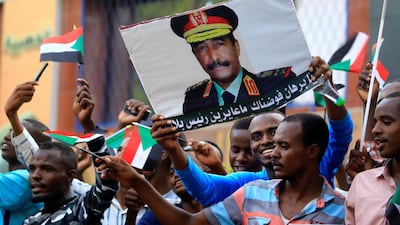
  • Sudanese supporters of the ruling Transitional Military Council (TMC) hold up a sign showing a portrait of its head General Abdel Fattah Al Burhan with a caption below reading in Arabic "we have delegated you Burhan, we want no president but you", during a rally in the centre of the capital Khartoum on May 31, 2019. AFP
    Sudanese supporters of the ruling Transitional Military Council (TMC) hold up a sign showing a portrait of its head General Abdel Fattah Al Burhan with a caption below reading in Arabic "we have delegated you Burhan, we want no president but you", during a rally in the centre of the capital Khartoum on May 31, 2019. AFP
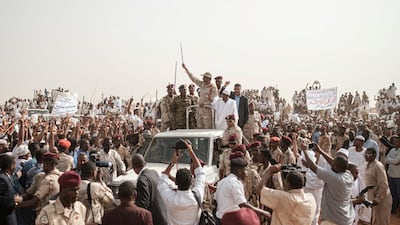
  • Mohamed Hamdan Dagalo, known as Himediti, deputy head of Sudan's ruling Transitional Military Council and commander of the Rapid Support Forces paramilitaries, waves a baton to supporters on a vehicle as he arrives for a rally in the village of Abraq, about 60 kilometres northwest of Khartoum, on June 22, 2019. AFP
    Mohamed Hamdan Dagalo, known as Himediti, deputy head of Sudan's ruling Transitional Military Council and commander of the Rapid Support Forces paramilitaries, waves a baton to supporters on a vehicle as he arrives for a rally in the village of Abraq, about 60 kilometres northwest of Khartoum, on June 22, 2019. AFP
  • Sudanese protestors celebrate in the streets of Khartoum after ruling generals and protest leaders announced they have reached an agreement on the disputed issue of a new governing body on July 5, 2019. AFP
    Sudanese protestors celebrate in the streets of Khartoum after ruling generals and protest leaders announced they have reached an agreement on the disputed issue of a new governing body on July 5, 2019. AFP
  • Thousands went to the streets to welcome the agreement on Saturday. AFP
    Thousands went to the streets to welcome the agreement on Saturday. AFP
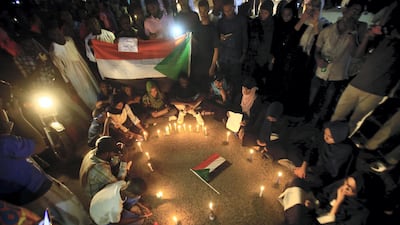
  • Sudanese protesters take part in a vigil in the capital Khartoum to mourn dozens of demonstrators killed last month in a raid on a Khartoum sit-in. AFP
    Sudanese protesters take part in a vigil in the capital Khartoum to mourn dozens of demonstrators killed last month in a raid on a Khartoum sit-in. AFP
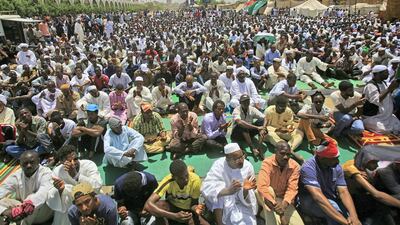
  • Sudanese protesters gather during Friday noon prayers outside the army headquarters in Khartoum on May 3, 2019, as they continue to protest demanding that the ruling military council hand power to a civilian administration. AFP
    Sudanese protesters gather during Friday noon prayers outside the army headquarters in Khartoum on May 3, 2019, as they continue to protest demanding that the ruling military council hand power to a civilian administration. AFP
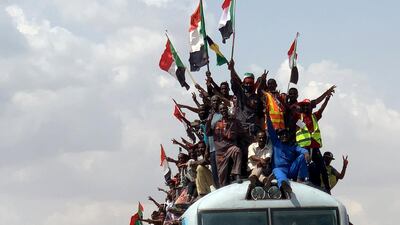
  • Sudanese civilians from other provinces ride on the train to join in the celebrations of the signing of Sudan's power-sharing deal. Reuters
    Sudanese civilians from other provinces ride on the train to join in the celebrations of the signing of Sudan's power-sharing deal. Reuters
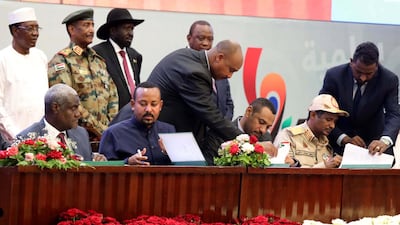
  • Sudan's Forces of Freedom and Change coalition leader Ahmad Rabiah (3-R) and Sudan's General and Vice President of Sudanese Transitional Military Council, Mohamed Hamdan Dagalo (2-R) sign power-sharing agreement,. EPA
    Sudan's Forces of Freedom and Change coalition leader Ahmad Rabiah (3-R) and Sudan's General and Vice President of Sudanese Transitional Military Council, Mohamed Hamdan Dagalo (2-R) sign power-sharing agreement,. EPA
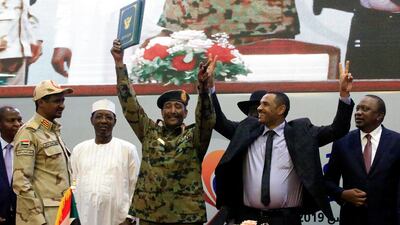
  • Sudan's Head of Transitional Military Council, Lieutenant General Abdel Fattah Al-Burhan, and Sudan's opposition alliance coalition's leader Ahmad Rabiah, celebrate the signing of the power-sharing deal, that paves the way for a transitional government, and eventual elections. Reuters
    Sudan's Head of Transitional Military Council, Lieutenant General Abdel Fattah Al-Burhan, and Sudan's opposition alliance coalition's leader Ahmad Rabiah, celebrate the signing of the power-sharing deal, that paves the way for a transitional government, and eventual elections. Reuters
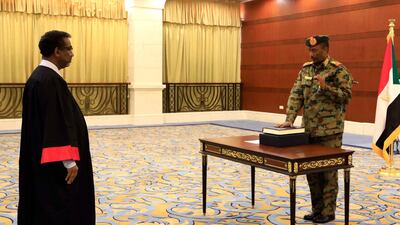
  • epa07783624 Leader of Sudan's transitional council, Lieutenant General Abdel Fattah Abdelrahman Burhan (R) is sworn in as the Head of the newly formed transitional Council at the presidential palace in Khartoum, Sudan, 21 August 2019. The Sudanese opposition and military council signed on 17 August a power sharing agreement. The agreement sets up a sovereign council made of five generals and six civilians, to rule the country until general elections. Protests had erupted in Sudan at the end of 2018, culminating in a long sit-in outside the army headquarters which ended with more than one hundred people being killed and others injured. Sudanese President Omar Hassan al-Bashir stepped down on 11 April 2019. EPA/STRINGER
    epa07783624 Leader of Sudan's transitional council, Lieutenant General Abdel Fattah Abdelrahman Burhan (R) is sworn in as the Head of the newly formed transitional Council at the presidential palace in Khartoum, Sudan, 21 August 2019. The Sudanese opposition and military council signed on 17 August a power sharing agreement. The agreement sets up a sovereign council made of five generals and six civilians, to rule the country until general elections. Protests had erupted in Sudan at the end of 2018, culminating in a long sit-in outside the army headquarters which ended with more than one hundred people being killed and others injured. Sudanese President Omar Hassan al-Bashir stepped down on 11 April 2019. EPA/STRINGER
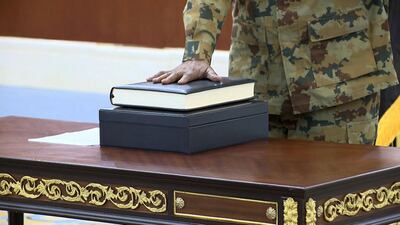
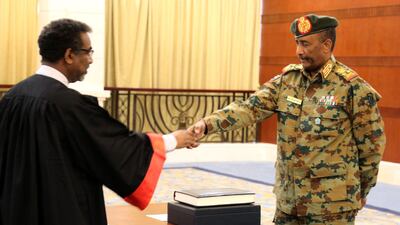
  • A pictured released by Sudan's Presidential Palace shows General Abdel Fattah al-Burhan, the head of Sudan's ruling military council, during a swearing in ceremony in Khartoum on August 21, 2019. Burhan was sworn today as chairman of Sudan's new sovereign council that will steer the country through a three-year transition to civilian rule. "General Abdel Fattah al-Burhan Abdel Rahman was sworn in as president of the sovereign council," the official SUNA news agency reported. / AFP / SUDAN PRESIDENTIAL PALACE / - / RESTRICTED TO EDITORIAL USE - MANDATORY CREDIT "AFP PHOTO / SUDAN PRESIDENTAIL PALACE" - NO MARKETING NO ADVERTISING CAMPAIGNS - DISTRIBUTED AS A SERVICE TO CLIENTS
    A pictured released by Sudan's Presidential Palace shows General Abdel Fattah al-Burhan, the head of Sudan's ruling military council, during a swearing in ceremony in Khartoum on August 21, 2019. Burhan was sworn today as chairman of Sudan's new sovereign council that will steer the country through a three-year transition to civilian rule. "General Abdel Fattah al-Burhan Abdel Rahman was sworn in as president of the sovereign council," the official SUNA news agency reported. / AFP / SUDAN PRESIDENTIAL PALACE / - / RESTRICTED TO EDITORIAL USE - MANDATORY CREDIT "AFP PHOTO / SUDAN PRESIDENTAIL PALACE" - NO MARKETING NO ADVERTISING CAMPAIGNS - DISTRIBUTED AS A SERVICE TO CLIENTS
  • A picture released by Sudan's Presidential Palace shows General Abdel Fattah al-Burhan, the head of Sudan's ruling military council, during a swearing in ceremony in Khartoum on August 21, 2019. Burhan was sworn today as chairman of Sudan's new sovereign council that will steer the country through a three-year transition to civilian rule. "General Abdel Fattah al-Burhan Abdel Rahman was sworn in as president of the sovereign council," the official SUNA news agency reported. / AFP / SUDAN PRESIDENTIAL PALACE / - / RESTRICTED TO EDITORIAL USE - MANDATORY CREDIT "AFP PHOTO / SUDAN PRESIDENTAIL PALACE" - NO MARKETING NO ADVERTISING CAMPAIGNS - DISTRIBUTED AS A SERVICE TO CLIENTS
    A picture released by Sudan's Presidential Palace shows General Abdel Fattah al-Burhan, the head of Sudan's ruling military council, during a swearing in ceremony in Khartoum on August 21, 2019. Burhan was sworn today as chairman of Sudan's new sovereign council that will steer the country through a three-year transition to civilian rule. "General Abdel Fattah al-Burhan Abdel Rahman was sworn in as president of the sovereign council," the official SUNA news agency reported. / AFP / SUDAN PRESIDENTIAL PALACE / - / RESTRICTED TO EDITORIAL USE - MANDATORY CREDIT "AFP PHOTO / SUDAN PRESIDENTAIL PALACE" - NO MARKETING NO ADVERTISING CAMPAIGNS - DISTRIBUTED AS A SERVICE TO CLIENTS
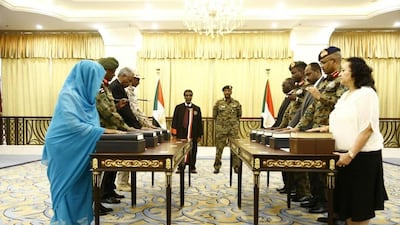
  • A picture released by Sudan's Presidential Palace shows General Abdel Fattah al-Burhan (C-R), the head of Sudan's ruling military council, standing during a swearing in of the new sovereign council, in Khartoum on August 21, 2019. Sudan took further steps in its transition towards civilian rule today with the swearing in of a new sovereign council, to be followed by the appointment of a prime minister. The body replaces the Transitional Military Council (TMC) that took charge after months of deadly street protests brought down longtime ruler Omar al-Bashir in April. Burhan, who already headed the TMC, was sworn in as the chairman of the new sovereign council in the morning. / AFP / SUDAN PRESIDENTIAL PALACE / - / RESTRICTED TO EDITORIAL USE - MANDATORY CREDIT "AFP PHOTO / SUDAN PRESIDENTAIL PALACE" - NO MARKETING NO ADVERTISING CAMPAIGNS - DISTRIBUTED AS A SERVICE TO CLIENTS
    A picture released by Sudan's Presidential Palace shows General Abdel Fattah al-Burhan (C-R), the head of Sudan's ruling military council, standing during a swearing in of the new sovereign council, in Khartoum on August 21, 2019. Sudan took further steps in its transition towards civilian rule today with the swearing in of a new sovereign council, to be followed by the appointment of a prime minister. The body replaces the Transitional Military Council (TMC) that took charge after months of deadly street protests brought down longtime ruler Omar al-Bashir in April. Burhan, who already headed the TMC, was sworn in as the chairman of the new sovereign council in the morning. / AFP / SUDAN PRESIDENTIAL PALACE / - / RESTRICTED TO EDITORIAL USE - MANDATORY CREDIT "AFP PHOTO / SUDAN PRESIDENTAIL PALACE" - NO MARKETING NO ADVERTISING CAMPAIGNS - DISTRIBUTED AS A SERVICE TO CLIENTS
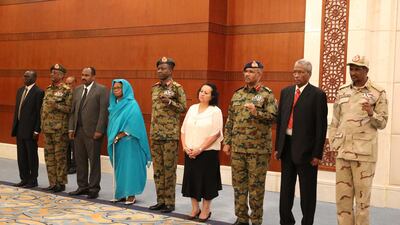
  • epa07784051 Members of Sudan's newly formed transitional Council (R-L) General Mohamed Hamdan Dagalo, Hassan Sheikh Idris, Genereal Ibrahim Jaber, Raja Nicola Issa Abdul-Masseh, General Shams al-Din Kabashi, Aisha Moussa, Mohamed Alfaki, General Yasser al-Atta and Sadeek Tawer look on during their sweaing-in ceremony at the presidential palace in Khartoum, Sudan, 21 August 2019. The Sudanese opposition and military council signed on 17 August a power sharing agreement. The agreement sets up a sovereign council made of five generals and six civilians, to rule the country until general elections. Protests had erupted in Sudan at the end of 2018, culminating in a long sit-in outside the army headquarters which ended with more than one hundred people being killed and others injured. Sudanese President Omar Hassan al-Bashir stepped down on 11 April 2019. EPA/MORWAN ALI
    epa07784051 Members of Sudan's newly formed transitional Council (R-L) General Mohamed Hamdan Dagalo, Hassan Sheikh Idris, Genereal Ibrahim Jaber, Raja Nicola Issa Abdul-Masseh, General Shams al-Din Kabashi, Aisha Moussa, Mohamed Alfaki, General Yasser al-Atta and Sadeek Tawer look on during their sweaing-in ceremony at the presidential palace in Khartoum, Sudan, 21 August 2019. The Sudanese opposition and military council signed on 17 August a power sharing agreement. The agreement sets up a sovereign council made of five generals and six civilians, to rule the country until general elections. Protests had erupted in Sudan at the end of 2018, culminating in a long sit-in outside the army headquarters which ended with more than one hundred people being killed and others injured. Sudanese President Omar Hassan al-Bashir stepped down on 11 April 2019. EPA/MORWAN ALI
  • Demonstrators march with banners and the old (L) and current (R) flags of Sudan outside a courthouse complex in the capital's twin city of Omdurman on August 21, 2019 during the trial of 40 members of Sudan's now-dissolved National Intelligence and Security Service facing charges over the death in custody of Ahmed al-Kheir, a teacher from the eastern town of Khashma el-Girba, in the early days of the wave of nationwide protests that eventually brought longtime ruler Omar al-Bashir. / AFP / Ahmed Mustafa
    Demonstrators march with banners and the old (L) and current (R) flags of Sudan outside a courthouse complex in the capital's twin city of Omdurman on August 21, 2019 during the trial of 40 members of Sudan's now-dissolved National Intelligence and Security Service facing charges over the death in custody of Ahmed al-Kheir, a teacher from the eastern town of Khashma el-Girba, in the early days of the wave of nationwide protests that eventually brought longtime ruler Omar al-Bashir. / AFP / Ahmed Mustafa
  • epa07784904 Sudan's new Prime Minister Abdalla Hamdok (L) swears in during a ceremony at the presidential palace in Khartoum, Sudan, 21 August 2019. The Sudanese opposition and military council signed on 17 August a power sharing agreement. The agreement sets up a sovereign council made of five generals and six civilians, to rule the country until general elections. Protests had erupted in Sudan in December 2018, culminating in a long sit-in outside the army headquarters which ended with more than one hundred people being killed and others injured. Sudanese President Omar Hassan al-Bashir stepped down on 11 April 2019. EPA/MARWAN ALI
    epa07784904 Sudan's new Prime Minister Abdalla Hamdok (L) swears in during a ceremony at the presidential palace in Khartoum, Sudan, 21 August 2019. The Sudanese opposition and military council signed on 17 August a power sharing agreement. The agreement sets up a sovereign council made of five generals and six civilians, to rule the country until general elections. Protests had erupted in Sudan in December 2018, culminating in a long sit-in outside the army headquarters which ended with more than one hundred people being killed and others injured. Sudanese President Omar Hassan al-Bashir stepped down on 11 April 2019. EPA/MARWAN ALI
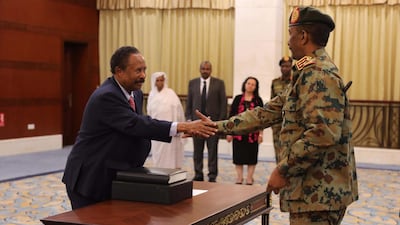
  • epa07784903 Sudan's new Prime Minister Abdalla Hamdok (L) shakes hands with Abdel Fattah Abdelrahman Burhan (R) after being sworn in during a ceremony at the presidential palace in Khartoum, Sudan, 21 August 2019. The Sudanese opposition and military council signed on 17 August a power sharing agreement. The agreement sets up a sovereign council made of five generals and six civilians, to rule the country until general elections. Protests had erupted in Sudan in December 2018, culminating in a long sit-in outside the army headquarters which ended with more than one hundred people being killed and others injured. Sudanese President Omar Hassan al-Bashir stepped down on 11 April 2019. EPA/MARWAN ALI
    epa07784903 Sudan's new Prime Minister Abdalla Hamdok (L) shakes hands with Abdel Fattah Abdelrahman Burhan (R) after being sworn in during a ceremony at the presidential palace in Khartoum, Sudan, 21 August 2019. The Sudanese opposition and military council signed on 17 August a power sharing agreement. The agreement sets up a sovereign council made of five generals and six civilians, to rule the country until general elections. Protests had erupted in Sudan in December 2018, culminating in a long sit-in outside the army headquarters which ended with more than one hundred people being killed and others injured. Sudanese President Omar Hassan al-Bashir stepped down on 11 April 2019. EPA/MARWAN ALI
  • Sudan's new Prime Minister Abdalla Hamdok speaks duringa press conference in Khartoum, Sudan, Wednesday, Aug. 21, 2019. (AP Photo)
    Sudan's new Prime Minister Abdalla Hamdok speaks duringa press conference in Khartoum, Sudan, Wednesday, Aug. 21, 2019. (AP Photo)

Bitter recriminations followed the attempted takeover on September 21. The facade of unity and common purpose marketed by both sides has perhaps been irreparably damaged, throwing the future of Sudan’s transition into deep uncertainty, Rasha Awad and other analysts said.

Political leaders and army generals have always been at loggerheads, taking their differences public for the first time since signing a power-sharing deal two years ago.

They have blamed each other for the country’s many woes while claiming the higher moral and patriotic ground. This acrimony has intensified speculations on a possible coup by army officers taking advantage of the popular discontent fuelled by an acute economic crisis.

Ms Awad, who is also the editor-in-chief at online newspaper Al Taghyier, believes the military is likely to again try to seize power.

“Last week’s attempted coup was not the real coup,” she said. “The real coup is the one being plotted by the military component of the transitional administration led by Gen Abdel-Fattah Al Burhan and his regional backers.”

The politicians have also threatened to bring the “masses” out on the streets to “protect the revolution” if the military does not show its commitment to the transition to democracy and respect for the politicians and activists who masterminded months of street protests against Al Bashir’s rule.

However, the power of politicians to mobilise has significantly diminished, with most Sudanese now preoccupied with their daily struggle to make ends meet.

Divisions between the pro-democracy politicians and activists have also devalued their standing among the masses.

Gen Al Burhan. Photo: Sudanese Armed Forces Media Office

Of the 65 years of independent Sudan, the generals have been at the helm for more than 50. The democratically elected governments have often failed at resolving challenges, such as ending civil wars or overhauling the economy.

But amid a dramatic change in Sudan's socio-political landscape, a military coup may no longer secure power for the plotters, analysts and activists contend.

Sudanese activists have used the power of social media to organise and mobilise. And the freedoms that came with the ousting of Al Bashir, they say, are difficult for any government to roll back.

“The citizens may be discontented, but a coup will not content them either,” Prime Minister Abdalla Hamdok said in response to charges of negligence and power abuse levelled against him and his government ministers by Sudan’s head of state, Gen Al Burhan, and his deputy, Gen Mohamed Hamdan Dagalo.

While the generals may not relish the prospect of handing over power to civilians, they can't attempt a power-grab given the backlash it would trigger, said prominent Sudan expert Hany Raslan at Egypt’s Al Ahram Centre for Political and Strategic Studies.

“The generals don’t want to leave power but they also cannot just keep the power,” Mr Raslan said. “They are more likely to try and change existing arrangements with the civilian politicians.”

His view is echoed by Sudanese activists such as Sulaima Ishaq, a lecturer at Al Ahfad university who took part in the “December Revolution” and is now a prominent civil society figure.

“Everyone realises that a coup will send the country back to being a pariah state and more years of crippling isolation,” she said.

General Mohamed Hamdan Dagalo, head of the Rapid Support Forces and deputy head of the Sovereign Council. Reuters

Gen Dagalo said on Saturday night: “Let us be clear: we have pledged before God from day one to shepherd the Sudanese people to democracy. Military regimes have been useless.”

But his comments and similar words by Gen Al Burhan have not been taken at face value by some, who continue to question the intentions of the military.

“There is no substitute now for the revolution to correct its course," Ms Awad said. "The civilians in the administration need to regroup and reconnect with the people. The Sudanese are totally opposed to coups and that’s something that should be built on.”

Her view that the military remains set on seizing power is not without evidence.

Gen Al Burhan, the head of the Sovereign Council, has been acting in an increasingly presidential manner of late, going it alone on major foreign policy decisions and speaking of the military as the land’s ultimate source of power.

He went on record last week reminding the politicians of the vast power the military wields and emphasising that the generals alone were in charge until elections were held.

Under the power-sharing deal signed in August 2019, Gen Al Burhan would be the country’s de facto president for 21 months before a civilian takes over from him for the remaining 18 months of the transitional period leading to elections.

However, a peace deal reached with rebel groups in October 2020 prompted an amendment of the power-sharing deal, adding 14 months to the transitional period.

The military and the pro-democracy movement, known as the Forces of Freedom and Change, differ over the exact date of the handover, but have asked the justice ministry to arbitrate.

“The problems are made worse with every passing day," Mr Raslan said. "The divisions in the ranks of the Forces of Freedom and Change and the splintering of the traditional political parties are not making things any easier. The transition simply cannot continue like this.”


How to help

Send “thenational” to the following numbers or call the hotline on: 0502955999
2289 – Dh10
2252 – Dh 50
6025 – Dh20
6027 – Dh 100
6026 – Dh 200

FIXTURES

Monday, January 28
Iran v Japan, Hazza bin Zayed Stadium (6pm)

Tuesday, January 29
UAEv Qatar, Mohamed Bin Zayed Stadium (6pm)

Friday, February 1
Final, Zayed Sports City Stadium (6pm)

BMW M5 specs

Engine: 4.4-litre twin-turbo V-8 petrol enging with additional electric motor

Power: 727hp

Torque: 1,000Nm

Transmission: 8-speed auto

Fuel consumption: 10.6L/100km

On sale: Now

Price: From Dh650,000

Specs

Engine: Dual-motor all-wheel-drive electric

Range: Up to 610km

Power: 905hp

Torque: 985Nm

Price: From Dh439,000

Available: Now

Dubai works towards better air quality by 2021

Dubai is on a mission to record good air quality for 90 per cent of the year – up from 86 per cent annually today – by 2021.

The municipality plans to have seven mobile air-monitoring stations by 2020 to capture more accurate data in hourly and daily trends of pollution.

These will be on the Palm Jumeirah, Al Qusais, Muhaisnah, Rashidiyah, Al Wasl, Al Quoz and Dubai Investment Park.

“It will allow real-time responding for emergency cases,” said Khaldoon Al Daraji, first environment safety officer at the municipality.

“We’re in a good position except for the cases that are out of our hands, such as sandstorms.

“Sandstorms are our main concern because the UAE is just a receiver.

“The hotspots are Iran, Saudi Arabia and southern Iraq, but we’re working hard with the region to reduce the cycle of sandstorm generation.”

Mr Al Daraji said monitoring as it stood covered 47 per cent of Dubai.

There are 12 fixed stations in the emirate, but Dubai also receives information from monitors belonging to other entities.

“There are 25 stations in total,” Mr Al Daraji said.

“We added new technology and equipment used for the first time for the detection of heavy metals.

“A hundred parameters can be detected but we want to expand it to make sure that the data captured can allow a baseline study in some areas to ensure they are well positioned.”

Chris%20Jordan%20on%20Sanchit
%3Cp%3EChris%20Jordan%20insists%20Sanchit%20Sharma%20will%20make%20an%20impact%20on%20the%20ILT20%2C%20despite%20him%20starting%20the%20campaign%20on%20Gulf%20Giants'%20bench.%3Cbr%3EThe%20young%20UAE%20seamer%20was%20an%20instant%20success%20for%20the%20side%20last%20season%2C%20and%20remained%20part%20of%20the%20XI%20as%20they%20claimed%20the%20title.%3Cbr%3EHe%20has%20yet%20to%20feature%20this%20term%20as%20the%20Giants%20have%20preferred%20Aayan%20Khan%20and%20Usman%20Khan%20as%20their%20two%20UAE%20players%20so%20far.%3Cbr%3EHowever%2C%20England%20quick%20Jordan%20is%20sure%20his%20young%20colleague%20will%20have%20a%20role%20to%20play%20at%20some%20point.%3Cbr%3E%22Me%20and%20Sanchit%20have%20a%20great%20relationship%20from%20last%20season%2C%22%20Jordan%20said.%3Cbr%3E%22Whenever%20I%20am%20working%20with%20more%20inexperienced%20guys%2C%20I%20take%20pleasure%20in%20sharing%20as%20much%20as%20possible.%3Cbr%3E%22I%20know%20what%20it%20was%20like%20when%20I%20was%20younger%20and%20learning%20off%20senior%20players.%3Cbr%3E%22Last%20season%20Sanchit%20kick-started%20our%20season%20in%20Abu%20Dhabi%20with%20a%20brilliant%20man-of-the-match%20performance.%3Cbr%3E%22Coming%20into%20this%20one%2C%20I%20have%20seen%20a%20lot%20of%20improvement.%20The%20focus%20he%20is%20showing%20will%20only%20stand%20him%20in%20good%20stead.%22%3C%2Fp%3E%0A

Mercer, the investment consulting arm of US services company Marsh & McLennan, expects its wealth division to at least double its assets under management (AUM) in the Middle East as wealth in the region continues to grow despite economic headwinds, a company official said.

Mercer Wealth, which globally has $160 billion in AUM, plans to boost its AUM in the region to $2-$3bn in the next 2-3 years from the present $1bn, said Yasir AbuShaban, a Dubai-based principal with Mercer Wealth.

Within the next two to three years, we are looking at reaching $2 to $3 billion as a conservative estimate and we do see an opportunity to do so,” said Mr AbuShaban.

Mercer does not directly make investments, but allocates clients’ money they have discretion to, to professional asset managers. They also provide advice to clients.

“We have buying power. We can negotiate on their (client’s) behalf with asset managers to provide them lower fees than they otherwise would have to get on their own,” he added.

Mercer Wealth’s clients include sovereign wealth funds, family offices, and insurance companies among others.

From its office in Dubai, Mercer also looks after Africa, India and Turkey, where they also see opportunity for growth.

Wealth creation in Middle East and Africa (MEA) grew 8.5 per cent to $8.1 trillion last year from $7.5tn in 2015, higher than last year’s global average of 6 per cent and the second-highest growth in a region after Asia-Pacific which grew 9.9 per cent, according to consultancy Boston Consulting Group (BCG). In the region, where wealth grew just 1.9 per cent in 2015 compared with 2014, a pickup in oil prices has helped in wealth generation.

BCG is forecasting MEA wealth will rise to $12tn by 2021, growing at an annual average of 8 per cent.

Drivers of wealth generation in the region will be split evenly between new wealth creation and growth of performance of existing assets, according to BCG.

Another general trend in the region is clients’ looking for a comprehensive approach to investing, according to Mr AbuShaban.

“Institutional investors or some of the families are seeing a slowdown in the available capital they have to invest and in that sense they are looking at optimizing the way they manage their portfolios and making sure they are not investing haphazardly and different parts of their investment are working together,” said Mr AbuShaban.

Some clients also have a higher appetite for risk, given the low interest-rate environment that does not provide enough yield for some institutional investors. These clients are keen to invest in illiquid assets, such as private equity and infrastructure.

“What we have seen is a desire for higher returns in what has been a low-return environment specifically in various fixed income or bonds,” he said.

“In this environment, we have seen a de facto increase in the risk that clients are taking in things like illiquid investments, private equity investments, infrastructure and private debt, those kind of investments were higher illiquidity results in incrementally higher returns.”

The Abu Dhabi Investment Authority, one of the largest sovereign wealth funds, said in its 2016 report that has gradually increased its exposure in direct private equity and private credit transactions, mainly in Asian markets and especially in China and India. The authority’s private equity department focused on structured equities owing to “their defensive characteristics.”

GOLF’S RAHMBO

- 5 wins in 22 months as pro
- Three wins in past 10 starts
- 45 pro starts worldwide: 5 wins, 17 top 5s
- Ranked 551th in world on debut, now No 4 (was No 2 earlier this year)
- 5th player in last 30 years to win 3 European Tour and 2 PGA Tour titles before age 24 (Woods, Garcia, McIlroy, Spieth)

The specs

Engine: Two permanent-magnet synchronous AC motors

Transmission: two-speed

Power: 671hp

Torque: 849Nm

Range: 456km

Price: from Dh437,900 

On sale: now

Where to donate in the UAE

The Emirates Charity Portal

You can donate to several registered charities through a “donation catalogue”. The use of the donation is quite specific, such as buying a fan for a poor family in Niger for Dh130.

The General Authority of Islamic Affairs & Endowments

The site has an e-donation service accepting debit card, credit card or e-Dirham, an electronic payment tool developed by the Ministry of Finance and First Abu Dhabi Bank.

Al Noor Special Needs Centre

You can donate online or order Smiles n’ Stuff products handcrafted by Al Noor students. The centre publishes a wish list of extras needed, starting at Dh500.

Beit Al Khair Society

Beit Al Khair Society has the motto “From – and to – the UAE,” with donations going towards the neediest in the country. Its website has a list of physical donation sites, but people can also contribute money by SMS, bank transfer and through the hotline 800-22554.

Dar Al Ber Society

Dar Al Ber Society, which has charity projects in 39 countries, accept cash payments, money transfers or SMS donations. Its donation hotline is 800-79.

Dubai Cares

Dubai Cares provides several options for individuals and companies to donate, including online, through banks, at retail outlets, via phone and by purchasing Dubai Cares branded merchandise. It is currently running a campaign called Bookings 2030, which allows people to help change the future of six underprivileged children and young people.

Emirates Airline Foundation

Those who travel on Emirates have undoubtedly seen the little donation envelopes in the seat pockets. But the foundation also accepts donations online and in the form of Skywards Miles. Donated miles are used to sponsor travel for doctors, surgeons, engineers and other professionals volunteering on humanitarian missions around the world.

Emirates Red Crescent

On the Emirates Red Crescent website you can choose between 35 different purposes for your donation, such as providing food for fasters, supporting debtors and contributing to a refugee women fund. It also has a list of bank accounts for each donation type.

Gulf for Good

Gulf for Good raises funds for partner charity projects through challenges, like climbing Kilimanjaro and cycling through Thailand. This year’s projects are in partnership with Street Child Nepal, Larchfield Kids, the Foundation for African Empowerment and SOS Children's Villages. Since 2001, the organisation has raised more than $3.5 million (Dh12.8m) in support of over 50 children’s charities.

Noor Dubai Foundation

Sheikh Mohammed bin Rashid Al Maktoum launched the Noor Dubai Foundation a decade ago with the aim of eliminating all forms of preventable blindness globally. You can donate Dh50 to support mobile eye camps by texting the word “Noor” to 4565 (Etisalat) or 4849 (du).

Brief scoreline

Switzerland 0

England 0

Result: England win 6-5 on penalties

Man of the Match: Trent Alexander-Arnold (England)

The White Lotus: Season three

Creator: Mike White

Starring: Walton Goggins, Jason Isaacs, Natasha Rothwell

Rating: 4.5/5

Top tips

Create and maintain a strong bond between yourself and your child, through sensitivity, responsiveness, touch, talk and play. “The bond you have with your kids is the blueprint for the relationships they will have later on in life,” says Dr Sarah Rasmi, a psychologist.
Set a good example. Practise what you preach, so if you want to raise kind children, they need to see you being kind and hear you explaining to them what kindness is. So, “narrate your behaviour”.
Praise the positive rather than focusing on the negative. Catch them when they’re being good and acknowledge it.
Show empathy towards your child’s needs as well as your own. Take care of yourself so that you can be calm, loving and respectful, rather than angry and frustrated.
Be open to communication, goal-setting and problem-solving, says Dr Thoraiya Kanafani. “It is important to recognise that there is a fine line between positive parenting and becoming parents who overanalyse their children and provide more emotional context than what is in the child’s emotional development to understand.”
 

Global state-owned investor ranking by size

1.

United States

2.

China

3.

UAE

4.

Japan

5

Norway

6.

Canada

7.

Singapore

8.

Australia

9.

Saudi Arabia

10.

South Korea

Updated: September 27, 2021, 6:47 AM