

Seeking to project strength and calm nerves, Egypt's President Abdel Fattah El Sisi said that his country's share of Nile waters was a “red line”, urging Egyptians to stop worrying about how the dam crisis with Ethiopia would be resolved.
Addressing about 50,000 flag-waving and cheering supporters at an open-air stadium late on Thursday, Mr Sisi held out an olive branch to Ethiopia in seeking a solution to their long-running water dispute.
But he vowed retribution if Addis Ababa denied Egypt its vital share of the Nile’s waters and encouraged Egyptians not to worry too much about the country’s water security.
“Your concern is legitimate, but things will be fine and our plans are going great. Don’t worry about a thing,” Mr El Sisi told the crowd.
“Please, live your lives. It is unbecoming for us to worry so much,” said the Egyptian leader, a career army officer elected president seven years ago.
But what options does the Egyptian leader have to bring about a satisfactory end to Egypt’s increasingly ominous quarrel with Ethiopia over the dam it is building on the Blue Nile – the river’s main tributary – and which Egypt fears would cut its share of the Nile’s waters with calamitous results?
Military action
President El Sisi has warned of “unimaginable instability” in the region if Egypt is denied its share of the Nile waters and that anyone assuming to be out of the reach of his military did so at their own peril.
In theory, Egypt has the hardware to carry out action against Ethiopia. It has long-range fighter jets in the French-made Rafale and its navy has helicopter and troop carriers. It also has German-made submarines armed with depth-to-ground missiles.
Egypt does not share a border with Ethiopia, with Sudan sitting between the two rivals. But Egypt has in recent months cemented military ties with Sudan, signing a co-operation agreement and holding a series of high-profile military exercises.
Hany Raslan, a prominent Africa expert from Egypt's Al Ahram Centre for Political and Strategic Studies, says a strike against the dam could spell a flooding disaster for Sudan, whose border runs less than 20 kilometres from the Grand Ethiopian Renaissance Dam, or GERD.
“A strike will most likely be aimed at halting or delaying further construction until a resolution is found,” he said.
Michael Hanna, a Middle East expert in New York, said: “The real crisis will come when there is a drought or if Ethiopia does something reckless.
"Direct military action was never a realistic option. Bombing the dam is a dangerous and crazy thing to do. Lots of people, rightfully it will seem, are concerned Egypt could already be using proxies against Ethiopia. “Conditions there encourage that.”
-
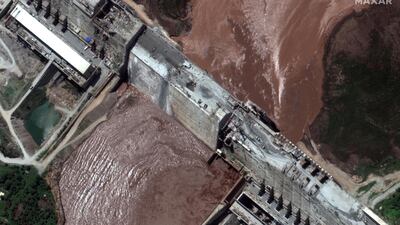
A satellite image taken on June 26, 2020 shows a close-up view of the Grand Ethiopian Renaissance Dam on the Blue Nile. Maxar Technologies via Reuters -
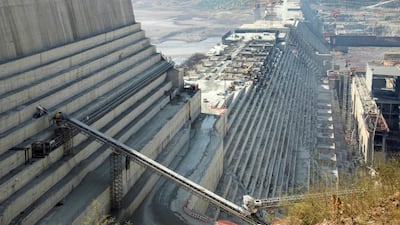
The construction site of the Grand Ethiopian Renaissance Dam in Guba in the North West of Ethiopia, seen in November 2017. AP -
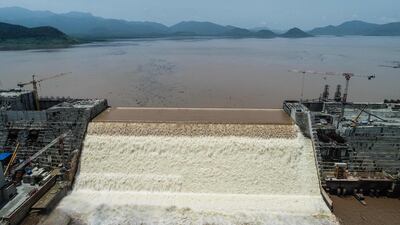
The Grand Ethiopian Renaissance Dam on the Blue Nile River in Guba, northwest Ethiopia. AFP -
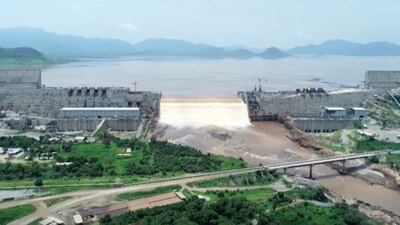
An aerial view of water levels at the Grand Ethiopian Renaissance Dam in Guba, Ethiopia, 2020. AFP -
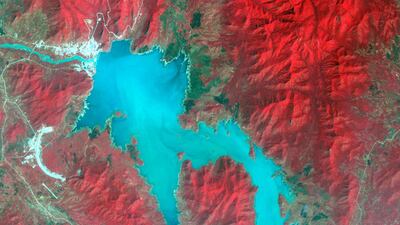
The Blue Nile River is seen as the Grand Ethiopian Renaissance Dam reservoir fills near the Ethiopia-Sudan border, in this broad spectral image taken on November 6, 2020. Reuters -
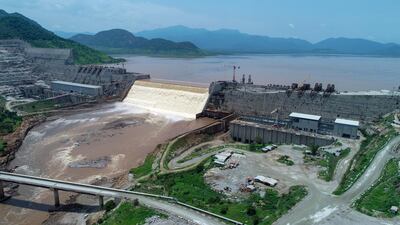
The Grand Ethiopian Renaissance Dam has been a source of discord for years. AP -

The GERD dam on the Blue Nile in Ethiopia has been under construction since 2011. EPA/MAXAR TECHNOLOGIES -
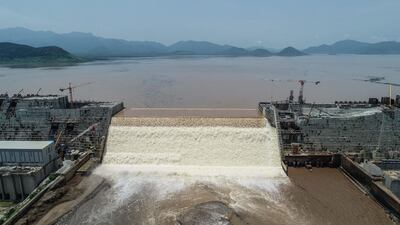
The Grand Ethiopian Renaissance Dam on the Blue Nile River is considered by Ethiopia to be integral to its energy supply, but neighbouring countries say it jeopardises their own water resources. AFP -
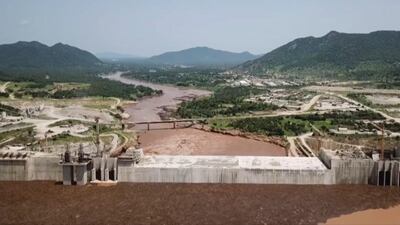
This frame grab from a video obtained from the Ethiopian Public Broadcaster (EBC) on July 20 and July 21, 2020 and released on July 24, 2020 shows an aerial view of water levels at the Grand Ethiopian Renaissance Dam in Guba, Ethiopia. AFP -
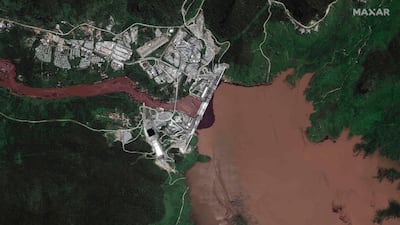
A view of northwestern Ethiopia that focuses on the status of the Grand Ethiopian Renaissance Dam (GERD) and the Blue Nile River on July 11, 2020. AFP -
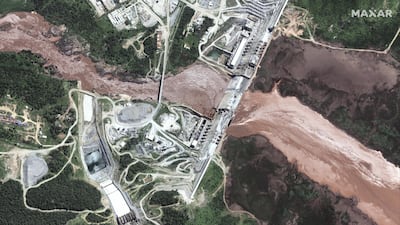
A handout satellite image shows a closeup view of the Grand Ethiopian Renaissance Dam (GERD) and the Blue Nile River in Ethiopia June 26, 2020. Maxar Technologies via Reuters -
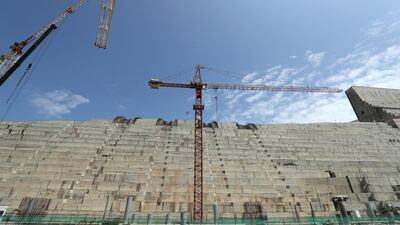
The foreign ministers of Egypt, Ethiopia and Sudan will return to Washington this week for another round of talks to reach an agreement on the Grand Ethiopian Renaissance Dam after missing the deadline last month. Reuters -
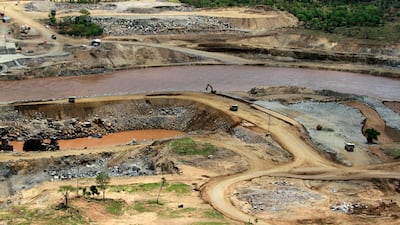
The Blue Nile river flows near the site of the planned Grand Renaissance Dam near Assosa in Ethiopia. AP -
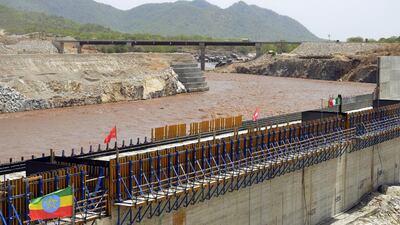
The Grand Renaissance Dam hydroelectric project in Ethiopia. Egypt belives Adis Abbaba is being deliberatley slow in negotiations. William Lloyd George / AFP -
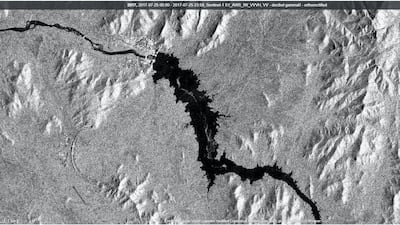
A combination picture of handout satellite images shows a view of the Grand Ethiopian Renaissance Dam (GERD) July 25, 2017 (top left), July 20, 2018 (top right), July 3, 2019 (bottom left), July 9, 2020 (bottom right) in Ethiopia, in these Sentinel-1 satellite imageries obtained by Reuters on July 14, 2020.


Diplomacy
The inaction of the UN Security Council when it met on July 8 on the Egyptian-Ethiopian dispute has left the most populous Arab nation pondering what to do next after world powers on the 15-member body appeared reluctant to intervene.
Egypt and Sudan took the issue to the Security Council hoping it will take their side in the dispute over the $5 billion hydroelectric dam after a decade of fruitless negotiations.
It did not happen.
Addis Ababa has responded to what it labels as “internationalising” the issue by telling Cairo and Khartoum they have nothing to fear from the GERD and urging the pair to return to negotiate in good faith under the auspices of the African Union.
Egypt sees its share of the Nile waters – on which it relies for more than 90 per cent of its freshwater needs – as a life-and-death issue. A significant reduction of that share, it argues, would wipe out hundreds of thousands of jobs and upends the food balance for its 100 million people.
Ethiopia’s rejection of an Egyptian-Sudanese proposal that the US, the UN and the EU mediate the dispute contributed to the acrimonious breakdown of the last round in talks in April. It is also unlikely that they would return to the negotiating table without the involvement of other parties.
“It’s the same old question and that’s whether Ethiopia is willing to make any accommodation and whether Egypt and Sudan are willing to shift their demands given the current situation,” said William Davison, an expert on Ethiopia in the International Crisis Group.
Behind the scenes, Egypt is seeking the direct involvement of Washington in the negotiations. The US mediated in the dispute in 2018-19, producing a draft agreement early in 2019 that Egypt accepted, but which Ethiopia walked away from at the last minute.
Now, the US is far more preoccupied with conditions in Ethiopia’s Tigray region, the scene of a civil war between separatist rebels and federal troops, than it is with the GERD.
“I am sceptical that the United States has a ready-made solution,” said Mr Hanna. “The United States does not have much traction with Ethiopia. It does not have many tools to use. It probably is looking for some sort of a status quo to stay for now.”
Egypt is lobbying other powers too. Its foreign minister, Sameh Shoukry, was in Brussels last week to discuss the dam dispute with EU officials. On Sunday, President El Sisi met with Chinese Foreign Minister Wang Yi at his summer office on the Mediterranean north of Cairo.
"The Chinese Foreign Minister explained his country's awareness of the utmost importance of the Nile to Egypt," a presidential statement said. "China will continue to be interested in seeing a solution that satisfies all parties."
Pressure on Ethiopia
Twenty years after the end of two decades of civil war, Ethiopia now looks like a country staring down the abyss, and for good reasons.
Ethnically and religiously diverse, it is under immense international pressure over allegations of widespread atrocities committed by federal troops in a war against the separatist rebels in Tigray that began in November.
Addis Ababa has also been vilified for allowing troops from neighbouring Eritrea and local Amhara militiamen to join the fight against the rebels, thus deepening anti-government sentiment in Tigray.
Prime Minister Abiy Ahmed, who won the Nobel peace prize shortly after taking office in 2018, is also under mounting domestic pressure, chiefly because of growing discontent among some of the country’s larger ethnic communities, such as the Amhara and the Oromo, whose grievances are over their share of national resources or the proportionality of their political representation.
Significantly, anti-government sentiments also run high in Benishangul-Gumuz, the region where the GERD is being built and where the latest parliamentary elections could not be held because of the shaky security situation.
The GERD, however, has been so successfully marketed by Mr Abiy and his predecessors that most if not all Ethiopians are convinced that it is their ticket out of poverty.
The prime minister has also framed the dispute over the GERD as rooted in colonial-era deals that favoured Egypt and Sudan. He also played the race card of the light-skinned Arabs of North Africa and black sub-Saharan Africans.
The notion of a nation imploding or targeted by enemies, real or imaginary, has been reflected in recent pronouncements by Mr Abiy and his government.
In a July 13 statement, the Ethiopian leader urged his people to “stand together” and continue to support his government in “every way possible and defend the country’s sovereignty and reverse the threat posed by internal and external enemies of the country”.
Ethiopia has in the past hinted that Egypt and Sudan may be behind recent unrest in Benishangul and accused Sudan of stoking a longstanding border dispute between the two nations for the benefit of Egypt, which has stated its unwavering support for its Sudanese allies on the issue.
“There’s a great deal of volatility in Ethiopia, but its position on the GERD will remain unchanged regardless of who is in charge in Addis Ababa,” said Mr Davison of the International Crisis Group.
“Abiy Ahmed has just won a huge election victory, but he continues to face massive problems at home and is under immense outside pressure.”

