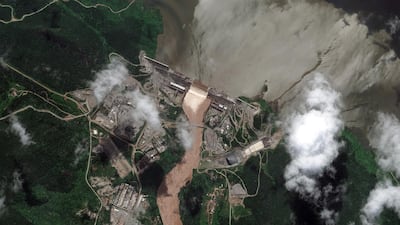
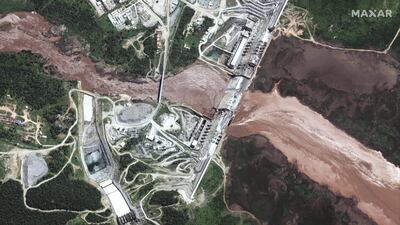
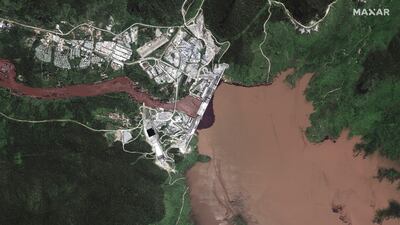
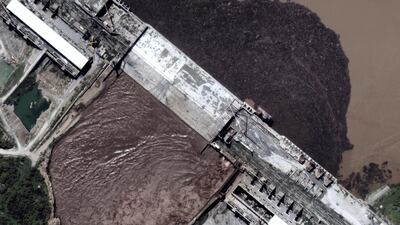
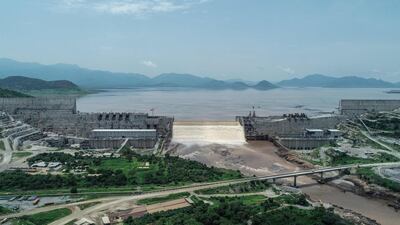
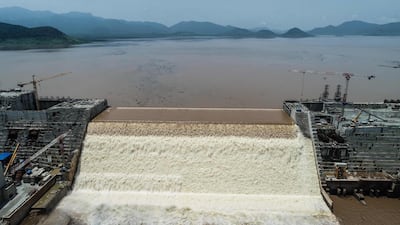
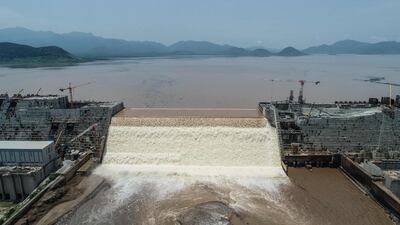
Egypt’s failure to use the UN Security Council to force a breakthrough in its dispute with Ethiopia over a Nile dam Addis Ababa is building has left it grappling with a delicate damage-control task.
Cairo had hoped last Thursday’s Security Council meeting on the Grand Ethiopian Renaissance Dam would bring renewed energy to protracted negotiations between Ethiopia and downstream nations Egypt and Sudan.
Instead, the second filling of the hydroelectric dam looks set to go ahead despite vehement opposition from Cairo and Khartoum.
This leaves Egypt struggling to contain the fallout from its diplomatic setback and running out of options to protect its share of the Nile’s waters.
Senior government officials are at pains to highlight the “benefits” of going to the council while they deliberate the way ahead.
Curiously, no one has mentioned the prospect of resuming the negotiations that acrimoniously broke down in April.
That was not unexpected given the concern of many Egyptians over the impact of the dam on their lives and the sensitive questions likely to be raised about the government’s handling of the crisis.
“The comments made by council members reflected the concern over the issue and the necessity to reach an agreement through the African Union, and that in itself is an achievement,” Egyptian Foreign Minister Sameh Shoukry said at the weekend.
“The meeting offered Egypt an opportunity to place within an official framework the history and chronology of 10 years of negotiations”, he said, offering an upbeat account of the meeting.
Egypt went to the council firmly convinced that right was on its side in the decade-long dispute over the dam, which is being built on the Blue Nile, the river’s main tributary.
But at the end, there was neither support nor much sympathy for Egypt’s case.
The outcome stunned Egypt as council members, including those counted by Cairo as allies and friends, were reluctant to take its side or denounce Ethiopia’s unilateral actions.
Instead, public comments by council members ignored Egypt’s argument that its very existence was on the line.
Responding to comments made by council members that issues of water and transnational rivers are best settled outside the 15-nation body, Mohamed Anis Salem of the Egyptian Council for Foreign Affairs said national security issues have been redefined over the past 20 years to include health, refugees, water and food.
“The council is failing in its role to engage in new security issues,” said Mr Salem, who is also a former Egyptian ambassador.
“Going to the Security Council was the natural step given the impasse in the negotiations process, but members are listening to their own interests and they don’t want to create dangerous precedents.”
The council has taken no action following the meeting, incensing Mr Shoukry who publicly claimed that Security Council members neglected their duty and prioritised their own national interests over the need to maintain security and stability in a combustible region.
On Sunday, the foreign ministers of Egypt and Sudan left New York for Brussels and Moscow respectively, signalling the possible end of any prospect for action by the council on the dam.
Officials, experts and pro-government TV talk show hosts have sought to deflect from the disappointment felt by Egyptians who had pinned so much hope on the council.
They praised the meeting, the second by the council on the dam in consecutive years, as a diplomatic victory.
Others said Egypt succeeded in showing the world that Ethiopia’s “intransigence” was threatening the security and stability of the East Africa and Horn of Africa regions.
The talk show hosts heaped lavish praise on Mr Shoukry’s address to the council, saying it was authoritative and compelling.
One host, the popular Amr Adeeb of the Saudi-owned MBC Masr, went so far as to invite an expert who interpreted as both comfortable and confident Mr Shoukry’s body language while delivering his comments to the council.
In reality, however, the outcome of the meeting has come as a painful reality check for a country that has heavily invested in one diplomatic offensive after another across much of the world to argue its case on the dam and portray Ethiopia as the villain.
“The bitter and painful truth is that we did not achieve what we had hoped for in the Security Council meeting last Thursday,” Imad Hussein, editor of the Cairo daily Al Shorouk, wrote in its Sunday edition.
“What happened in the Security Council should be a wake-up call that we hold ourselves accountable and ask how did we come to this diplomatic end when Ethiopia, which is internally vulnerable and is experiencing a quasi-civil war, succeed in convincing the world of its viewpoint?”

COMPANY%20PROFILE
%3Cp%3E%3Cstrong%3EName%3A%3C%2Fstrong%3E%20Floward%0D%3Cbr%3E%3Cstrong%3EBased%3A%20%3C%2Fstrong%3ERiyadh%2C%20Saudi%20Arabia%0D%3Cbr%3E%3Cstrong%3EFounders%3A%20%3C%2Fstrong%3EAbdulaziz%20Al%20Loughani%20and%20Mohamed%20Al%20Arifi%0D%3Cbr%3E%3Cstrong%3ESector%3A%20%3C%2Fstrong%3EE-commerce%0D%3Cbr%3E%3Cstrong%3ETotal%20funding%3A%20%3C%2Fstrong%3EAbout%20%24200%20million%0D%3Cbr%3E%3Cstrong%3EInvestors%3A%20%3C%2Fstrong%3EAljazira%20Capital%2C%20Rainwater%20Partners%2C%20STV%20and%20Impact46%0D%3Cbr%3E%3Cstrong%3ENumber%20of%20employees%3A%20%3C%2Fstrong%3E1%2C200%3C%2Fp%3E%0A
What is type-1 diabetes
Type 1 diabetes is a genetic and unavoidable condition, rather than the lifestyle-related type 2 diabetes.
It occurs mostly in people under 40 and a result of the pancreas failing to produce enough insulin to regulate blood sugars.
Too much or too little blood sugar can result in an attack where sufferers lose consciousness in serious cases.
Being overweight or obese increases the chances of developing the more common type 2 diabetes.
Sri Lanka squad for tri-nation series
Angelo Mathews (c), Upul Tharanga, Danushka Gunathilaka, Kusal Mendis, Dinesh Chandimal, Kusal Janith Perera, Thisara Perera, Asela Gunaratne, Niroshan Dickwella, Suranga Lakmal, Nuwan Pradeep, Dushmantha Chameera, Shehan Madushanka, Akila Dananjaya, Lakshan Sandakan and Wanidu Hasaranga
World Cricket League Division 2
In Windhoek, Namibia - Top two teams qualify for the World Cup Qualifier in Zimbabwe, which starts on March 4.
UAE fixtures
Thursday February 8, v Kenya; Friday February 9, v Canada; Sunday February 11, v Nepal; Monday February 12, v Oman; Wednesday February 14, v Namibia; Thursday February 15, final
The nine articles of the 50-Year Charter
1. Dubai silk road
2. A geo-economic map for Dubai
3. First virtual commercial city
4. A central education file for every citizen
5. A doctor to every citizen
6. Free economic and creative zones in universities
7. Self-sufficiency in Dubai homes
8. Co-operative companies in various sectors
9: Annual growth in philanthropy
Indoor cricket in a nutshell
Indoor Cricket World Cup – Sep 16-20, Insportz, Dubai
16 Indoor cricket matches are 16 overs per side
8 There are eight players per team
9 There have been nine Indoor Cricket World Cups for men. Australia have won every one.
5 Five runs are deducted from the score when a wickets falls
4 Batsmen bat in pairs, facing four overs per partnership
Scoring In indoor cricket, runs are scored by way of both physical and bonus runs. Physical runs are scored by both batsmen completing a run from one crease to the other. Bonus runs are scored when the ball hits a net in different zones, but only when at least one physical run is score.
Zones
A Front net, behind the striker and wicketkeeper: 0 runs
B Side nets, between the striker and halfway down the pitch: 1 run
C Side nets between halfway and the bowlers end: 2 runs
D Back net: 4 runs on the bounce, 6 runs on the full
Checks continue
A High Court judge issued an interim order on Friday suspending a decision by Agriculture Minister Edwin Poots to direct a stop to Brexit agri-food checks at Northern Ireland ports.
Mr Justice Colton said he was making the temporary direction until a judicial review of the minister's unilateral action this week to order a halt to port checks that are required under the Northern Ireland Protocol.
Civil servants have yet to implement the instruction, pending legal clarity on their obligations, and checks are continuing.
Company Fact Box
Company name/date started: Abwaab Technologies / September 2019
Founders: Hamdi Tabbaa, co-founder and CEO. Hussein Alsarabi, co-founder and CTO
Based: Amman, Jordan
Sector: Education Technology
Size (employees/revenue): Total team size: 65. Full-time employees: 25. Revenue undisclosed
Stage: early-stage startup
Investors: Adam Tech Ventures, Endure Capital, Equitrust, the World Bank-backed Innovative Startups SMEs Fund, a London investment fund, a number of former and current executives from Uber and Netflix, among others.
RESULTS
Bantamweight: Victor Nunes (BRA) beat Azizbek Satibaldiev (KYG). Round 1 KO
Featherweight: Izzeddin Farhan (JOR) beat Ozodbek Azimov (UZB). Round 1 rear naked choke
Middleweight: Zaakir Badat (RSA) beat Ercin Sirin (TUR). Round 1 triangle choke
Featherweight: Ali Alqaisi (JOR) beat Furkatbek Yokubov (UZB). Round 1 TKO
Featherweight: Abu Muslim Alikhanov (RUS) beat Atabek Abdimitalipov (KYG). Unanimous decision
Catchweight 74kg: Mirafzal Akhtamov (UZB) beat Marcos Costa (BRA). Split decision
Welterweight: Andre Fialho (POR) beat Sang Hoon-yu (KOR). Round 1 TKO
Lightweight: John Mitchell (IRE) beat Arbi Emiev (RUS). Round 2 RSC (deep cuts)
Middleweight: Gianni Melillo (ITA) beat Mohammed Karaki (LEB)
Welterweight: Handesson Ferreira (BRA) beat Amiran Gogoladze (GEO). Unanimous decision
Flyweight (Female): Carolina Jimenez (VEN) beat Lucrezia Ria (ITA), Round 1 rear naked choke
Welterweight: Daniel Skibinski (POL) beat Acoidan Duque (ESP). Round 3 TKO
Lightweight: Martun Mezhlumyan (ARM) beat Attila Korkmaz (TUR). Unanimous decision
Bantamweight: Ray Borg (USA) beat Jesse Arnett (CAN). Unanimous decision
FROM%20THE%20ASHES
%3Cp%3EDirector%3A%20Khalid%20Fahad%3C%2Fp%3E%0A%3Cp%3EStarring%3A%20Shaima%20Al%20Tayeb%2C%20Wafa%20Muhamad%2C%20Hamss%20Bandar%3C%2Fp%3E%0A%3Cp%3ERating%3A%203%2F5%3C%2Fp%3E%0A
10 tips for entry-level job seekers
- Have an up-to-date, professional LinkedIn profile. If you don’t have a LinkedIn account, set one up today. Avoid poor-quality profile pictures with distracting backgrounds. Include a professional summary and begin to grow your network.
- Keep track of the job trends in your sector through the news. Apply for job alerts at your dream organisations and the types of jobs you want – LinkedIn uses AI to share similar relevant jobs based on your selections.
- Double check that you’ve highlighted relevant skills on your resume and LinkedIn profile.
- For most entry-level jobs, your resume will first be filtered by an applicant tracking system for keywords. Look closely at the description of the job you are applying for and mirror the language as much as possible (while being honest and accurate about your skills and experience).
- Keep your CV professional and in a simple format – make sure you tailor your cover letter and application to the company and role.
- Go online and look for details on job specifications for your target position. Make a list of skills required and set yourself some learning goals to tick off all the necessary skills one by one.
- Don’t be afraid to reach outside your immediate friends and family to other acquaintances and let them know you are looking for new opportunities.
- Make sure you’ve set your LinkedIn profile to signal that you are “open to opportunities”. Also be sure to use LinkedIn to search for people who are still actively hiring by searching for those that have the headline “I’m hiring” or “We’re hiring” in their profile.
- Prepare for online interviews using mock interview tools. Even before landing interviews, it can be useful to start practising.
- Be professional and patient. Always be professional with whoever you are interacting with throughout your search process, this will be remembered. You need to be patient, dedicated and not give up on your search. Candidates need to make sure they are following up appropriately for roles they have applied.
Arda Atalay, head of Mena private sector at LinkedIn Talent Solutions, Rudy Bier, managing partner of Kinetic Business Solutions and Ben Kinerman Daltrey, co-founder of KinFitz
Apple%20Mac%20through%20the%20years
%3Cp%3E1984%20-%20Apple%20unveiled%20the%20Macintosh%20on%20January%2024%3Cbr%3E1985%20-%20Steve%20Jobs%20departed%20from%20Apple%20and%20established%20NeXT%3Cbr%3E1986%20-%20Apple%20introduced%20the%20Macintosh%20Plus%2C%20featuring%20enhanced%20memory%3Cbr%3E1987%20-%20Apple%20launched%20the%20Macintosh%20II%2C%20equipped%20with%20colour%20capabilities%3Cbr%3E1989%20-%20The%20widely%20acclaimed%20Macintosh%20SE%2F30%20made%20its%20debut%3Cbr%3E1994%20-%20Apple%20presented%20the%20Power%20Macintosh%3Cbr%3E1996%20-%20The%20Macintosh%20System%20Software%20OS%20underwent%20a%20rebranding%20as%20Mac%20OS%3Cbr%3E2001%20-%20Apple%20introduced%20Mac%20OS%20X%2C%20marrying%20Unix%20stability%20with%20a%20user-friendly%20interface%3Cbr%3E2006%20-%20Apple%20adopted%20Intel%20processors%20in%20MacBook%20Pro%20laptops%3Cbr%3E2008%20-%20Apple%20introduced%20the%20MacBook%20Air%2C%20a%20lightweight%20laptop%3Cbr%3E2012%20-%20Apple%20launched%20the%20MacBook%20Pro%20with%20a%20retina%20display%3Cbr%3E2016%20-%20The%20Mac%20operating%20system%20underwent%20rebranding%20as%20macOS%3Cbr%3E2020%20-%20Apple%20introduced%20the%20M1%20chip%20for%20Macs%2C%20combining%20high%20performance%20and%20energy%20efficiency%3Cbr%3E2022%20-%20The%20M2%20chip%20was%20announced%3Cbr%3E2023%20-The%20M3%20line-up%20of%20chip%20was%20announced%20to%20improve%20performance%20and%20add%20new%20capabilities%20for%20Mac.%3C%2Fp%3E%0A
The specs
Engine: 6.2-litre supercharged V8
Power: 712hp at 6,100rpm
Torque: 881Nm at 4,800rpm
Transmission: 8-speed auto
Fuel consumption: 19.6 l/100km
Price: Dh380,000
On sale: now
Summer special
Tips for taking the metro
- set out well ahead of time
- make sure you have at least Dh15 on you Nol card, as there could be big queues for top-up machines
- enter the right cabin. The train may be too busy to move between carriages once you're on
- don't carry too much luggage and tuck it under a seat to make room for fellow passengers
Key facilities
- Olympic-size swimming pool with a split bulkhead for multi-use configurations, including water polo and 50m/25m training lanes
- Premier League-standard football pitch
- 400m Olympic running track
- NBA-spec basketball court with auditorium
- 600-seat auditorium
- Spaces for historical and cultural exploration
- An elevated football field that doubles as a helipad
- Specialist robotics and science laboratories
- AR and VR-enabled learning centres
- Disruption Lab and Research Centre for developing entrepreneurial skills