


US and French diplomats have attempted to pressure a reluctant Saudi Arabia to increase its involvement in Lebanon in what analysts described as an unprecedented effort to save the crisis-hit country from itself.
But the outcome of their negotiations remains unclear apart from potentially delivering more in-kind humanitarian aid.
Ambassadors Anne Grillo of France and Dorothy Shea of the US visited Saudi Arabia on Thursday to discuss Lebanon's economic crisis and political paralysis.
They said in a joint statement afterwards that the country desperately needed a “fully empowered government”.
The international community has refused to bail out the cash-strapped state after decades of mismanagement and corruption, arguing that politicians should first bring in laws to increase transparency and accountability.
Lebanese political analyst
The failure of Lebanese leaders to act has led to severe electricity, water and medical shortages amid rapidly increasing inflation and poverty. The local currency is trading at more than 19,000 Lebanese pounds to the dollar – less than a tenth of its official value.
Lebanon is without a fully functioning government and political bickering over the formation of a new one persists. The previous Cabinet resigned following the deadly blast that rocked Beirut’s port on August 4 last year.
-
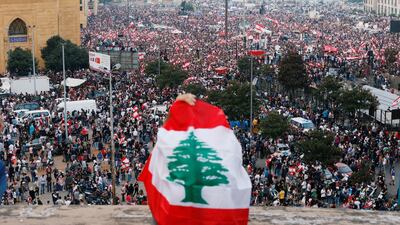
A general view of demonstrators during an anti-government protest in central Beirut. Reuters -
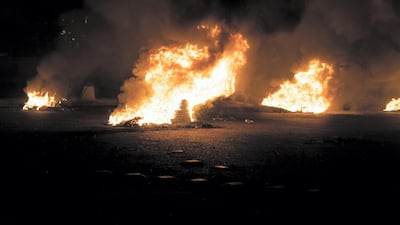
Protesters burn tyres and set up a roadblock on the Beirut-Saida motorway. William Lowry / The National -

Protesters in Nabatiyeh wave flags during an afternoon demonstration. William Lowry / The National -

Protesters in Nabatiyeh wave flags. William Lowry / The National -
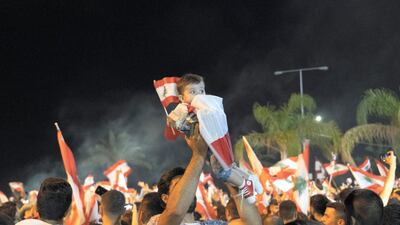
A man holds a baby wrapped in the Lebanese flag high in the air during a protest in Sour. William Lowry / The National -

Demonstrators take part in an anti-government protest in Beirut. Reuters -

Anti-government protesters shout slogans in Beirut. AP Photo -

A general view of demonstrators during an anti-government protest in central Beirut. Reuters -

An anti-government protester waves a flare during a street demonstration. AP Photo -

A man lifts a child as demonstrators chant and carry national flags during an anti-government protest in the southern city of Nabatiyeh.


“We are providing a lot of emergency and humanitarian aid to Lebanon but we could do much more if the Lebanese shouldered their responsibilities,” a French diplomatic source told The National. The US embassy in Beirut was not immediately available for comment.
Saudi Arabia has traditionally been financially supportive of Lebanon and aligned with its Sunni Muslim and pro-Western leaders. But it has distanced itself in recent years owing to increasing concerns about the power wielded by Hezbollah. The Shiite Muslim group is backed by Saudi Arabia’s regional archenemy, Iran.
Saudi analyst Ali Shihabi, who sits on the advisory board of the NEOM city megaproject, said it was unlikely that Saudi Arabia will deliver more than in-kind help.
“Saudi Arabia has been running a deficit for years and has its own requirements to restructure its economy. The days of the Saudi chequebook are over,” he said.
“I think this idea of getting on a plane to Saudi Arabia to ask them to write a cheque is ridiculous because that is not how such an issue would be approached by the kingdom any more.”
Mr Shihabi said the US and France should have put pressure on Lebanese leaders by freezing their overseas assets at the start of the economic crisis in 2019.
France, the former colonial power, warned in May that it would impose sanctions on politicians blocking government formation. However, the threat has fallen on deaf ears. The only top official being investigated for his wealth in France is Riad Salameh, head of the Lebanese central bank.
Yet Saudi Arabia is still open to providing in-kind support such as field hospitals, medicine and food, including to the Lebanese military, Mr Shihabi said.
The 80,000-strong army is the only state institution to continue receiving direct support and Turkey, Morocco, Iraq and France have all sent food packages to help it feed its soldiers. Diplomatic sources previously told The National that Ms Grillo and Ms Shea would ask Riyadh to step in, but Saudi Arabia had not officially commented on their visit at the time of writing.
Karim El Mufti, professor of political science at Saint Joseph University in Beirut, said that France and the US were more interested in Riyadh remaining diplomatically involved in Lebanon than in asking for cash assistance.
“They're saying: 'Even if you don’t care, let’s try to keep Lebanon afloat from a humanitarian and security perspective to not create a new Somalia on the borders with Israel which would give Hezbollah free range',” he said.
The fact that the two ambassadors represented the interest of their own countries as well as of the Lebanese people is widely viewed as a diplomatic first.
“It's an interesting gesture: foreign diplomats travelled from Beirut to Riyadh to provide for a population that is not theirs," Prof El Mufti said. "Yet from a protocol perspective, it has zero weight, because they are not foreign affairs ministers.”
Earlier this week, French MP Gwendal Rouillard suggested setting up an international task force in Lebanon, supervised by the UN and the World Bank. Its exact structure remains vague but his proposal is significant because of his proximity to French Foreign Affairs Minister Jean-Yves Le Drian who has repeatedly warned that Lebanon is on the verge of collapse.
Prof El Mufti said that the UN provides the strongest international legal mechanism to fill in the power vacuum left by Lebanon's elite. The UN's trusteeship council, which normally administrates countries without sovereignty, has been dormant since 1994, but can be reactivated, he said.
"Lebanon has no way of implementing its sovereignty today. It's in social, economic and financial chaos," he told The National
For Prof El Mufti, the Riyadh meeting was a “last warning to the Lebanese government: 'If you don’t decide, we’ll step in and decide for you, and to hell with sovereignty'”.

