Hope and strife: South Sudan 10 years after independence
Ahmed Maher reports from Juba, where South Sudan's leaders are working to reverse the fortunes of the world's youngest country after years of civil war
When South Sudan finally became independent after a 56-year struggle and a bitter secession from Sudan, it was a dream come true for many.
Roughly the size of the United Kingdom and Germany combined, the new country had its own passports, as well as football and basketball teams singing a national anthem under their own flag.
One of the most diverse nations in Africa, with more than 60 languages and dozens of ethnic groups, South Sudan was hailed as a way out of decades of strife.
US President Barack Obama said the 2011 referendum on dividing what was then Africa's largest country was a "new chapter in history".
The decisions of Sudan's leaders, he said, would determine whether its people moved "toward peace and prosperity, or slide backwards into bloodshed".
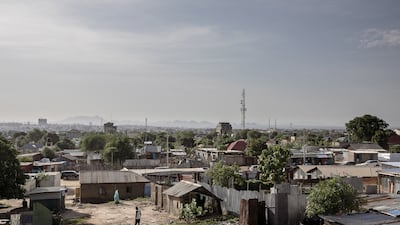
But 10 years after independence, visitors to the capital Juba will see a country suffering from underdevelopment and extreme poverty – the direct result of five years of civil war that stymied the transformation of the young country into a viable state.
Today, many farmers struggle to sell their crops of millet and maize not because of instability but because of the lack of basic infrastructure and a near-total absence of buyers with any money.
The National visited South Sudan to see how the world's youngest country has fared during a decade of independence and to investigate what the future holds for a nation brought to the brink by years of brutal conflict.
A decade of strife
Only two years after the hard-won secession from Sudan, the country fell into another deadly internecine conflict in 2013 that continued until 2018.
Fighting broke out amid a leadership struggle between President Salva Kiir Mayardit and his Vice President Riek Machar, who represented the country's two largest tribes – the Dinka and the Nuer respectively – and competed for the country's vast resources.
A shantytown in Juba, the capital of South Sudan. South Sudan secured a $174 million loan from the International Monetary Fund in April to help finance its budget and stabilise the currency.
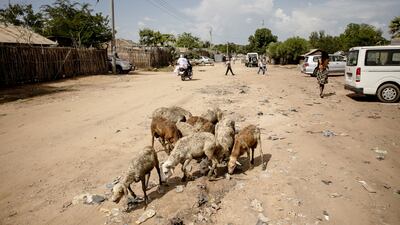
Lambs graze in the middle of a dirt road in Juba, the capital of South Sudan.
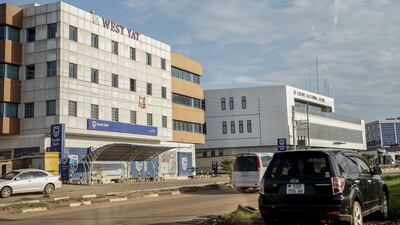
Branches of Stanbic Bank, left, and Ebony National Bank, on a street in Juba, South Sudan. South Sudan secured a $174 million loan from the International Monetary Fund in April to help finance its budget and stabilise the currency.
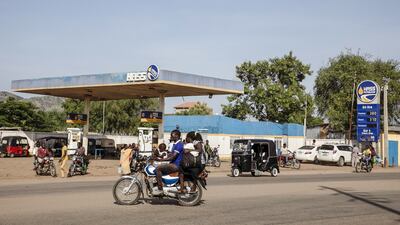
Motorcyclists at a petrol station in Juba, the capital of South Sudan.
Customers queue at a market stall in Juba, South Sudan.
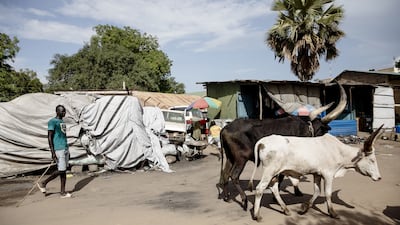
A man walks cattle along a dirt road in Juba, South Sudan. South Sudan secured a $174 million loan from the International Monetary Fund in April.
The rebels who once fought against a regime that largely marginalised them now fought amongst themselves. The five-year war caused dire food shortages, all but destroyed the country's fledgling health sector and hit international investment badly – problems that continue to blight South Sudan today
Some people in the south whisper that they would have voted to remain united with Sudan if they had only known the difficult years that lay ahead, referring to Assawdaniya, which in Arabic means the unity of Sudan.
The South Sudanese civil war is believed to have resulted in close to 400,000 deaths, according to a report published in 2018 by the London School of Hygiene and Tropical Medicine and financed by the US State Department.
Nearly 3.9 million people, mostly women and children, were forcibly displaced, many of them more than once. About 2.3 million people fled to neighbouring countries in search of safety.
The conflict, and drought, also plunged the country into famine in early 2017.
The UN's World Food Programme said it helped to feed about half the country's population last year, with about six million receiving food aid, and the proportion of the population living under the international poverty line rose from 51 per cent in 2009 to 82 per cent in 2016.
Today, the typical income of a civil servant is around $2 per day, according to the World Bank.
Widespread poverty is the main reason South Sudan ranks 187th out of 189 countries in the Human Development Index (HDI), and also helps to explain why the average life expectancy is only 57, compared with the global average of 72.
The World Bank says South Sudan experienced near-hyperinflation because of its civil war, which caused a 60-fold increase in the prices of basic goods in an already fragile economy where most work is self-employment in agriculture.
The country's currency has depreciated nearly one hundred-fold since independence, and a parallel market for US dollars has developed, with a gap of 100 per cent or more between the parallel and official exchange rates.
Since 2011, non-oil GDP has fallen by 37 per cent and household disposable income by 70 per cent.
The Coronavirus pandemic and recurrent lockdowns have brought imports of food and medical supplies from Kenya and Uganda to a standstill.
Hundreds of thousands of children in South Sudan are facing an uncertain future.
According to Unicef, more than 70 per cent of the country’s children are out of school.
.
A decade of hope
There were great expectations for South Sudan after it gained independence.
Its creation was the result of a landmark agreement in 2005 that ended Africa's longest-running civil war.
Made up of Sudan's 10 southernmost provinces, the new country was the first to be founded in Africa since Eritrea broke away from Ethiopia in 1993.
A power-sharing agreement brought an end to the fighting in 2018, and in February last year, the rivals - Mr Mayardit and Mr Machar, struck a unity deal for a coalition government after several false starts and short-lived peace deals.
The country's leaders say they have learnt hard lessons, but with the country still largely divided along tribal lines, significant hurdles remain in the way of a lasting peace.
“Tribalism has been a challenge and that’s why the national dialogue has been initiated," said General Lul Ruai Koang, the spokesman for the South Sudanese Army.
"Our diversity shouldn’t be a source of division. I shouldn’t look at my tribe as the supreme tribe. Every tribe adds to our society," he told The National.
"We now have become peace-makers in the region as we have mediated between the north and different rebels groups and the Sudanese government.”
General Lul Ruai Koang of the South Sudanese Army in Juba. The National
South Sudan's leaders have, for now, laid to rest their ethnic rivalries and launched a nationwide campaign led by a unified army to disarm civilians and negotiate with the few splinter groups that could threaten the latest peace agreement.
The country seems to be on the road to post-conflict recovery at last, with a government budget based almost entirely on oil revenues.
But South Sudan has other potential sources of wealth.
The country is believed to hold large mineral and metal deposits. It has vast tracts of viable farmland, forests, and the potential to generate clean hydroelectric power from the White Nile.
“This is a strategic plan of the country, the government has a plan to build a dam for the generation of electricity and power because you can’t have a country without industrialisation,” Deputy Foreign Minister Deng Dau Deng Malek told The National in Juba.
The country is highly vulnerable to climate change and natural disasters such as massive floods and invasion of desert locusts.
“Look at the country today, most of South Sudan is flooded as we speak. The Upper Nile State is under water. We weren’t given the opportunity as a country to think and plan. You look at the needs of the population, you look at the growing industries,” he said.
Archived photo of Southern Sudanese celebrate their first independence day in front of a newly constructed statue of the late John Garang, the former leader of the Sudan People's Liberation Army, in the capital city of Juba. Pete Muller/AP
Will peace last?
South Sudan’s leaders say they are determined to maintain peace in order to create a prosperous future.
But the country’s next general elections, expected in 2023, could expose the fault lines between the country's main tribes.
Independent monitors accuse the country's political elites of exploiting South Sudan's ethnic diversity to achieve personal gains.
The country's leaders have pledged to forge a political system based not on tribalism but on democracy, but it remains to be seen whether the divisions that have already plunged the country into civil war once will resurface.
The birth of South Sudan was greeted with "considerable optimism at the time," said Nicholas Haysom, the UN Special Representative for South Sudan and Head of the UN mission in the country.
“Undoubtedly, there has been some disappointment with what's been achieved in the intervening 10 years,” he told The National.
“The political elites and stakeholders in South Sudan have spent a considerable amount of time stitching together what is called here a revitalised peace agreement, which is an attempt to patch up a previous peace agreement in a way which is more likely to lead to a successful outcome," he said.
While South Sudan's leaders have been working hard to implement the agreement, he said, progress has been slow.
"But there is evidence that the pace is picking up somewhat," he added.
The management of South Sudan's vast untapped natural resources could also emerge as a point of contention once more.
The World Bank says there is no transparency on how the country manages oil revenues, production and exports, which are all “shrouded in secrecy” and resources have been poorly managed. The latest round of conflict has soaked up most of the available funds.
South Sudan ranked 179 out of 180 on the Corruption Perceptions Index of Transparency International, which has become the leading global indicator of public sector corruption.
Many South Sudanese suspect foul play in the government's handling of the economy.
One South Sudanese woman, who works for a Norwegian aid agency in the capital and did not want to be identified, said: “It’s mind-boggling that South Sudan has an ocean of oil reserves, a third of the reserves in sub-Saharan Africa, but remains one of the most impoverished and least developed countries in the world."

A lesson in simple, seasonal eating. Wedges of tomato, chunks of cucumber, thinly sliced red onion, coriander or parsley leaves, and perhaps some fresh dill are drizzled with a crushed walnut and garlic dressing. Do consider yourself warned: if you eat this salad in Georgia during the summer months, the tomatoes will be so ripe and flavourful that every tomato you eat from that day forth will taste lacklustre in comparison.
Badrijani nigvzit
A delicious vegetarian snack or starter. It consists of thinly sliced, fried then cooled aubergine smothered with a thick and creamy walnut sauce and folded or rolled. Take note, even though it seems like you should be able to pick these morsels up with your hands, they’re not as durable as they look. A knife and fork is the way to go.
Pkhali
This healthy little dish (a nice antidote to the khachapuri) is usually made with steamed then chopped cabbage, spinach, beetroot or green beans, combined with walnuts, garlic and herbs to make a vegetable pâté or paste. The mix is then often formed into rounds, chilled in the fridge and topped with pomegranate seeds before being served.
PROFILE OF INVYGO
Started: 2018
Founders: Eslam Hussein and Pulkit Ganjoo
Based: Dubai
Sector: Transport
Size: 9 employees
Investment: $1,275,000
Investors: Class 5 Global, Equitrust, Gulf Islamic Investments, Kairos K50 and William Zeqiri
Fujairah is a crucial hub for fuel storage and is just outside the Strait of Hormuz, a vital shipping route linking Middle East oil producers to markets in Asia, Europe, North America and beyond.
The strait is 33 km wide at its narrowest point, but the shipping lane is just three km wide in either direction. Almost a fifth of oil consumed across the world passes through the strait.
Iran has repeatedly threatened to close the strait, a move that would risk inviting geopolitical and economic turmoil.
Last month, Iran issued a new warning that it would block the strait, if it was prevented from using the waterway following a US decision to end exemptions from sanctions for major Iranian oil importers.
Stars: Varun Dhawan, Samantha Ruth Prabhu, Kashvi Majmundar, Kay Kay Menon
Rating: 4/5
Living in...
This article is part of a guide on where to live in the UAE. Our reporters will profile some of the country’s most desirable districts, provide an estimate of rental prices and introduce you to some of the residents who call each area home.
The figure was broadly flat immediately before the Covid-19 pandemic, standing at 216,000 in the year to June 2018 and 224,000 in the year to June 2019.
It then dropped to an estimated 111,000 in the year to June 2020 when restrictions introduced during the pandemic limited travel and movement.
The total rose to 254,000 in the year to June 2021, followed by steep jumps to 634,000 in the year to June 2022 and 906,000 in the year to June 2023.
The latest available figure of 728,000 for the 12 months to June 2024 suggests levels are starting to decrease.
Groom and Two Brides
Director: Elie Semaan
Starring: Abdullah Boushehri, Laila Abdallah, Lulwa Almulla
If you’re going to go grey, a great style, well-cared for hair (in a sleek, classy style, like a bob), and a young spirit and attitude go a long way, says Maria Dowling, founder of the Maria Dowling Salon in Dubai.
It’s easier to go grey from a lighter colour, so you may want to do that first. And this is the time to try a shorter style, she advises. Then a stylist can introduce highlights, start lightening up the roots, and let it fade out. Once it’s entirely grey, a purple shampoo will prevent yellowing.
“Get professional help – there’s no other way to go around it,” she says. “And don’t just let it grow out because that looks really bad. Put effort into it: properly condition, straighten, get regular trims, make sure it’s glossy.”
The bio
Who inspires you?
I am in awe of the remarkable women in the Arab region, both big and small, pushing boundaries and becoming role models for generations. Emily Nasrallah was a writer, journalist, teacher and women’s rights activist
How do you relax?
Yoga relaxes me and helps me relieve tension, especially now when we’re practically chained to laptops and desks. I enjoy learning more about music and the history of famous music bands and genres.
What is favourite book?
The Perks of Being a Wallflower - I think I've read it more than 7 times
What is your favourite Arabic film?
Hala2 Lawen (Translation: Where Do We Go Now?) by Nadine Labaki
What is favourite English film?
Mamma Mia
Best piece of advice to someone looking for a career at Google?
If you’re interested in a career at Google, deep dive into the different career paths and pinpoint the space you want to join. When you know your space, you’re likely to identify the skills you need to develop.
FIXTURES
Saturday
5.30pm: Shabab Al Ahli v Al Wahda
5.30pm: Khorfakkan v Baniyas
8.15pm: Hatta v Ajman
8.15pm: Sharjah v Al Ain Sunday
5.30pm: Kalba v Al Jazira
5.30pm: Fujairah v Al Dhafra
8.15pm: Al Nasr v Al Wasl
UAE currency: the story behind the money in your pockets
Ali Khaseif, Mohammed Al Shamsi, Fahad Al Dhanhani, Khalid Essa, Bandar Al Ahbabi, Salem Rashid, Shaheen Abdulrahman, Khalifa Al Hammadi, Mohammed Al Attas, Walid Abbas, Hassan Al Mahrami, Mahmoud Khamis, Alhassan Saleh, Ali Salmeen, Yahia Nader, Abdullah Ramadan, Majed Hassan, Abdullah Al Naqbi, Fabio De Lima, Khalil Al Hammadi, Khalfan Mubarak, Tahnoun Al Zaabi, Muhammed Jumah, Yahya Al Ghassani, Caio Canedo, Ali Mabkhout, Sebastian Tagliabue, Zayed Al Ameri
Look north
BBC business reporters, like a new raft of government officials, are being removed from the national and international hub of London and surely the quality of their work must suffer.
Draw:
Group A: Egypt, DR Congo, Uganda, Zimbabwe
Group B: Nigeria, Guinea, Madagascar, Burundi
Group C: Senegal, Algeria, Kenya, Tanzania
Group D: Morocco, Ivory Coast, South Africa, Namibia
Friday, September 29
First practice: 7am - 8.30am
Second practice: 11am - 12.30pm
Saturday, September 30
Qualifying: 1pm - 2pm
Sunday, October 1
Race: 11am - 1pm
Timeline
2012-2015
The company offers payments/bribes to win key contracts in the Middle East
May 2017
The UK SFO officially opens investigation into Petrofac’s use of agents, corruption, and potential bribery to secure contracts
September 2021
Petrofac pleads guilty to seven counts of failing to prevent bribery under the UK Bribery Act
October 2021
Court fines Petrofac £77 million for bribery. Former executive receives a two-year suspended sentence
December 2024
Petrofac enters into comprehensive restructuring to strengthen the financial position of the group
May 2025
The High Court of England and Wales approves the company’s restructuring plan
July 2025
The Court of Appeal issues a judgment challenging parts of the restructuring plan
August 2025
Petrofac issues a business update to execute the restructuring and confirms it will appeal the Court of Appeal decision
October 2025
Petrofac loses a major TenneT offshore wind contract worth €13 billion. Holding company files for administration in the UK. Petrofac delisted from the London Stock Exchange
Eoin Morgan (capt), Moeen Ali, Jofra Archer, Jonny Bairstow, Jos Buttler (wkt), Tom Curran, Liam Dawson, Liam Plunkett, Adil Rashid, Joe Root, Jason Roy, Ben Stokes, James Vince, Chris Woakes, Mark Wood
Uefa Champions League semi-final, first leg
Bayern Munich v Real Madrid When: April 25, 10.45pm kick-off (UAE) Where: Allianz Arena, Munich Live: BeIN Sports HD Second leg: May 1, Santiago Bernabeu, Madrid
Biog
Mr Kandhari is legally authorised to conduct marriages in the gurdwara
He has officiated weddings of Sikhs and people of different faiths from Malaysia, Sri Lanka, Russia, the US and Canada
Father of two sons, grandfather of six
Plays golf once a week
Enjoys trying new holiday destinations with his wife and family
Walks for an hour every morning
Completed a Bachelor of Commerce degree in Loyola College, Chennai, India
2019 is a milestone because he completes 50 years in business
Members of Syria's Alawite minority community face threat in their heartland after one of the deadliest days in country’s recent history. Read more
TERMINAL HIGH ALTITUDE AREA DEFENCE (THAAD)
What is THAAD?
It is considered to be the US's most superior missile defence system.
Production:
It was created in 2008.
Speed:
THAAD missiles can travel at over Mach 8, so fast that it is hypersonic.
Abilities:
THAAD is designed to take out ballistic missiles as they are on their downward trajectory towards their target, otherwise known as the "terminal phase".
Purpose:
To protect high-value strategic sites, such as airfields or population centres.
Range:
THAAD can target projectiles inside and outside the Earth's atmosphere, at an altitude of 150 kilometres above the Earth's surface.
Creators:
Lockheed Martin was originally granted the contract to develop the system in 1992. Defence company Raytheon sub-contracts to develop other major parts of the system, such as ground-based radar.
UAE and THAAD:
In 2011, the UAE became the first country outside of the US to buy two THAAD missile defence systems. It then stationed them in 2016, becoming the first Gulf country to do so.
FIGHT CARD
Fights start from 6pm Friday, January 31
Catchweight 82kg
Piotr Kuberski (POL) v Ahmed Saeb (IRQ)
Women’s bantamweight
Cornelia Holm (SWE) v Corinne Laframboise (CAN)
Welterweight
Omar Hussein (JOR) v Vitalii Stoian (UKR)
Welterweight
Josh Togo (LEB) v Ali Dyusenov (UZB)
Flyweight
Isaac Pimentel (BRA) v Delfin Nawen (PHI)
Catchweight 80kg
Seb Eubank (GBR) v Mohamed El Mokadem (EGY)
Lightweight
Mohammad Yahya (UAE) v Ramadan Noaman (EGY)
Lightweight
Alan Omer (GER) v Reydon Romero (PHI)
Welterweight
Ahmed Labban (LEB) v Juho Valamaa (FIN)
Featherweight
Elias Boudegzdame (ALG) v Austin Arnett (USA)
Super heavyweight
Roman Wehbe (LEB) v Maciej Sosnowski (POL)
Non-profit arts studio Tashkeel launched this annual initiative with the intention of supporting budding designers in the UAE. This year, three talents were chosen from hundreds of applicants to be a part of the sixth creative development programme. These are architect Abdulla Al Mulla, interior designer Lana El Samman and graphic designer Yara Habib.
The trio have been guided by experts from the industry over the course of nine months, as they developed their own products that merge their unique styles with traditional elements of Emirati design. This includes laboratory sessions, experimental and collaborative practice, investigation of new business models and evaluation.
It is led by British contemporary design project specialist Helen Voce and mentor Kevin Badni, and offers participants access to experts from across the world, including the likes of UK designer Gareth Neal and multidisciplinary designer and entrepreneur, Sheikh Salem Al Qassimi.
The final pieces are being revealed in a worldwide limited-edition release on the first day of Downtown Designs at Dubai Design Week 2019. Tashkeel will be at stand E31 at the exhibition.
Lisa Ball-Lechgar, deputy director of Tashkeel, said: “The diversity and calibre of the applicants this year … is reflective of the dynamic change that the UAE art and design industry is witnessing, with young creators resolute in making their bold design ideas a reality.”