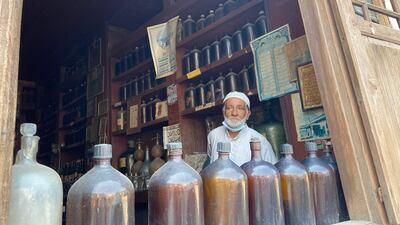
The old city of Srinagar houses a 400-year-old shop dedicated to the queen of flowers. Arq-i-Gulab is the only surviving rose water distillery in Indian-administered Kashmir, situated only a few metres from the Khanqah-e-Moula shrine.
The wood and brick shop is run by Abdul Aziz Kozgar, 65, who can be reached via a weather-beaten window he opens to communicate – in fluent English – with customers and passers-by. Three sides of the shop are packed with dark-coloured glass bottles and antique-looking jars of varying sizes, placed on wooden shelves with handwritten slips pasted on them.
Kozgar learnt the art of making manually distilled rose water from his forefathers who came from Turkey and settled in Kashmir. “This shop was opened by my great-grandfather in 1820 after he imported glass jars, pitchers and carafes from France, the US and parts of UK to start his business, after he himself learnt the art from his ancestors,” Kozgar tells The National. The family name translates from Persian as “users of jars”.
Dressed in a traditional Kashmiri kurta pyjama, his head covered with a white skull cap, Kozgar starts to fill small, unlabelled plastic bottles from big white canes. Instantly, a soothing whiff of rose water engorges the air. “This shop, these jars remain in the same place as my ancestors positioned them. These are my treasures and gifts I have inherited,” says Kozgar, who retired early from his job to carry on this legacy.
“You can see the bottles have gathered dust, they look murky, the handwritten notes have faded, but I do not want to touch them or tamper with the names. I want to keep it the way my great-grandfather, grandfather and father have kept it.
“We used to have separate rooms full of rose petals. I have grown up fascinated by the making of rose water and other syrups, and it was that fascination that pushed me to learn the process,” he says.
Kozgar talks about the time when his family were the go-to for residents of the Srinagar valley for making herbal medicines that could cure “any disease”.
“I used to visit [the] Kozgars as a child,” says Kashmiri historian and poet Zareef Ahmad Zareef. "Once I had a cough and my father got me Arq-i-gawzaban that cured me completely after just two doses. Habibullah Kozgar and his father used to mix different saps extracted from ingredients like cinnamon, rose, cardamom and carom seeds in an appropriate quantity written by a hakim."
I do not know what will happen to these precious jars after me, but until I am alive, this place will live with me
Abdul Aziz Kozgar,
owner, Arq-i-Gulab
Kozgar says: “Kozgar was a common name in Kashmir, [but] we had a variety of medicinal syrups. Even a decade or so ago, when harsh winters struck Kashmir, many people caught a cold or had a sore throat, and they rushed to my grandfather who would give them syrups to cure their disease.
“But with time, hakims and unani clinics vanished due to the arrival of modern medicine and it impacted us equally. There was a time when people would throng our shop but that has faded. Slowly, we stopped making syrups and other medicines, but clung on to rose water.”
Rose water has antiseptic and anti-inflammatory properties, and contains antioxidants that can help guard skin cells from damage. Rose water is also a common ingredient in South Asian cuisine, and is used in sweets such as laddoo, gulab jamun and peda, and to flavour milk, lassi, rice pudding and other dairy-based dishes. In Kashmir, it is also used in shrines and home temples to sprinkle on devotees during religious gatherings.
Originally a practitioner of traditional medicine, Kozgar joined the family business in part because of his father Habibullah’s enthusiasm for his children to carry forward the legacy. Although Kozgar wants his children to continue the tradition, too, he does not want to force them into a business that cannot guarantee a financially sound household.
Kozgar sells a litre of manually made rose water for 40 Indian rupees ($0.55), whereas store-sold brands retail 100 millilitres for no less than 70 rupees. “The rose water I make is extracted from Koshur gulab [Kashmiri roses] sourced from various parts of the valley and from the same vendors my father bought from," says Kozhar.
“I do not know what will happen to this place, these precious jars, after me, but until I am alive, this place will live with me. My children know how to make rose water. I have taught them, I have done my part, but to carry it forward is their decision,” says Kozgar, all the while looking away through the window, lest he be called upon to pass on some rose water bottles to potential customers.

The specs
Engine: 2.0-litre 4cyl turbo
Power: 261hp at 5,500rpm
Torque: 405Nm at 1,750-3,500rpm
Transmission: 9-speed auto
Fuel consumption: 6.9L/100km
On sale: Now
Price: From Dh117,059
The specs
Engine: 1.5-litre, 4-cylinder turbo
Transmission: CVT
Power: 170bhp
Torque: 220Nm
Price: Dh98,900
Tightening the screw on rogue recruiters
The UAE overhauled the procedure to recruit housemaids and domestic workers with a law in 2017 to protect low-income labour from being exploited.
Only recruitment companies authorised by the government are permitted as part of Tadbeer, a network of labour ministry-regulated centres.
A contract must be drawn up for domestic workers, the wages and job offer clearly stating the nature of work.
The contract stating the wages, work entailed and accommodation must be sent to the employee in their home country before they depart for the UAE.
The contract will be signed by the employer and employee when the domestic worker arrives in the UAE.
Only recruitment agencies registered with the ministry can undertake recruitment and employment applications for domestic workers.
Penalties for illegal recruitment in the UAE include fines of up to Dh100,000 and imprisonment
But agents not authorised by the government sidestep the law by illegally getting women into the country on visit visas.
8 UAE companies helping families reduce their carbon footprint
Greenheart Organic Farms
This Dubai company was one of the country’s first organic farms, set up in 2012, and it now delivers a wide array of fruits and vegetables grown regionally or in the UAE, as well as other grocery items, to both Dubai and Abu Dhabi doorsteps.
www.greenheartuae.com
Modibodi
Founded in Australia, Modibodi is now in the UAE with waste-free, reusable underwear that eliminates the litter created by a woman’s monthly cycle, which adds up to approximately 136kgs of sanitary waste over a lifetime.
www.modibodi.ae
The Good Karma Co
From brushes made of plant fibres to eco-friendly storage solutions, this company has planet-friendly alternatives to almost everything we need, including tin foil and toothbrushes.
www.instagram.com/thegoodkarmaco
Re:told
One Dubai boutique, Re:told, is taking second-hand garments and selling them on at a fraction of the price, helping to cut back on the hundreds of thousands of tonnes of clothes thrown into landfills each year.
www.shopretold.com
Lush
Lush provides products such as shampoo and conditioner as package-free bars with reusable tins to store.
www.mena.lush.com
Bubble Bro
Offering filtered, still and sparkling water on tap, Bubble Bro is attempting to ensure we don’t produce plastic or glass waste. Founded in 2017 by Adel Abu-Aysha, the company is on track to exceeding its target of saving one million bottles by the end of the year.
www.bubble-bro.com
Coethical
This company offers refillable, eco-friendly home cleaning and hygiene products that are all biodegradable, free of chemicals and certifiably not tested on animals.
www.instagram.com/coethical
Eggs & Soldiers
This bricks-and-mortar shop and e-store, founded by a Dubai mum-of-four, is the place to go for all manner of family products – from reusable cloth diapers to organic skincare and sustainable toys.
www.eggsnsoldiers.com
Mental%20health%20support%20in%20the%20UAE
%3Cp%3E%E2%97%8F%20Estijaba%20helpline%3A%208001717%3Cbr%3E%E2%97%8F%20UAE%20Ministry%20of%20Health%20and%20Prevention%20hotline%3A%20045192519%3Cbr%3E%E2%97%8F%20UAE%20Mental%20health%20support%20line%3A%20800%204673%20(Hope)%3Cbr%3EMore%20information%20at%20hope.hw.gov.ae%3C%2Fp%3E%0A
The Voice of Hind Rajab
Starring: Saja Kilani, Clara Khoury, Motaz Malhees
Director: Kaouther Ben Hania
Rating: 4/5
The specs: 2018 Nissan 370Z Nismo
Price, base / as tested: Dh182,178
Engine: 3.7-litre V6
Power: 350hp @ 7,400rpm
Torque: 374Nm @ 5,200rpm
Transmission: Seven-speed automatic
Fuel consumption, combined: 10.5L / 100km
Hotel Silence
Auður Ava Ólafsdóttir
Pushkin Press
Opening weekend Premier League fixtures
Weekend of August 10-13
Arsenal v Manchester City
Bournemouth v Cardiff City
Fulham v Crystal Palace
Huddersfield Town v Chelsea
Liverpool v West Ham United
Manchester United v Leicester City
Newcastle United v Tottenham Hotspur
Southampton v Burnley
Watford v Brighton & Hove Albion
Wolverhampton Wanderers v Everton
UAE v Gibraltar
What: International friendly
When: 7pm kick off
Where: Rugby Park, Dubai Sports City
Admission: Free
Online: The match will be broadcast live on Dubai Exiles’ Facebook page
UAE squad: Lucas Waddington (Dubai Exiles), Gio Fourie (Exiles), Craig Nutt (Abu Dhabi Harlequins), Phil Brady (Harlequins), Daniel Perry (Dubai Hurricanes), Esekaia Dranibota (Harlequins), Matt Mills (Exiles), Jaen Botes (Exiles), Kristian Stinson (Exiles), Murray Reason (Abu Dhabi Saracens), Dave Knight (Hurricanes), Ross Samson (Jebel Ali Dragons), DuRandt Gerber (Exiles), Saki Naisau (Dragons), Andrew Powell (Hurricanes), Emosi Vacanau (Harlequins), Niko Volavola (Dragons), Matt Richards (Dragons), Luke Stevenson (Harlequins), Josh Ives (Dubai Sports City Eagles), Sean Stevens (Saracens), Thinus Steyn (Exiles)
Apple product price list
iPad Pro
11" - $799 (64GB)
12.9" - $999 (64GB)
MacBook Air
$1,199
Mac Mini
$799
