

Screaming babies are considered by many travellers to be the scourge of the skies.
Time and again, airline passengers have taken to social media to vent their annoyance – and what they consider to be their bad luck – having spent hours on a plane in close proximity to a restless young child when all they wanted was for a peaceful few hours or more while hunkered down shoulder-to-shoulder with strangers.
But for customers of Japan Airlines, a new level of strategy has arrived when selecting seats prior to check-in.
The airline has introduced a feature which shows where the babies on the flight are sitting, so passengers can choose to sit further away if that's what they are seeking.
A message on the airline's website states: "Passengers travelling with children between eight days and two years old who select their seats on the JAL website will have a child icon displayed on their seats on the seat selection screen. This lets other passengers know a child may be sitting there."
It added: "Child icons are not displayed in the following situations: Seats booked as part of a tour or using award tickets. Seats selected through means other than the JAL website. Child icons may not be displayed correctly if there is a change in aircraft."
Whether this means passengers will wait longer before booking their seats so that they can see where youngsters are sitting remains to be seen.
Japan Airlines isn't the first to introduce this feature, however, with All Nippon Airways reported to have utilised it for a while.
As word spread on social media, there was a mixed reaction with some suggesting it should be adults rather than the babies who need avoiding.
One recent passenger, Rahat Ahmed, tweeted his thanks to Japan Airlines for the prior warning of where babies were sitting during his 13-hour trip.
"This really ought to be mandatory across the board," he said.
He then added that on later flights, he chose to sit next to several babies and found "some great, some loud. It happens. Some adults were worse."
________________
China's new $11bn 'starfish' airport, designed by Zaha Hadid, opens
-

The new Beijing Daxing International Airport, designed by Zaha Hadid, resembles a starfish from the air. China OUT / AFP / STR -

Visitors walk at the departure lobby after the launch ceremony for the new Daxing International Airport. AP -

Staff members walk past a terminal hall of the newly opened Daxing International Airport in Beijing. REUTERS -
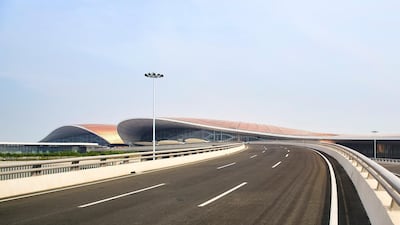
Beijing Daxing International Airport features a bronze roof, and a sprawling curved design. Courtesy Hufton+Crow -

The design features glass panels in the roof to enhance natural light, Courtesy Hufton+Crow -

Beijing Daxing International Airport is made up of five connected concourses. Courtesy Hufton+Crow -
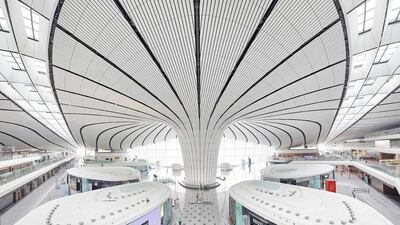
Zaha Hadid designed the airport the gather people around a central terrace. Courtesy Hufton+Crow -
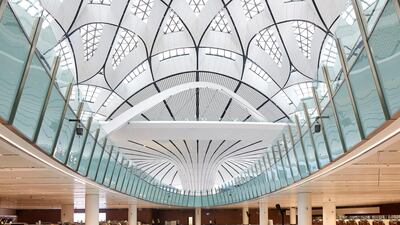
Beijing Daxing International Airport took five years to build and cost and estimated $11bn (Dh40bn). Courtesy Hufton+Crow -

The airport's interiror has the clear mark of Pritzker Prize winning architecht Zaha Hadid. Courtesy Hufton+Crow -

The first passengers flew from Beijing Daxing International Airport, five years after construction began. Courtesy Hufton+Crow -

Iraqi-British architect Zaha Hadid's love of curves is visible throughout the new Beijing Daxing International Airport. Courtesy: Hufton+Crow -

Beijing Daxing International Airport is the second airport in China's capital, located 46km south of the city centre.Courtesy Hufton+Crow -

Zaha Hadid's design was created to bring as much natural light into the airport as possible. Courtesy Hufton+Crow -

Zaha Hadid's influence is visible throughout the terminal, which is the largest single-building terminal in the world. Courtesy Hufton+Crow



