

A futuristic jet funded by KLM and Airbus has completed its maiden test flight.
The Flying-V took to the sky for the first time from an airbase in Germany in July, newly released images show.
Researchers from Delft University of Technology in Amsterdam worked with a team from Airbus to fly the three-metre-long scaled-down model of the sustainable jet.

Cementing its ability to stay airborne, the Flying-V completed take-off and some in-air manoeuvres and approaches, as well as a successful, albeit slightly bumpy, landing.
The aircraft has a unique two-prong design that means passengers travelling on it would sit along each of its wings, rather than in the fuselage. Computer calculations have predicted that the plane's aerodynamic shape and reduced weight could reduce fuel consumption by 20 per cent compared to today's most advanced jets.
The 22.5-kilogram scale model was more than a year in the making and was powered by two electric ducted fan engines. The test flight eased airborne-related worries for the team behind the design, but also led to some new findings.
A smooth take-off but a bumpy landing
-
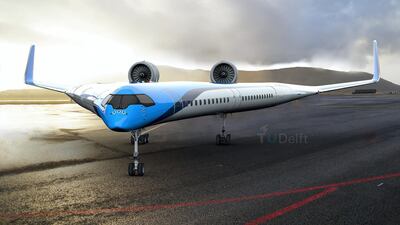
The Flying-V is a design for a highly energy-efficient long-distance aeroplane. Courtesy Edwin Wallet -
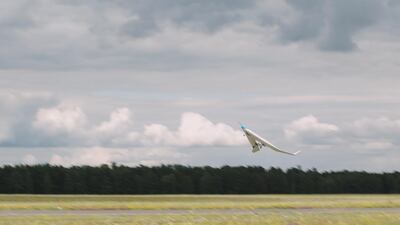
The jet's improved aerodynamic shape and reduced weight will reduce fuel consumption by 20 per cent. Courtesy Joep van Oppen -

The jet will offer travellers a variety of seating options, including clusters and lie-flat beds. Courtesy TUDelft -
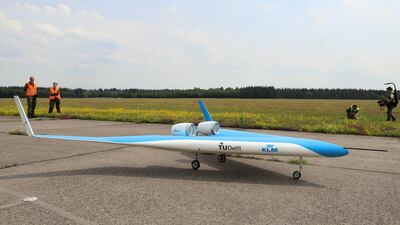
Researchers, engineers and a drone pilot of TU Delft travelled to an airbase in Germany for the first real test flight of the scaled model. Courtesy Malcolm Brown -

TU Delft preparation of model Flying-V. Courtesy Guus Schoonewille -

The flight crew with the scale model. Courtesy Malcolm Brown -
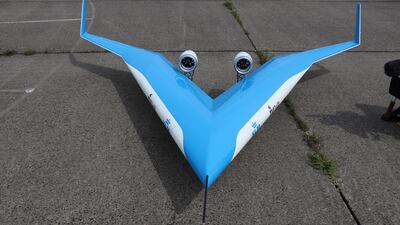
The Flying-V scale model is nearly three-metres-long and weighs 22.5 kilograms. Courtesy Malcolm Brown -
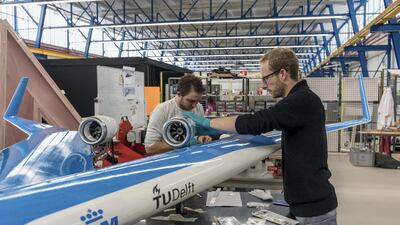
The team had to change the centre of gravity of the aircraft and fix the antenna to improve telemetry. Courtesy Henri Werrij -
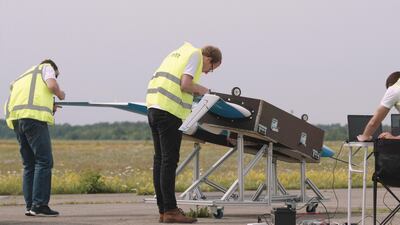
The test flight proved that the Flying-V's design caused a Dutch roll, which can mean a bumpy landing. Courtesy Joep van Oppen -
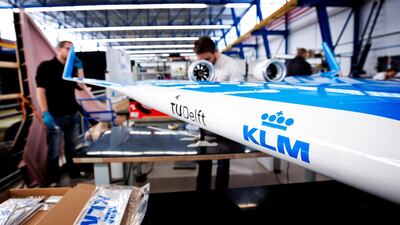
The next step for researchers will be providing the Flying-V with sustainable propulsion. Courtesy Guus Schoonewille


"One of our worries was that the aircraft might have some difficulty lifting-off, since previous calculations had shown that rotation could be an issue. The team optimised the scaled flight model to prevent the issue, but the proof of the pudding is in the eating. You need to fly to know for sure," said project leader Roelof Vos.
The team got the proof they needed, as the rotation on take-off played out flawlessly and at a speed of 80 kilometres per hour. The plane’s thrust was also good and flight speeds and angles were as predicted.
When it came to landing, the aircraft did so successfully, but in a way that would be rather uncomfortable if it were repeated with passengers on board.
The test flight showed that the Flying-V's current design leads to too much movement or wobbling in the wings, something known in aviation terms as "too much Dutch roll". This leads to an unsteady landing and the team will now get to work using data collected during the test flight to improve this.
Another step for the Flying-V team is to power the jet with sustainable propulsion now that researchers have determined it could carry liquid hydrogen. More test flights will be carried out as the design progresses.
The passenger experience
Although it will be a while before passengers get to experience flying on the jet, the most radical change, when they do, will be finding themselves seated in one of the Flying-V's wings.

New lightweight seat designs will offer more comfort and make the most of the aircraft's unique shape. There will also be four different seating options, including lounge chairs, group seating, individual seats and collapsible beds.
A passenger common area, resting space and buffet-style food hall are also in the works, and researchers are developing plans to revamp aircraft bathrooms as we know them to better suit the jet's design.

The original plan for the Flying-V aircraft design came from Justus Benad, a student at the Berlin Institute of Technology. It draws parallels with a similar design patented by a German aeronautics engineer in 1910.

