


In the extremely secure basement of a retail outlet and workshop of Queensmith, one of Britain's largest jewellery manufacturers, I was gazing at two diamonds, watching the light sparkle from them into different colours.
Brett Afshar, the founder and chief executive of Queensmith, which is based in London's Hatton Garden, historically one of the world's centres for diamond dealing, had challenged me to tell the difference between two diamonds.
The two stones in question have the same “c “s – clarity, carat, colour and cut. They were oval, two-carat stones of exceptional cut, colour and clarity.
But one was natural, dug from the Earth which formed it over hundreds of millions of years. The other was lab-grown, made by material scientists in a machine in Eastern Europe, probably over about two months. Chemically and structurally they were identical and I could not tell the difference.
“The reason I know you wouldn't be able to is that I can't tell the difference,” Mr Afshar told me.
jeweller
Just by looking at them, neither of us, or anyone else for that matter, can tell the difference between the two diamonds. But under a microscope, the lab-grown one will have a serial mark.
“I can tell the difference,” Mr Afshar said, “but I need gemological equipment to be able to do it.”
However, the two stones differ in one major aspect: the natural one is worth more than £30,000, while the lab-grown stone is valued at about £4,200.
It's this price differential that's causing the biggest disruption in the diamond market in 100 years.

Future of fad?
From Dubai to the US and from India and China, scientists have been replicating natural processes to create diamonds almost indistinguishable from the stones that took nature hundreds of millions of years to make up to 150 miles beneath the earth's crust.
Technology has disrupted countless industries over the years and diamonds are no exception, as the cost of creating lab-grown diamonds has fallen dramatically over the decades.
But these “disrupter” diamonds have sparked a debate within the industry – are they the future or just a fad?
Natural or mined diamonds are still deemed as being a rarity, a special prize forged over millennia and gleaned from the depths of Mother Earth. A lab-grown diamond, while identical, can be created in a matter of weeks.
“Human desire for rare and valuable objects runs deep – that’s something that we have been drawn to since the beginning of time,” one of the world's leading diamond experts, Paul Zimnisky, told The National.
“I don’t think that’s going to all of a sudden change. It may not be completely logical or practical, but it is what it is – I guess it’s a study in human psychology.
“But precious gems and metals make us feel good, they make us feel special – and maybe part of that is because they are impractical and thus bring some spice to our lives.”

Mr Afshar isn't so sure, given that about 80 per cent of the diamonds his craftspeople are setting into rings, necklaces and other forms of jewellery are lab-grown.
“If I was only selling natural stones, I'd be worried by the advent of lab-grown,” he told The National.
“How many people are going to look at these two stones and say, 'well, I can't tell the difference, but this one here costs a car's worth more than the other one'.
“You can see why 80 per cent of our clients will opt for a lab-grown stone.”
Natural diamond traders tend to refer to lab-grown as synthetic, a term lab-grown enthusiasts dismiss because such diamonds are chemically identical to their mined versions.
Martin Rapaport, the chairman of the Rapaport Group, feels that “the diamond and jewellery trade’s promotion of synthetic diamonds as a replacement for natural diamonds is driven by greed”.
“The sharp drop in synthetic diamond prices will disappoint consumers who purchased synthetic diamonds at high prices,” Mr Rapaport said earlier this year.
“They will not trust the diamond trade again. There will be a consumer backlash. The diamond and jewellery trade will suffer reputational damage.
“We estimate a 30 per cent drop in short-to-medium term natural diamond demand due to the negative impact of synthetics.
“It will take years for natural diamond demand to recover,” he added.
As such, the diamond industry has been charged with much emotion and polarity ever since lab-grown diamonds started to make big inroads into the global market almost ten years ago.
But lab-grown diamonds are not new – General Electric made them in the 1950s. What's changed is that technology has advanced and the process has become cheaper. By some estimates, the market for lab-grown diamonds grew from $1 billion in 2016 to $12 billion in 2022.
Lab-grown diamonds are created using two different methods. One mirrors the conditions that made the natural diamonds in the Earth's mantle, up to 150km below the surface. Pure carbon is pressed within a metal cube and exposed to immense heat and pressure through electric pulses. Eventually, the carbon breaks down and crystallises into a diamond. This method is referred to as High Pressure High Temperature (HPTP).
The other method, invented in the 1980s, “grows” a diamond from a seed or sliver of diamond in a vacuum chamber. The chamber is then filled with carbon-rich gases and heated to extremely high temperatures and as the gas turns to plasma, carbon pieces are released and become layered on to the seed, and the diamond “grows”. This method is called Chemical Vapor Deposition (CVD).
HPHT takes about two months to create a diamond, while the CVD method can produce a stone in weeks.
For Mr Afshar, the HPHT method tends to produce higher-quality diamonds, whereas the risk of discolouration and the need for post-production treatments is higher with CVD diamonds.
“Diamonds are not created equal, not grown equal,” he told The National.
“You've got an awful lot of poor quality, mass commercial, quickly-grown, lab-grown finding its way on to the market, and that's pushing down prices. But the demand for the very nicest lab-grown stones remains.”

Nonetheless, average prices of lab-grown diamonds tend to be about 80-90 per cent less than those of natural diamonds, for several reasons.
Natural diamonds have a longer and more expensive supply chain from mine to cutting floor to jeweller's shop window. Far fewer people come into contact with a lab-grown diamond on its way to being set in an engagement ring. However, while lab-grown stones completely bypass the mining process, the capital costs of the advanced technology used to create them can be fairly high.
But even so, Mr Zimnisky expects that at some point in the future, “the sale of lab diamonds by volume will far exceed that of natural diamonds, given that lab diamonds are a manufactured product”.
“It is not uncommon in the jewellery industry for manufactured gemstones produced and sold to exceed that of natural gemstones,” he told The National.
“I think as lab-grown diamonds fall in price, the volume sold will continue to increase. You will see lab diamonds used in more and more lower-priced fashion jewellery.”

Demand remains robust for natural diamonds and while they are much rarer than lab-grown, their supply is also quite tightly controlled so that prices stay robust. Theoretically, the only limitation on the supply of lab-grown diamonds is the rate at which they can be made.
“There's a lot of supply, but the actual supply of the really high-quality goods, and by that, I'm talking about stones that have been as-grown, haven't been tampered with, have no post-growth treatments, Mr Afshar said.
“Those are becoming harder to find in certain sizes, simply because the manufacturing processes are difficult – it’s difficult to grow a nice quality diamond.”
“But we've seen prices fall, which for customers, is great. It means that you can get a bigger stone make the budget work a lot harder.”
According to the diamond pricing website StoneAlgo, the price of a 2-carat lab-grown diamond dropped by more than eight per cent in the past month. Over the last year, lab-grown diamond prices have fallen more than 30 per cent, while natural diamonds have fallen by about 8.5 per cent.

Carbon neutrality and conflict-free
While the technology for lab-grown diamonds has been around for decades, it's only been comparatively recently that the methods have become commercially viable and in many cases environmentally sustainable.
There are now facilities across the world capable of making lab-grown diamonds that are carbon neutral, which in itself is part of the appeal, Mr Afshar believes.
“Mother Earth does not give up her treasures lightly,” he told The National.
“You have to move millions of tonnes of rock to expose a small amount of diamonds. With a lab-grown stone, yes it does require a lot of energy to produce it, but if you can produce responsibly. So, all of the stones that we sell are certificated as carbon neutral. An awful lot of work's gone in to make sure that happens.”
The demand for lab-grown diamonds created using renewable energy led the world's largest jewellery maker, Pandora, to decide to ditch natural diamonds completely three years ago and make exclusive use of lab-grown stones.
Alexander Lacik, chief executive and president of Copenhagen-based Pandora said recently that lab-grown diamonds “combine beauty and responsibility” and “represent the future of luxury”.
To create a sense of the scale of what the exclusive use of lab-grown diamonds means to Pandora, the company points out that if all diamonds were mined with the same carbon footprint as Pandora lab-grown stones, it would save more than 6 million tons of carbon dioxide a year, which is equal to the emissions from Denmark's electricity used last year.
There is also an ethical dimension when Mr Lacik speaks of “responsibility” in that lab-grown diamonds, by their nature, sidestep the issue of conflict or so-called blood diamonds.
Conflict diamonds funded several civil wars in Africa, including in Sierra Leone, Angola, the Democratic Republic of Congo and Liberia.
While an international certification scheme set up in 2003 called the Kimberley Process has helped quell the illicit trade in conflict diamonds, many say its remit is too narrow and organisations like Global Witness maintain that blood diamonds from conflict areas in places like the Central African Republic still find their way to international markets.
Having said that, it should be noted that most of the world's natural diamonds come from reputable sources, like the mining company, De Beers.
Bigger diamond, lower price
Ultimately, the choice between natural and lab-grown is down to the diamond buyer. Staring at the two diamonds in the basement of Queensmith in Hatton Garden, it's easy to see how customers could be swayed by the enormous price difference.
Tellingly, Mr Afshar points out that Queensmith is not seeing the average spend on an engagement ring diamond falling, be it natural or lab-grown.
“I think what's happening is that people are saying, ‘Well, I can get more for my money if I choose a lab-grown stone. I can get a bigger diamond of higher quality for a lower price’.”
But, there's also an emotional element to buying a diamond, which is difficult to discount. Those who favour natural over lab-grown, like Martin Rapaport, say that especially when it comes to engagement rings, “the idea that the gift of commitment must be expensive will dominate and many traditional women who received synthetic diamonds will feel cheated”.
“The wealthy class may turn to other natural gems now that the reputation of diamonds has been tarnished,” he added.
Far from being tarnished, Mr Afshar claims the advent of lab-grown stones has “democratised” the diamond market.
“How come one girl gets to live out her Kim Kardashian dreams? Every girl wants that, and what lab-grown allows you to do is democratise it,” he told The National.
“Of course, it's going to eat into the market for natural stones. It's such a perfect substitute.”
-
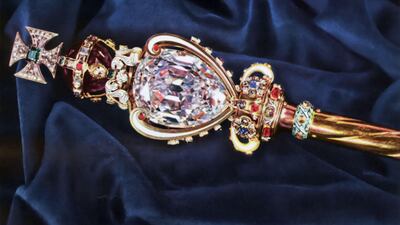
The Cullinan I diamond, or Great Star of Africa, is set in the head of the UK's Sovereign's Sceptre. It is one of nine diamonds cut from original Cullinan, the largest gem-quality rough diamond on record, discovered in South Africa in 1905. Getty Images -
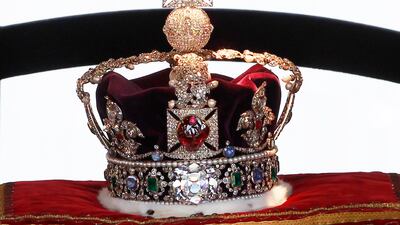
The Cullinan II diamond, or the Second Star of Africa, is also cut from the original Cullinan stone, and set in the front of the UK's Imperial State Crown. Getty Images -
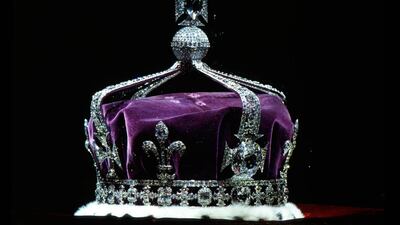
The Koh-i-Noor diamond, one of the largest cut diamonds in the world, is set in the Crown Of Queen Elizabeth, the Queen Mother. Getty Images -
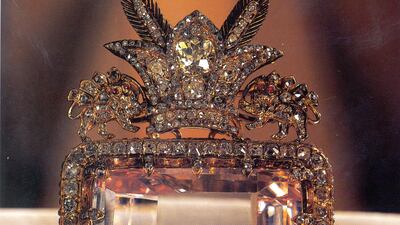
The Daria-i-Noor diamond is another of the world's largest cut diamonds, and is part of the Iranian National Jewels collection of the Central Bank of Iran. Wikimedia Commons -
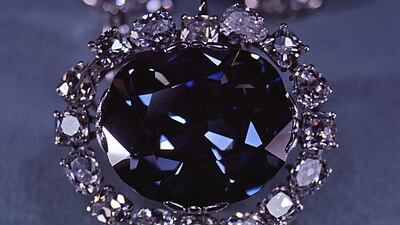
The Hope Diamond, estimated to be worth $200–350 million. It was once owned by King Louis XIV of France in the 1600s, and is now in the National Museum of Natural History in Washington, D.C. Wikimedia Commons -
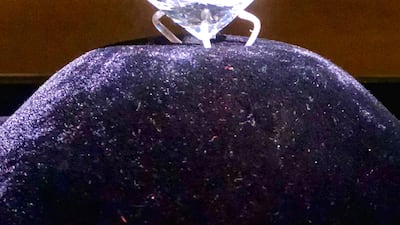
The Jacob Diamond, discovered in 1884, is estimated to be worth £100 million and is owned by the government of India. Wikimedia Commons -
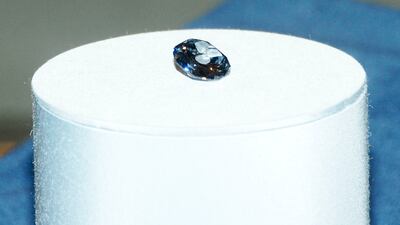
The Wittelsbach-Graff Diamond estimated worth is $80 million. It was discovered in India in the mid 1600s. Getty Images -
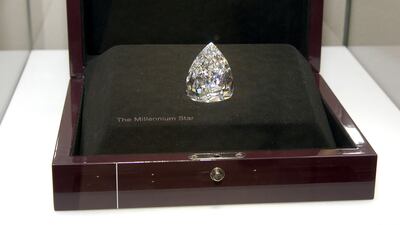
The Millennium Star is a diamond owned by De Beers, and is insured for £100,000,000. It was discovered in the Democratic Republic of Congo, at the time known as Zaire, in 1990. Getty Images -

The Centenary diamond, discovered in South Africa in 1986. Only the Cullinan I and II diamonds are larger than it. Getty Images -
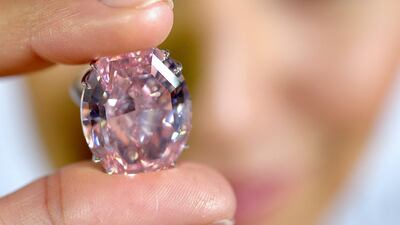
The Pink Star diamond was sold at auction for $71.2 million in Hong Kong in 2017. It was discovered in 1999 in South Africa. AP



