Join The National and Table Tales on a culinary journey around the Middle East to savour the quintessential dishes that embody the spirit of Ramadan. From table staples to family favourites, this series of recipes pays homage to the holy month and the home cook.
Fatteh is a Levantine dish of fried or toasted bread layered with grains, meat or vegetables and topped with yoghurt. There isn’t a direct translation in English for fatteh, which is derived from the Arabic verb fatta, meaning to crumble bread. Some refer to it as the “nachos of the Middle East”. Fatteh is popular at iftar tables for its soothing layer of yoghurt.
Recipe contributor Hanan Sayed Worrell of Table Tales says: "Historically, the aubergine has been a favourite of the poor and ridiculed by the rich. Early on, aubergines (eggplants in the US) were round and white, resembling large eggs. Some say that the vegetable's Arabic name, bad al jan, which means the djinn has laid eggs, shows that it was considered evil.
“But not in this case. Fattet al makdous is a well-known Damascene dish, which might be laborious to make, but has dramatic appeal with its different layers of texture and flavours. I learnt to make it from my Syrian grandmother.”
“Over the years, I have also adapted an easier vegetarian version, by simply slicing the eggplant, brushing it with oil and grilling it in the oven before simmering in the tomato sauce, to make a divine fatteh that is at once creamy, tangy and crunchy.”
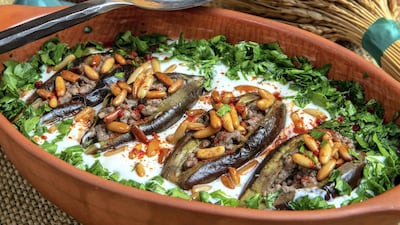
Fattet al makdous – stuffed aubergine in tomato and yoghurt-tahini sauce
Serves 8
Ingredients for the stuffed aubergine:
- 1 tbsp olive oil
- 55g pine nuts, divided
- 120ml cooking oil, divided
- 1 medium onion, chopped
- 350g minced beef
- 1 tsp seven spice
- ½ tsp cinnamon
- Salt and black pepper, to taste
- 5kg (about 8-9) baby aubergines
Ingredients for tomato sauce:
- 2 tbsp olive oil
- 1 medium onion, chopped
- 750g tomato sauce
- 1 tbsp tomato paste
- 1 tsp sugar
- 1 tbsp vinegar
- Salt and pepper, to taste
Ingredients for yoghurt sauce:
- 450g plain yoghurt
- 1-2 cloves garlic, crushed
- 2 tbsp tahini
- 2-3 tbsp lemon juice
- Salt and black pepper, to taste
Ingredients for fatteh:
- 1-2 small pittas
- Cooking oil (if frying the bread)
- Pomegranate seeds and chopped parsley, to garnish
Method for stuffed aubergine:
- Saute the pine nuts in one spoon of oil, shaking the pan until lightly browned. Remove and drain on paper towels.
- Add two tablespoons of cooking oil to the skillet and saute the onions until transparent. Add the beef and crush with a fork to combine. Season with seven spice, cinnamon, salt and pepper, reduce the heat and simmer for 15 minutes or until the beef has cooked. Remove from the heat. Stir in two tablespoons of the pine nuts.
- Peel the aubergines lengthwise in alternating strips. Hollow with a corer and fill with the meat and pine nut mixture. Add the remaining cooking oil to a deep skillet over medium heat. Fry the aubergine, turning until golden brown.
Method for tomato sauce:
- In a wide saucepan, saute the onions in olive oil until transparent. Add the tomato sauce, paste, sugar, vinegar, salt and pepper. Simmer for 10 minutes. Adjust seasoning to taste.
- Add the aubergines to the sauce and simmer on low heat for 30 to 40 minutes or until the aubergines are soft, turning them over a couple times.
Method for yoghurt sauce:
- Mix the yoghurt with all the ingredients. Adjust to taste. Bring to room temperature.
Method for fatteh:
- Cut the pitta into two centimetre squares. Fry in hot oil for a minute or two until golden brown. Remove and drain on paper towels. (Alternatively, open the pitta, toast in the oven and then crush into pieces.)
- To serve, place the pitta pieces at the bottom of a deep serving dish and pour over the yoghurt sauce.
- Layer the aubergine from the tomato sauce over it. Drizzle with the remaining sauce. Sprinkle pine nuts on top and garnish with pomegranate seeds and parsley.
This dish has been brought to you by international recipe hunter Hanan Sayed Worrell, author of Table Tales: The Global Nomad Cuisine of Abu Dhabi. The Table Tales concept celebrates the people and stories that give flavour to recipes of the Middle East.

Jigra
Starring: Alia Bhatt, Vedang Raina, Manoj Pahwa, Harsh Singh
Key facilities
- Olympic-size swimming pool with a split bulkhead for multi-use configurations, including water polo and 50m/25m training lanes
- Premier League-standard football pitch
- 400m Olympic running track
- NBA-spec basketball court with auditorium
- 600-seat auditorium
- Spaces for historical and cultural exploration
- An elevated football field that doubles as a helipad
- Specialist robotics and science laboratories
- AR and VR-enabled learning centres
- Disruption Lab and Research Centre for developing entrepreneurial skills
Everton 1 Stoke City 0
Everton (Rooney 45 1')
Man of the Match Phil Jagielka (Everton)
THE SPECS – Honda CR-V Touring AWD
Engine: 2.4-litre 4-cylinder
Power: 184hp at 6,400rpm
Torque: 244Nm at 3,900rpm
Transmission: Continuously Variable Transmission (CVT)
0-100kmh in 9.4 seconds
Top speed: 202kmh
Fuel consumption: 6.8L/100km
Price: From Dh122,900
RESULTS
5pm Maiden (PA) Dh70,000 (Dirt) 1,400m
Winner AF Nashrah, Tadhg O’Shea (jockey), Ernst Oertel (trainer)
5.30pm Maiden (PA) Dh70,000 (D) 1,400m
Winner Mutaqadim, Riccardo Iacopini, Ibrahim Al Hadhrami.
6pm Maiden (PA) Dh70,000 (D) 1,600m
Winner Hameem, Jose Santiago, Abdallah Al Hammadi.
6.30pm Maiden (PA) Dh70,000 (D) 1,600m
Winner AF Almomayaz, Sandro Paiva, Ali Rashid Al Raihe.
7pm Handicap (PA) Dh70,000 (D) 1,800m
Winner Dalil Al Carrere, Fernando Jara, Mohamed Daggash.
7.30pm Handicap (TB) Dh70,000 (D) 1,000m
Winner Lahmoom, Royston Ffrench, Salem bin Ghadayer.
8pm Handicap (PA) Dh70,000 (D) 1,000m
Winner Jayide Al Boraq, Bernardo Pinheiro, Khalifa Al Neyadi.
UAE currency: the story behind the money in your pockets
THE SPECS
Engine: 2.0-litre 4-cylinder turbo
Power: 275hp at 6,600rpm
Torque: 353Nm from 1,450-4,700rpm
Transmission: 8-speed dual-clutch auto
Top speed: 250kph
Fuel consumption: 6.8L/100km
On sale: Now
Price: Dh146,999
Key findings of Jenkins report
- Founder of the Muslim Brotherhood, Hassan al Banna, "accepted the political utility of violence"
- Views of key Muslim Brotherhood ideologue, Sayyid Qutb, have “consistently been understood” as permitting “the use of extreme violence in the pursuit of the perfect Islamic society” and “never been institutionally disowned” by the movement.
- Muslim Brotherhood at all levels has repeatedly defended Hamas attacks against Israel, including the use of suicide bombers and the killing of civilians.
- Laying out the report in the House of Commons, David Cameron told MPs: "The main findings of the review support the conclusion that membership of, association with, or influence by the Muslim Brotherhood should be considered as a possible indicator of extremism."
Springsteen: Deliver Me from Nowhere
Director: Scott Cooper
Starring: Jeremy Allen White, Odessa Young, Jeremy Strong
Rating: 4/5
FA CUP FINAL
Chelsea 1
Hazard (22' pen)
Manchester United 0
Man of the match: Eden Hazard (Chelsea)
Killing of Qassem Suleimani
How the bonus system works
The two riders are among several riders in the UAE to receive the top payment of £10,000 under the Thank You Fund of £16 million (Dh80m), which was announced in conjunction with Deliveroo's £8 billion (Dh40bn) stock market listing earlier this year.
The £10,000 (Dh50,000) payment is made to those riders who have completed the highest number of orders in each market.
There are also riders who will receive payments of £1,000 (Dh5,000) and £500 (Dh2,500).
All riders who have worked with Deliveroo for at least one year and completed 2,000 orders will receive £200 (Dh1,000), the company said when it announced the scheme.
Who was Alfred Nobel?
The Nobel Prize was created by wealthy Swedish chemist and entrepreneur Alfred Nobel.
- In his will he dictated that the bulk of his estate should be used to fund "prizes to those who, during the preceding year, have conferred the greatest benefit to humankind".
- Nobel is best known as the inventor of dynamite, but also wrote poetry and drama and could speak Russian, French, English and German by the age of 17. The five original prize categories reflect the interests closest to his heart.
- Nobel died in 1896 but it took until 1901, following a legal battle over his will, before the first prizes were awarded.
