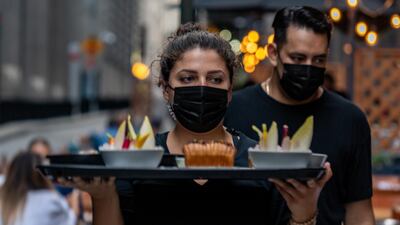
If staff can wear face masks all day, customers should remember to do so when they need to leave the table, even temporarily. Photo: David 'Dee' Delgado / Bloomberg

Covid-19 restaurant etiquette: 5 things to keep in mind when dining out during the pandemic


Janice Rodrigues
  • English
  • Arabic

There was a time when dining etiquette meant keeping your elbows off the table, chewing with your mouth closed and ensuring everyone was served before tucking into the meal.

While these basics remain unchanged, the onset of the coronavirus has impacted the way we view eating out as a whole. Tacit table manners are no longer limited to knowing which cutlery to use when (the rule for that, by the way, is to start from the outside and work your way in). If you're heading to a restaurant during and, we suspect, even after the pandemic, here are some niceties and necessities to keep in mind.

Stay well-versed on changing rules

Amanda Herholdt, operations manager at The Coffee Club, believes one of the most important measures when dining out is to be mindful of the current Covid-19 regulations. “We are following these health and safety guidelines so that we can assure guests that we are offering them a safe environment to dine out or order in,” she says.

In Dubai, current Covid-19 rules allow for up to eight guests per table. As part of an update to these regulations, restaurants have also been given the option to use dividers instead of placing tables two metres apart.

Meanwhile, Dubai's Department of Tourism and Commerce Marketing has said that bars and restaurants in the emirate must suspend all entertainment activities by 1am, and hotels must stop providing food and drinks after 3am, with the exception of delivery and room service.

Abu Dhabi restaurants are currently allowed to operate at 80 per cent capacity and have four people per table, says Pascal Pinazo, general manager at Fouquet’s, plus all tables must be spaced two metres apart.

Chef Reif Othman of Reif Japanese Kushiyaki asks customers not to request extra chairs or to join tables. Antonie Robertson / The National

It's important to keep these changing rules in mind when making requests at a restaurant. For example, Reif Othman, founder of Reif Japanese Kushiyaki Restaurant, requests that customers do not ask staff for additional chairs or tables to the space assigned to them. "Especially in a small restaurant that doesn't allow for additional seating, this might violate the two-metre social-distancing rule set by authorities," he says.

Put on face masks when leaving the table

If restaurant staff can wear face masks at all times, customers can do the same when they are not seated. Chris Whiteoak / The National

Pinazo says wearing masks is one of the most basic precautions. "Masks are obligatory when guests are away from the table. We are also providing a disposal bin on the table for this and a replacement mask whenever necessary," he says.

If you feel that's too tough, remember that staff at restaurants have to wear masks all day. As one irate restaurant goer puts it: "That means customers can surely pop one on when walking to the toilet or while pacing back and forth, talking on the phone. When seated at a safe distance and eating, it's normal to take it off, but when standing over people and walking around, put one on.

"Not doing so is not only worthy of a fine, but it's also immensely disrespectful. The customer is not always right, and waiters are busy enough trying to tackle new norms while keeping service running smoothly."

Meanwhile, when seated at the dining table, remember to put that face mask away. "It's unhygienic and rude to keep it on the table, especially when staff have to put food there. Tuck it into your pocket, bag or purse," says Othman.

Keep up with your reservations

With tables being spaced out, restaurants are still not able to accommodate as many customers as they once did. That means it's doubly important to make a reservation when you're planning to eat out, to avoid any crowding at the entrance. Likewise, if you can't make the reservation, take the trouble to cancel it. Not showing up is not only rude, but it can also cost the restaurant, which often turns away customers if it has been fully booked.

Brian Voelzing, group executive chef at Lincoln Hospitality, which oversees La Serre, The Loft at Dubai Opera, Distillery and Taikun, says it's not fair to business or to the staff. "We try to engineer the menus in such a way that we don't have wastage. But if you think you've got 42 people coming in for brunch and you're preparing food platters, and 42 don't turn up, then you are left with extra food."

After you're done with your dinner, don't stay past your allotted time. "Staff need time to properly sanitise the table before seating the next guests," says Othman.

Avoid touching anything you don’t have to

Zomato has launched contactless dining, so you can browse menus, order meals and pay bills using QWR codes

No matter how careful you’re being with your personal hygiene, it's best to avoid touching more surfaces than you have to during these times. Some establishments may have menu cards on tables but if you have the option, scan the QR code with your phone to see the menu.

The rule also applies to another person’s plate. If your dining companion isn’t family or sharing food may make them uncomfortable or unsafe, be respectful of their personal space and don’t offer them your food, either.

Be kind and patient

The restaurant industry has been hard hit over the past year, and it would be best to be mindful of changes staff are still undergoing as they keep up with the new normal. "Sometimes, the mask makes it difficult for them to communicate properly," Herholdt says. "We kindly ask that guests show some patience to team members serving them in restaurants."


UAE currency: the story behind the money in your pockets
SEMI-FINAL

Monterrey 1 

Funes Mori (14)

Liverpool 2

Keita (11), Firmino (90 1)

THE SPECS


Engine: 1.5-litre


Transmission: 6-speed automatic


Power: 110 horsepower 


Torque: 147Nm 


Price: From Dh59,700 


On sale: now  


Mercer, the investment consulting arm of US services company Marsh & McLennan, expects its wealth division to at least double its assets under management (AUM) in the Middle East as wealth in the region continues to grow despite economic headwinds, a company official said.

Mercer Wealth, which globally has $160 billion in AUM, plans to boost its AUM in the region to $2-$3bn in the next 2-3 years from the present $1bn, said Yasir AbuShaban, a Dubai-based principal with Mercer Wealth.

Within the next two to three years, we are looking at reaching $2 to $3 billion as a conservative estimate and we do see an opportunity to do so,” said Mr AbuShaban.

Mercer does not directly make investments, but allocates clients’ money they have discretion to, to professional asset managers. They also provide advice to clients.

“We have buying power. We can negotiate on their (client’s) behalf with asset managers to provide them lower fees than they otherwise would have to get on their own,” he added.

Mercer Wealth’s clients include sovereign wealth funds, family offices, and insurance companies among others.

From its office in Dubai, Mercer also looks after Africa, India and Turkey, where they also see opportunity for growth.

Wealth creation in Middle East and Africa (MEA) grew 8.5 per cent to $8.1 trillion last year from $7.5tn in 2015, higher than last year’s global average of 6 per cent and the second-highest growth in a region after Asia-Pacific which grew 9.9 per cent, according to consultancy Boston Consulting Group (BCG). In the region, where wealth grew just 1.9 per cent in 2015 compared with 2014, a pickup in oil prices has helped in wealth generation.

BCG is forecasting MEA wealth will rise to $12tn by 2021, growing at an annual average of 8 per cent.

Drivers of wealth generation in the region will be split evenly between new wealth creation and growth of performance of existing assets, according to BCG.

Another general trend in the region is clients’ looking for a comprehensive approach to investing, according to Mr AbuShaban.

“Institutional investors or some of the families are seeing a slowdown in the available capital they have to invest and in that sense they are looking at optimizing the way they manage their portfolios and making sure they are not investing haphazardly and different parts of their investment are working together,” said Mr AbuShaban.

Some clients also have a higher appetite for risk, given the low interest-rate environment that does not provide enough yield for some institutional investors. These clients are keen to invest in illiquid assets, such as private equity and infrastructure.

“What we have seen is a desire for higher returns in what has been a low-return environment specifically in various fixed income or bonds,” he said.

“In this environment, we have seen a de facto increase in the risk that clients are taking in things like illiquid investments, private equity investments, infrastructure and private debt, those kind of investments were higher illiquidity results in incrementally higher returns.”

The Abu Dhabi Investment Authority, one of the largest sovereign wealth funds, said in its 2016 report that has gradually increased its exposure in direct private equity and private credit transactions, mainly in Asian markets and especially in China and India. The authority’s private equity department focused on structured equities owing to “their defensive characteristics.”

Benefits of first-time home buyers' scheme
  • Priority access to new homes from participating developers
  • Discounts on sales price of off-plan units
  • Flexible payment plans from developers
  • Mortgages with better interest rates, faster approval times and reduced fees
  • DLD registration fee can be paid through banks or credit cards at zero interest rates
DIVINE%20INTERVENTOIN
%3Cp%3EStarring%3A%20Elia%20Suleiman%2C%20Manal%20Khader%2C%20Amer%20Daher%3C%2Fp%3E%0A%3Cp%3EDirector%3A%20Elia%20Suleiman%3C%2Fp%3E%0A%3Cp%3ERating%3A%204.5%2F5%3C%2Fp%3E%0A