
I have never considered myself a minimalist. I like nice things, enjoy shopping and can easily convince myself that a purchase is an investment rather than an indulgence.
But since becoming pregnant with my first child, I have found myself navigating a level of consumerism unlike anything I have experienced before.
It started with a spreadsheet.
A friend sent over a document curated by a well-known influencer and businesswoman. It was a comprehensive list of everything one could possibly need for a newborn. There were tabs, categories, colour-coded cells and links to products. It was a work of type-A art. But it was also overwhelming.
managing director of Peninsula Psychology
With the lists come the new words – Artipoppe, Isofix, Owlet – all of which come with a sizeable price tag, designed to solve problems I didn't know existed.
On the subject of the fabled Artipoppe, I asked friends on Instagram whether a baby carrier could really justify a Dh1,650 ($450) price tag. The replies were split: people either swore by it or couldn't fathom spending that much money on something that straps a baby to your chest, even if it does come in leopard print. The suggestion to shop for one second-hand came up more than once.

My friends without children are looking on bemused, asking how much stuff one tiny person could possibly need. It's a fair question.
Part of the problem is that, as a first-time mother, I am entering an entirely new market. I consider myself a reasonably informed consumer, but when it comes to babies, I have no frame of reference. Until recently, I couldn't have told you the difference between a travel system and a pram (I am still not 100 per cent sure I now know), or why one bottle steriliser might cost three times as much as another.
When you don't know what you need, it is remarkably easy to be persuaded that you need everything.
Rita Figueiredo, managing director of Peninsula Psychology, says this is something brands can exploit.
"Marketing, particularly on social media, can introduce a concern parents had not even considered and then present a product as a way of reducing that risk," she says. “Research on consumption during the transition to motherhood describes how social expectations about being a good mother can be reinforced through marketing … This is perhaps the most troubling part: the suggestion that buying a particular product makes someone a better, more caring parent."
There is, of course, the excitement of it all.

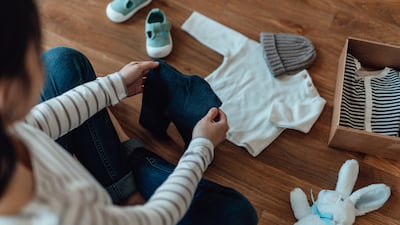
Having a baby is a huge milestone and buying things is one of the few tangible ways to prepare for something that still feels abstract. Choosing a cot, organising tiny clothes and imagining the little person who will eventually use them is lovely.
But I am also acutely aware that being able to browse, compare and deliberate over these purchases is a privilege in itself. For many expectant parents, the challenge isn't deciding what not to buy, but finding the money for the essentials.
Maryanne Peacock, host of the Mother Tongue podcast, believes that it is enthusiasm that drives the urge to overbuy, rather than external influences.
“With your first, you don’t really know what you’ll need, so you’re more likely to buy things just in case. Social media, recommendations from friends and brands all feed into that. When you keep seeing something described as a must-have, you start to think you should probably have it too,” she says. Adding, “We need more reassurance that you can have the basics ready and figure other things out once your baby is here.”
Alongside my excitement are the intrusive thoughts. What if the baby won't sleep? What if feeding is difficult? What if I find myself lost in the middle of the night, desperately needing something I could have bought months earlier?
Preparing with products can become the one part of parenting that feels controllable. "You can’t practise the 3am feeds or know what your baby’s personality will be like, but you can buy the bassinet," says Anna Baker, founder of SleepBaker sleep consultancy.
"The tricky part is that the stuff doesn’t make you ready. Knowledge does, support does, and a good night’s sleep definitely does," Baker adds.

A bassinet, or Moses basket, is another polarising product. To some, they're an essential; others dismiss them as a waste of space and money, something you'll only use for a handful of months. This has made me more interested in products that grow with my child – cots that convert into beds, high chairs that can be used for years, and car seats that have a purpose long after the newborn stage.
specialist in baby travel safety at Britax Romer Arabia
It's a philosophy echoed by Karishma Rajput, brand lead at Stokke Middle East.
“I would challenge the idea that being prepared means having everything bought, assembled and perfectly organised before the baby arrives," she says.
"The best purchases are not necessarily the newest, most talked-about or most expensive. They are the ones that genuinely meet a need and continue to be useful as circumstances change."

As well as looking for products with longevity, I have been exploring second-hand options. Babies grow so quickly that plenty of equipment and clothing is barely used before being outgrown. Buying pre-loved or accepting hand-me-downs from friends makes financial and environmental sense. And there is something satisfying about giving a beautifully made piece of furniture a second life, rather than assuming everything needs to be bought brand new.
This is not an argument against shopping for the essentials, particularly when safety is involved. But I am trying not to lose sight of the difference between items that genuinely protect a child and unnecessary gadgets sold with a safety spin.
"For car travel, a suitable and safe car seat is an essential rather than an optional extra," says Hossam Gamal, specialist in baby travel safety and product training at Britax Romer Arabia.

But even here, more expensive does not automatically mean more appropriate. Gamal stresses that parents should choose a seat that fits their child and vehicle and understand how to install and use it correctly.
"Babies do not need an elaborate collection of equipment to begin exploring the world around them," Gamal says.
It is also an area where I would be particularly cautious about sourcing second-hand, unless I could be certain of a car seat's history, condition and suitability.
Ultimately, I am trying to separate what a baby genuinely needs from products I am being encouraged to want. Something another parent considers indispensable might never be opened in our house, while a product we have dismissed could turn out to be the best thing we buy.
The most useful advice I have received, and something I am trying to remind myself daily as I browse Next, Amazon and Mamas and Papas, is the simplest: you can always buy things later.
Amid the spreadsheets, shopping lists and targeted advertising, that is surprisingly easy to forget.

