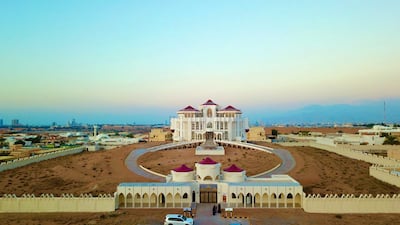

Built on a hill in Ras Al Khaimah as a grand private residence, Al Qasimi Palace spent much of its existence unoccupied.
Its history stretches back to 1975, but the property sat empty for about 35 years, leading to its reputation as a haunted house.
With no inhabitants, the palace became a breeding ground for stories of strange activity that began circulating among the people living nearby. Some have reported seeing children’s faces appear at windows and furniture moving on its own, while supernatural spirits, or jinn, are said to occupy the building.


The accounts gave the palace a reputation that spread beyond the neighbourhood and attracted people curious to enter it.
After a spell as a private museum, the property is now on the market for Dh23.5 million.
Behind the gates

The building opened to the public as a museum in 2019, enabling visitors to walk through Al Qasimi Palace's decorated rooms and see what was hiding behind its gates.
It is billed by the Ras Al Khaimah Tourism Development Authority as an “abandoned palace”, but its reputation as the emirate's haunted house has stuck.
Wasim Halabieh, who runs the palace and is a spokesman for its owner, Tareq Al Sharhan, says at least some of the sounds that fuel the haunted rumours can be explained by people entering the property without permission.
During the years when it stood largely empty, people would sneak inside and move around the building, Halabieh tells The National.
“So that’s where the rumours came from, that ghosts are living inside,” he says, adding that the stories persisted even after Al Sharhan bought the property in 2019.
Decorated history

The explanation is more ordinary than the stories that made the palace famous, but the building itself is anything but modest. Across its 35 rooms are ornate furnishings, colourful tiles, painted ceilings and decorative sculptures.
The palace was commissioned by the late Sheikh Abdulaziz bin Humaid Al Qasimi, a member of Ras Al Khaimah’s ruling family. A board displayed at the property says he selected the hilltop site after the establishment of the UAE, intending to create a residence with views across the emirate. A building permit was issued on June 2, 1975.
Work on the foundations and structure took a decade, after which artisans from around the world were brought in to decorate the palace. Their work combined local, Indian and Moroccan influences, among others.

French and Belgian chandeliers hang above marble details, while figurative paintings and carvings feature throughout the building.
Some of the palace’s artwork was damaged by people who believed the figurative images might attract jinn. They scratched out the eyes of humans and animals from paintings, and beheaded plaster birds, as noted in a 2020 story in The National.
When it comes to why the palace remained empty, a board displayed inside says Sheikh Abdulaziz, too, faced opposition from close friends and family over the artwork with human and animal figures.
“He was a lover of beauty and art”, the board reads, and did not want to remove pieces that had required significant time and money to create. “Therefore, the palace was abandoned for some time.”

Speaking to The National in 2020, Al Sharhan, who grew up in the neighbourhood, said rumours about the palace being haunted began mid-construction. “Yanni, how can it be haunted if it’s not even finished?” he said.
Al Sharhan bought the palace from Sheikh Abdulaziz’s heirs in 2019 and began restoring it.
Work included repairs to its murals, sculptures, tiles and furniture, as well as the gardens. By late that year, it opened as a museum and members of the public were being admitted to a building many had previously known only from the outside.
“Everybody knew this place was for ghosts. I thought I could change its story to something better, something cultural, something for tourists,” Al Sharhan said.
Part of the palace’s appeal lies in what remains inside. Paintings, sculptures, ornate furniture and decorative pieces fill its rooms, while Al Sharhan said more items were uncovered in the rooms and the basement during restoration. He believes some could be worth millions of dirhams, although he did not identify the pieces and their value has not been independently established.
Does it feel haunted?
Knowing the palace’s reputation before arriving shaped my experience of it. The first two floors felt less unsettling than I expected, and I was more occupied by the detailed interiors.
On the third floor, I noticed a strange smell and felt uncomfortable in one particular room. Nothing happened that I could point to as evidence of anything supernatural, but I did not want to linger. It was difficult to separate the feeling from the stories I had heard before entering.
The palace is now being offered for sale at Dh22.5 million, or Dh23.5 million with its furniture and artefacts. Halabieh says the property has been priced based on a valuation by a third-party company.

