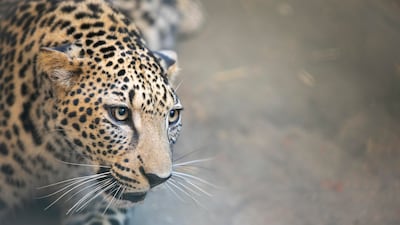

The Smithsonian's National Zoo in Washington is developing a new habitat for the critically endangered Arabian leopard, with a breeding pair expected to travel to the US from Saudi Arabia.
The Royal Commission for AlUla and the Smithsonian’s National Zoo and Conservation Biology Institute announced the project on Thursday as part of a partnership focused on conservation and research. According to the Smithsonian, the habitat is expected to open in 2029.
Fewer than 120 Arabian leopards are estimated to remain in the wild, making the subspecies one of the world’s rarest big cats.

Currently, the species is also held at conservation and wildlife facilities across the Arabian Peninsula, including Al Ain Zoo, Arabia’s Wildlife Centre in Sharjah and Al Hefaiyah Mountain Conservation Centre in Kalba, as well as the Mohamed bin Zayed Nature Reserve in Bahrain.
The two leopards are expected to be transferred from Saudi Arabia’s conservation breeding programme, although the move remains subject to technical assessments and regulatory approvals, including for animal welfare, genetic suitability and readiness.
The Washington habitat will introduce the Arabian leopard to an international audience while highlighting efforts to protect the species in the kingdom.
“Protecting the critically endangered Arabian Leopard is long-term work,” said Abeer Al Akel, chief executive of the Royal Commission for AlUla. “It means restoring the landscapes it needs, strengthening the science behind its recovery, and developing the Saudi conservation talent who will help carry this mission forward.
“Through our partnership with Smithsonian, [the] RCU is connecting AlUla’s natural legacy with global conservation expertise – building the knowledge, capability and long-term conditions needed to support the species’ recovery.”

The RCU operates a leopard conservation breeding programme, accredited by the European Association of Zoos and Aquaria, in Taif, where the managed population has more than doubled since the commission took over.
The programme aims to maintain a genetically diverse population of Arabian leopards under human care while supporting the longer-term goal of returning the species to the wild. Scientists and animal-care specialists from the RCU and the Smithsonian will work together on research, breeding and management of the population’s genetic diversity.
The partnership will also include training and knowledge exchange, with selected Saudi and AlUla students expected to take part in a professional exchange programme at the Smithsonian-Mason School of Conservation in Virginia next summer.
The Arabian leopard was historically found across parts of the Arabian Peninsula, but its population has declined substantially, with habitat loss and declining prey populations among the threats to its survival.
The species has a long connection to AlUla, where depictions of leopards have been found in ancient rock art.
At the announcement ceremony in Washington, the Smithsonian was presented with a sandstone replica of an AlUla petroglyph depicting a leopard beneath a horse-drawn chariot. The original is broadly dated to between 800 BCE and 400 CE and the replica will become part of the new exhibit.
The collaboration forms part of a wider programme aimed at returning Arabian leopards to the wild in AlUla.
Rather than setting a fixed date for reintroduction, the RCU says progress will depend on conditions that also include sufficient prey and the ability to monitor the leopards over the long term.
Protected areas cover more than half of AlUla and work is under way to restore vegetation and reintroduce native wildlife.
The AlUla Native Plant Nursery and Seed Bank has produced more than one million native plant seedlings, with more than 650,000 supplied to more than 70 RCU projects.
More than 74,400 hectares have also been rehabilitated in Sharaan National Park, where the RCU says vegetation cover has increased from about 6 per cent in 2018 to 50 per cent by mid-2026.

More than 1,700 animals have been released as part of AlUla's wildlife restoration programme, with successful breeding subsequently recorded in reserves. The reintroductions are intended to help rebuild ecosystems and establish a sustainable prey base for Arabian leopards in the wild.
“Extinction is not inevitable,” said Brandie Smith, the John and Adrienne Mars director of the Smithsonian National Zoological Park. “When we bring together exceptional animal care, cutting-edge science, sustained investment and partners committed for the long term, we can change the future for wildlife.
“This exhibit will connect millions of people with one of the rarest cats on Earth and with the science and collaboration working to save it.”

