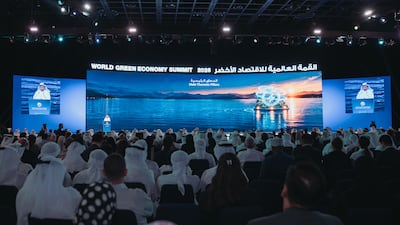
Thousands of delegates gathered at Dubai's World Trade Centre on Wednesday for the opening day of the World Green Economy Summit (WGES), with speakers pressing the case that the transition to a green economy requires change not just from governments and industries but from every individual consumer.
The summit brought together figures from waste management, artificial intelligence and environmental finance, among many other sectors. The conversations ranged from the contents of a Dubai rubbish chute to the future of AI-powered desalination, and most confirmed that solutions exist, but we still need incentive structures and out-of-the-box thinking from entrepreneurs looking to scale them.
Waste as a resource
For Timothy Clarke, chief executive of Dubai's Warsan Waste Management Centre (WWMC), the single most important shift in thinking is linguistic. "We need to stop talking about ‘waste’," he said. "It is a hugely valuable ‘resource’. We have a resource which, at the moment, we destroy, we throw away. But actually what we need is for people to look at that and say, ‘I can use that part of it for something else’."

WWMC receives 6,000 tonnes of unsorted waste every day from Dubai Municipality, burning it to generate electricity. The plant works, but Mr Clarke argues it is the last resort, not the goal. "If nothing comes to the energy-from-waste plant, that is a success for me, because it means we are recycling everything."
Getting there requires a policy environment that makes recycled materials economically competitive with virgin ones. "Everybody always goes for the cheapest product that meets their requirements," he said. "If cost is a major driver, we have got to make sure that the green alternatives are economic, so that people make the wiser, sustainable, recycling choice."
Cleaning rivers before the plastic reaches the sea
Sitting alongside Mr Clarke on a morning panel about driving the circular economy was Anssi Mikola, co-founder of River Recycle, a company that operates cleaning and recycling operations on rivers in the developing world. He argues that the ocean plastic crisis starts inland, where inadequate waste infrastructure leaves communities with rivers as their only disposal option.

"The rivers are the only place where nobody comes after you," Mr Mikola said. "It is out of sight, out of mind. Nobody is responsible for it. Once you get it in the river, it moves to the next municipality."
River Recycle is now operational on 20 rivers and is expanding to 30, a milestone Mr Mikola described as significant because it opens the door to larger, city-scale solutions rather than individual waterway interventions. "It has taken a long time to prove that the cleaning works and that the recycling part works."
The company's challenge – and its reason for attending WGES – is funding. Scaling a circular economy in developing nations requires capital those nations do not have. "We exist to save the oceans," Mr Mikola said, "and the oceans have been destroyed by developing countries. You need funding to scale up a circular economy in those countries."
Blended finance instruments – combining philanthropic seed funding with impact investment – are the vehicle he is seeking. The connections made at events like WGES, he said, matter as much as the panel discussions.
AI's place in a green summit
AI was also, naturally, integral to the conversation. Darren Kimura, chief executive of AISquared, delivered one of the morning's keynote addresses. "A summit, by nature, brings together leaders in an area – people that can actually create policy, laws, guidance, thought leadership," Mr Kimura told The National. "And then it allows you to bring different perspectives in and hopefully change the way people are thinking or what they are doing."
His keynote included what he called the Dubai AI Challenge: a call for the UAE's technology community to stop measuring AI by headline-grabbing capabilities and start measuring it by concrete environmental outcomes. "Rather than having AI just create interesting things that are cool, like a headline, why don't we try to quantify it with things like metrics that show how much we are actually saving? How much money we are saving and how much water we are saving?"

Mr Kimura's presence at a green economy summit raised an obvious question, given the volume of criticism directed at AI's water and energy consumption. He argues the technology's footprint depends entirely on how it is designed and deployed. New liquid cooling approaches – immersing processors in nano-material fluids rather than relying on water evaporation – can significantly reduce data centre water use, for example. And AI applied to resource management can drive efficiencies that offset its own demands, he said.
"Using AI to actually get to those new technologies will help us to reduce it in the grand scheme of things over time," he said, "and I think that is something that is not necessarily talked about in the common conversation."
His company's focus is on sovereign, democratised AI; models small enough to run within a single company or household, keeping data private and computation local. A new family of such models is due imminently. "Giving the power to the consumer – I think that is really what we are trying to do now."
The challenge of getting everyone involved
Across the morning sessions, it was agreed that the green economy cannot be built by summits alone. Mr Clarke said: "Everybody needs to be involved in this. It is not something that governments or industries can do. A lot of it is the individual person – about your choices when you go into a supermarket."
He was particularly pointed about packaging. Around 15 per cent of the waste arriving at WWMC each day consists of single-use items – packaging that consumers did not want, bundled around the product they did want. The solution, he said, requires both consumer pressure and business leadership. "What we need is for more people to be influencing people directly to make the right choices."
Mr Mikola is thinking in similarly collective terms. For example, he noted that River Recycle turns electricity into heat in its processing operations, while WWMC turns heat into electricity. "Why don't we just work together?" he asked. “And take the heat once it is there, rather than getting all the losses that it takes to turn it into energy?"
That kind of lateral thinking, he suggested, is what a summit like WGES is designed to produce. "I hope [the event] leads to people thinking a bit more outside the box – looking at the bigger picture rather than just your own,” added Mr Mikola. “The solution may not be inside your focus, but there may still be a very good solution out there."
This page was produced by The National in partnership with WGES

