


When Dr Ahmed Sherif moved to the UK six years ago, he struggled to meet another Egyptian doctor at the hospital that recruited him.
By the time he left London’s Great Ormond Street Hospital a year later, in 2019, he recalled there was at least one doctor from Egypt working in every department.
The UK’s National Health Service, has sought to fill gaps in staff shortages by recruiting healthcare workers from overseas.
An estimated one in five overseas healthcare professionals are now part of the workforce, the first time this milestone has been reached, analysis by PA has shown.
Egyptians make up almost 3 per cent of NHS doctors, with more than a third (36.6 per cent) of the NHS doctors being foreign nationals, according to the PA.
This is a sharp rise from 2020, where just under one in three (30 per cent) NHS doctors came from overseas, and 2016, where it was more than a quarter of NHS doctors (26.6 per cent).
Three in 10 nurses are now non-British nationals.
These doctors have made difficult choices to come to the UK, often spending months away from their families as they wait for their immigration visas, or feeling isolated in a new country.
“The challenges are there, but everyone thinks it's worth it,” Dr Sherif said.
Dr Sherif, 39, now works as a paediatric trainee at the Royal Devon University NHS Trust, and is now one stage away from becoming a consultant – or senior doctor.
Egypt’s doctors traditionally emigrated to the Gulf countries, where salaries were considerably higher, and where the shared culture and language made the move easier.
But when the UK relaxed its immigration rules for overseas doctors in 2019, many were drawn there, Dr Sherif told The National.
They sought the NHS’s valued training opportunities that would allow them to progress in their medical career.
“You can join the training system and come out as a consultant,” he said.
Dr Sherif said training with the NHS exposed him to the expertise he had “only heard about in textbooks".

“You have access to the consultants who write the medical guidelines. The people who publish the medical research are all working [in the NHS]” he said.
Having come to the UK before the new immigration rules came into effect, Dr Sherif and spent years studying for English language and other medical exams.
“Doing that while also doing clinical work in Cairo was hard,” he said.
Dr Sherif wanted to witness the NHS first hand, so that he could contribute to reforming the system in Cairo, which also provides universal healthcare.
“Our system in Egypt is based on the same principle as the NHS: it’s a free service of all. I was thinking of how to return to Egypt and improve the situation,” he said.
Having graduated in the years running up to the 2011 Arab uprisings, which saw the overthrow of President Hosni Mubarak in Egypt, he hoped he could bring change to his country.
“There’s a whole generation of doctors who grew up around the revolution,” he said.
Yet moving to the UK also comes with challenges. It took Dr Sherif about four months for his two children and then-pregnant wife to be able to join him.
During the pandemic, they were not able to travel to Egypt to see family when loved ones had died. The absence of extended family support meant they struggled to organise child care.
Dr Sherif says he was lucky to have started his NHS career in London at Great Ormond Street Hospital, a world leader in paediatrics.
“London is a diverse city, and Gosh is the most diverse hospital on the continent. Everyone is a stranger,” he said.
But Egyptian colleagues who were recruited outside of London have felt alienated, Dr Sherif said.
“They struggled for at least the first first two years," he said. "They told me they were feeling judged, not liked and not trusted."
The UK has faced chronic workforce shortages, with many British doctors leaving the profession or going to work overseas because of low wages and long hours.
There are signs that these conditions may also be taking their toll on Egyptian and other non-national doctors.
Many of Dr Sherif's Egyptian colleagues in the NHS are considering going to the Gulf when their training in the UK is complete, he said.
Health chiefs have warned that overseas recruitment could not fill vacancies forever.
Of the 335,763 full-time equivalent (FTE) nurses and health visitors in England in September 2023 whose nationality was known, three in 10, or 100,776, were non-UK nationals, according to the PA analysis.
This is up from about two in 10 (19.7 per cent) three years earlier, in September 2020, and is the highest proportion since current data began in 2009.
The most common non-UK nationality is Indian, accounting for 10.1 per cent of all FTE nurses and health visitors, followed by Filipino (7.7 per cent), Nigerian (2.5 per cent) and Irish (1.1 per cent).
Among doctors, Indian was again the most common non-UK nationality, accounting for 8 per cent of all doctors, followed by Pakistani (3.7 per cent), Egyptian (2.9 per cent) and Nigerian (2 per cent).
Of the total 1,282,623 FTE hospital and community health service staff in England in September 2023 whose nationality was known, 20.4 per cent were non-UK nationals, the PA analysis found.
This is up from 13 per cent in September 2016 and 11.9 per cent in September 2009, when the data series began.
Danny Mortimer, chief executive of the NHS Employers organisation, said the analysis “shows how reliant the NHS has become on its talented international workforce”.
The NHS through the decades - in pictures
-
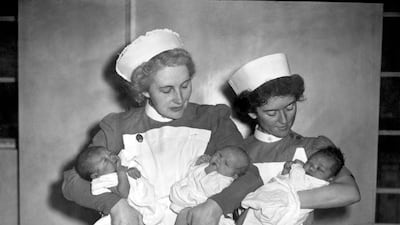
The first babies born on July 5, 1948, the day the NHS was launched in the UK. Getty Images -

People take part in a doorstep survey about the need for a National Health Service in 1944. Getty Images -

The sorting of ballot papers in the British Medical Association to ascertain doctors' views on joining the National Health Service scheme, in April 1948. Getty Images -
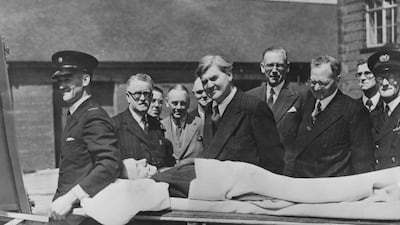
Minister for health Aneurin Bevan watches a demonstration of a new stretcher in Preston, on the first day of the new National Health Service. Getty Images -
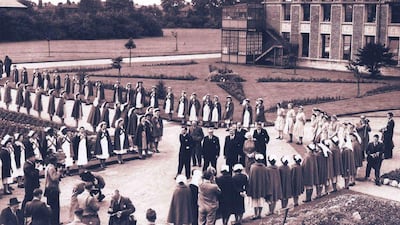
Mr Bevan's visit to Park Hospital, Manchester, now named Trafford General Hospital, on July 5, 1948. PA -

Nurses of Whipps Cross Hospital, in London, singing Christmas carols to one of the patients in bed in 1952. Getty Images -

NHS patients queuing in the rain outside a mobile X-ray unit parked in a street in New Cross, London in 1954. Getty Images -
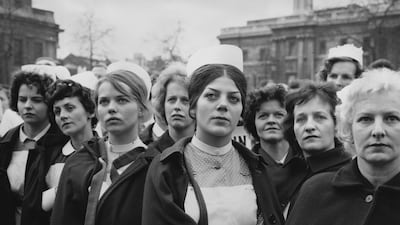
Some of the 8,000 nurses attending a protest meeting at Trafalgar Square, London, in support of their pay claim in 1952. Getty Images -

A nurse in the operating theatre of St Bartholomew's Hospital, London, in 1968. Getty Images -
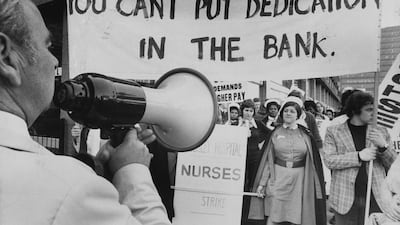
Nurses demonstrating outside the Ministry of Health, London, in 1974. Getty Images -

Demonstrators protesting in London against proposed NHS funding cuts in 1984. Getty Images -
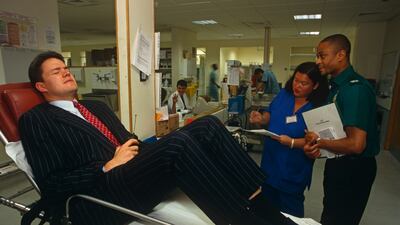
A busy Friday night in the A&E section of the Royal London Hospital in 1998. Getty Images -

Unison members protest in front of the British Parliament to protest against conditions which will turn the NHS into a two-tier system in 2003. Getty Images -

Work during the construction of Birmingham's Queen Elizabeth Hospital, in 2007. Getty Images -

Performers dance in a scene in tribute of the NHS during the Opening Ceremony of the London 2012 Olympic Games. Getty Images -
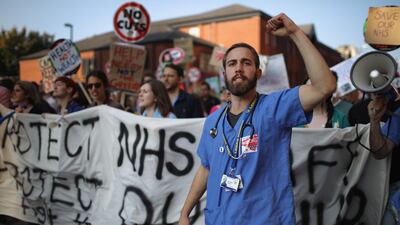
NHS workers take part in an anti-austerity protest during the first day of the 2015 Conservative Party Autumn Conference in Manchester. Getty Images -
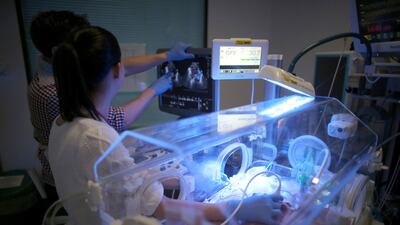
Doctors treat a baby, receiving light therapy, inside an incubator in the Birmingham Women's Hospital in 2015. Getty Images -
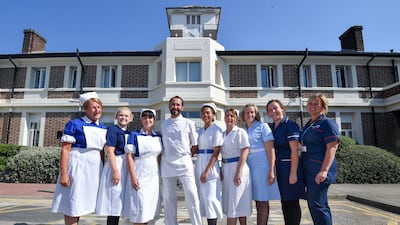
Nurses in uniforms from each decade of the NHS celebrate the 70th birthday of the NHS in 2018. Getty Images -

A nurse enters the Covid-19 Red Zone at Glan Clwyd Hospital in Wales in 2020. Getty Images -
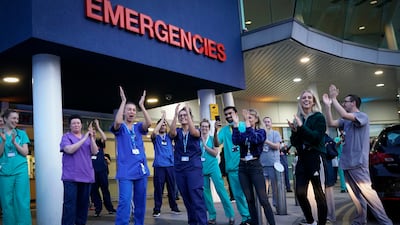
NHS staff applaud at the entrance of the Royal Liverpool Hospital as part of the "Clap For Our Carers" campaign in April 2020. Getty Images -
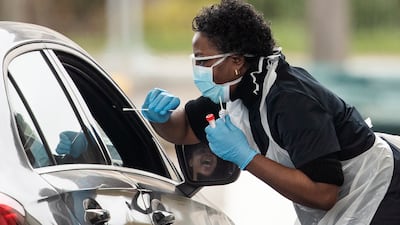
A nurse takes a swab at a Covid-19 drive-through testing station for NHS staff in Chessington in 2020. Getty Images -
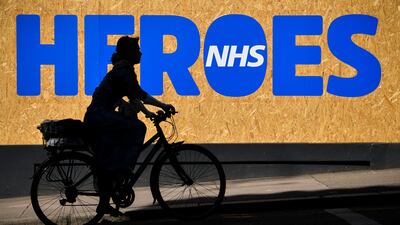
A sign of support for the NHS during the coronavirus lockdown in 2020 in Glasgow. Getty Images -

Domestic caretaker Jim Johnson outside Blackpool Victoria Hospital during the coronavirus pandemic in 2020. Getty Images -
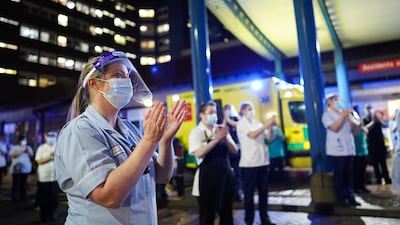
NHS staff members gather outside the University Hospital of North Tees to show their respects and applaud Captain Sir Tom Moore. Getty Images -

NHS staff and key workers queue in the Louisa Jordan Hospital before receiving the coronavirus vaccine in 2021 in Glasgow, Scotland. Getty Images -
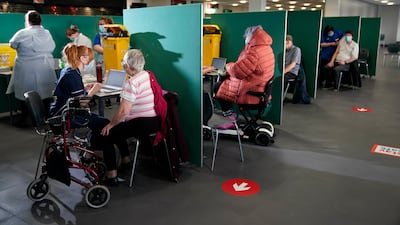
NHS staff administer the AstraZeneca Covid-19 vaccine in 2021 in St Helens. Getty Images -

An ambulance paramedic speaks as NHS workers and supporters gather outside Downing Street during strike action in 2022. Getty Images -

Demonstrators, holding placards and banners, during a strike by NHS nursing staff outside St. Thomas' Hospital in London, in 2022. Getty Images -

Ambulance workers on a picket line during strike action at Chorley Ambulance Station in 2023. Bloomberg -
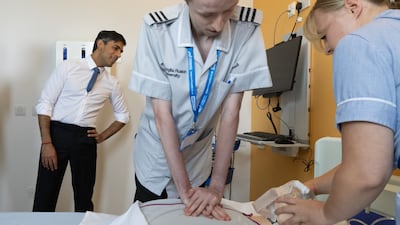
Prime Minister Rishi Sunak is given a demonstration of CPR while visiting the NHS's Addenbrooke's Hospital in 2023. Getty Images


Without such staff the health service “could have very easily buckled under the pressures it has been put under”, including rising demand, the pandemic and strike action, Mr Mortimer told PA.
But he warned that international recruitment would not make up for staff shortages.
“There is no room for complacency, as we will not be able to continue to draw on international recruitment to fill NHS vacancies forever,” Mr Mortimer said.
He called for better retention measures to attract new staff to the NHS.
“If anything, retention is just as important as attracting new staff into the NHS and will be key in the short term,” he said.
“Expanding the number of staff we train here is also important, so it is vital the continued expansion of training and education, set out in the NHS England long-term workforce plan, is maintained.”
Not all NHS staff groups have had a rise in non-UK nationals in their workforce.
The figure for consultants has remained broadly unchanged, standing at 22.2 per cent in September 2023, compared with 21.6 per cent in September 2020 and 23.2 per cent in September 2009.
The proportion has jumped recently for midwives, from 7.1 per cent in 2020 to 9 per cent in 2023, although this represents a return to levels seen in 2009, when it stood at 9.1 per cent.
However medical support staff have steadily seen an increase in non-UK nationals over time, from 7.2 per cent in 2009 to 10.3 per cent in 2016 and 17.6 per cent in 2023.
Lucina Rolewicz, researcher at the independent think tank The Nuffield Trust, told PA that international nurses had proved “pivotal” to the government meeting its 2019 pledge to increase the number of NHS nurses in England by 50,000.
But she feared that this was not a “sustainable, long-term solution", with the NHS “competing” with other health systems for overseas staff.
Two in five (38 per cent) of nurses and midwifes from overseas left the NHS within five years of joining, Ms Rolewicz said.
More needed to be done to reduce the number of people quitting training and attract more graduates to the NHS.
The workforce plan, published in 2023, set out steps to recruit thousands more staff for the NHS in England over 15 years, with possibly an extra 60,000 doctors and 170,000 more nurses in place by 2036/37.
Alex Baylis, assistant director of policy at health charity The King’s Fund, said that workforce planning had failed to keep pace with increasing demand.
“There are currently over 120,000 posts that are vacant in the NHS in England, including 42,000 nursing posts and nearly 9,000 medical posts,” he told PA.
“Since professional training takes several years, the NHS will be highly dependent on recruiting from overseas for at least the next five years, and retaining current staff, if vacancies are to be filled.
Overseas staff needed to be “recognised and valued” for their work in the NHS, Mr Baylis said.
“The NHS needs to make sure they are well supported as they get used to our system, they have access to ongoing training and career progression and, above all, they are treated fairly and not discriminated against,” he said.
A Department of Health and Social Care representative said: “International recruitment has a valuable role in helping the NHS deliver its world-class care, but it is important we boost the domestic workforce and decrease our reliance on agency staff and overseas workers.
“The first ever NHS long-term workforce plan was commissioned by the government to train, retain and reform the workforce, and put the NHS on a sustainable footing into the future.
“Backed by £2.4 billion, the plan will double the number of medical school places, almost double the number of adult nurse training places, and increase the number of GP training places by 50 per cent by 2031.
“Through these domestic training expansions, we expect around 10 per cent of our workforce to be recruited internationally in 15 years’ time, compared to nearly a quarter today.”
Yet Dr Sherif is optimistic that the NHS can overcome its present challenges.
“The whole country is trying to protect the NHS," he said. "There is a culture that the NHS belongs to the people, and people are really keen for it to be fixed."

