


This month marks a decade since the Arab uprisings erupted, ending the reign of some of the region’s longest-ruling leaders, but also opening up many wounds that the Middle East has yet to heal. The uprisings are a chapter in history that is still unfinished, as countries like Iraq and Lebanon continue to witness protests demanding change, not dissimilar to those that took place a decade ago. Sudan and Algeria went through dramatic political transitions last year and the new establishments in both countries have to work hard to earn the trust of their peoples.
For many in the Middle East, the coming weeks and months will have difficult anniversaries to mark, with the loss of loved ones on battlefields, in prisons or in attempts of escape through land and sea. For some, it will be an opportunity to mark a moment of optimism – as positive changes in countries like Tunisia did take hold and the systems in other countries like Jordan were tested and held steadfast.
There are many discussions and arguments over the merit and outcomes of the uprisings in the Arab world at the end of the first decade of this century. Discussions over legitimacy continue; the highest bar of that being competence, which includes delivering dignified lives for all. And while the study of history and the impact of major events is important, equally vital is taking stock of where we are in the Arab world today. In some ways, 10 years is a long time and much has happened independent of those uprisings. Too many outsiders look at the region solely through the prism of events from the last decade.

The reality is that in several countries, war and internal strife continue to wreak havoc, like in Syria, Yemen and Libya. In other Arab countries, there is a completely different reality. In the UAE, questions around economic transformation and technological advancement lead the way. In Saudi Arabia, having just concluded the G20 presidency, the focus is on diversification and how the global order is developing.
We have witnessed the end of one regional order and are living through the rise of a new one, without clarity on how it will eventually shape up. In addition to the political fallout of the uprisings of 2010/2011 and the years that followed, with the proliferation of non-state actors in a number of weakened republics, in 2020 we are contending with the fallout from Covid-19 and all its ramifications. The scrutiny that governments are being subjected to is based on their ability to deliver for their people. Functioning health and education systems, digital infrastructure and human safety are the hallmarks of success – and they require a functioning state to deliver them.
-
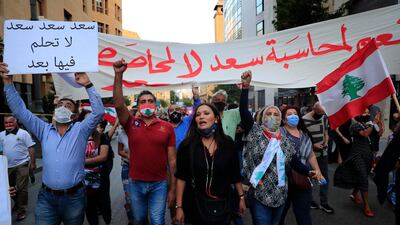
Anti-government protesters shout slogans during a protest to denounce the naming of former premier Saad Hariri as a potential candidate as the country's new prime minister, in downtown Beirut, Lebanon. AP Photo -
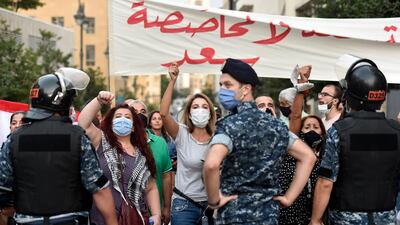
Anti-government protesters shout slogans during a protest against former Prime Minister Saad Hariri in downtown Beirut. EPA -
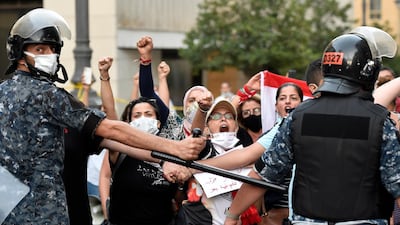
Anti-government protesters shout slogans during a protest against former Prime Minister Saad Hariri in downtown Beirut. EPA -
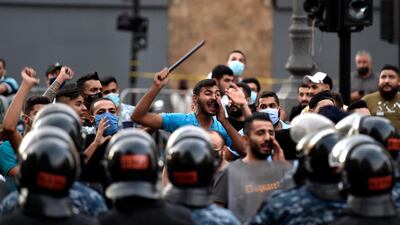
Supporters of former Lebanese Prime Minister Saad Hariri shout slogans against anti-government protesters during a protest against former Prime Minister Saad Hariri in downtown Beirut. EPA -
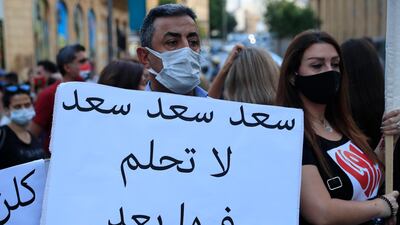
An anti-government protester holds an Arabic placard that reads: "Saad don't dream on it any more," during a protest to denounce the naming of former Prime minister Saad Hariri as a potential candidate as the country's new prime minister, in downtown Beirut. AP Photo -
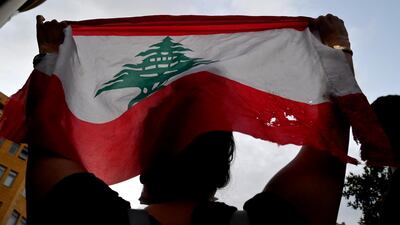
Anti-government protesters carry a national flag during a protest against former Prime Minister Saad Hariri in downtown Beirut. EPA -
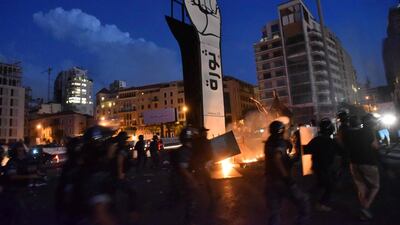
Members of the Lebanese security forces intervene after the ‘Revolution fist’, symbol of Lebanon’s October 2019 uprising, was set on fire during clashes between anti-government protesters and supporters of former prime minister Saad Hariri, in the capital Beirut's central Martyr's square. AFP -
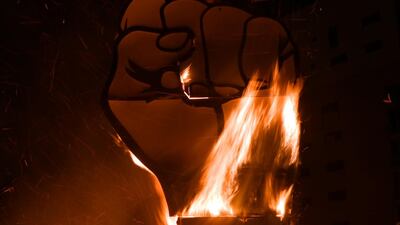
The symbol of the October revolution is set on fire allegedly by supporters of former Prime Minister Saad Hariri at Martyr's square. EPA -
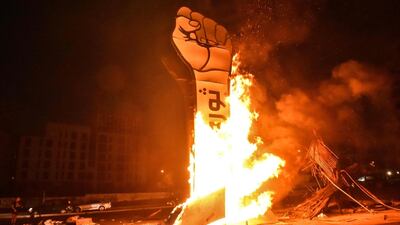
The ‘Revolution fist’, symbol of Lebanon’s October 2019 uprising, burns after it was set on fire during clashes between anti-government protesters and supporters of former prime minister Saad Hariri, in the capital Beirut's central Martyr's square. AFP -
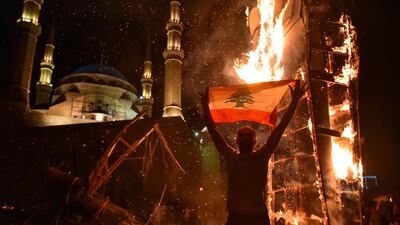
A Lebanese man raises a national flag as the ‘Revolution fist’, symbol of Lebanon’s October 2019 uprising, burns after being torched during clashes between anti-government protesters and supporters of former prime minister Saad Hariri, in the capital Beirut's central Martyr's square. AFP


Over the past year, protests in Iraq and Lebanon have provided an example of what the people of both nations are demanding: sovereign and competent states. Fighting corruption and setting strong state institutions are primary demands. Both countries have been pushed into a paradigm that has served the interests of sectarian political parties, feeding off nepotism and corruption. In both countries, the masses have declared their rejection of sectarian dogma and called for politics based on national, rather than confessional, identities. This post-sectarian moment is an important one that, in 2010, seemed almost impossible. It must not be lost.
In the wider region, a number of issues that were problematic a decade ago continue to be of a source of destabilisation, and they must be tackled. The longer the delay in dealing with them, the more difficult they will get. At the top of the list is the challenge of human development. The next UNDP global report on human development is expected to be launched on December 15. The discrepancy between different Arab nations on its index is a reflection on governance, much more than it is on the resources of each state.
Issues of youth unemployment, climate change and political quagmires in a number of countries continue to await solutions, but they have not remained stagnant.
Undoubtedly, for too many in the Arab world, there is a sense of dismay about lost potential. Across the board, there needs to be a seizing of opportunities wherever possible and a concerted effort to come up with new solutions where none of the existing ones have worked. But there are also very young Arabs forging a path forward despite the odds.
Some are lucky, living in stable and effective countries, like the UAE, which has ranked as the number one destination young Arabs seek to emigrate to for the past decade, and which celebrates its 49th National Day, marking its union, tomorrow. The national motto of the county is "Impossible is Possible". Perhaps that is a theme we can adopt around the Arab world. Making what seems impossible possible, particularly as we look to emerge from the Covid-19 pandemic, will require renewed energy and hope, despite the losses of too many sons and daughters of the region over the past decade.
Mina Al-Oraibi is editor-in-chief of The National

