


A new list of risk factors for dementia has been developed by scientists, including a tool that can “strongly predict” whether a person will develop the condition in the next 14 years.
The 11 risk factors, including lifestyle, personal characteristics and history of illness, were found to predict with good accuracy whether or not people in mid-life would go on to develop dementia.
Scientists examined data on people aged 50 to 73 taking part in two major long-term British studies – the UK Biobank study and the Whitehall II study.
A total of 220,762 people with an average age of 60 from the UK Biobank study were examined to develop the risk assessment tool and 2,934 people with an average age of 57 from the Whitehall II study helped to validate it.
Led by academics at the University of Oxford, researchers compiled a list of 28 known factors linked to dementia risk and then whittled it down to the strongest predictors.
This produced a list of 11 predictive factors which were then used to develop the UK Biobank Dementia Risk Score tool.
The 11 factors are age, education, a history of diabetes, a history of depression, a history of stroke, parental history of dementia, levels of deprivation, high blood pressure, high cholesterol, living alone and gender.
Researchers also examined these risk factors alongside whether or not people carried the APOE gene, which is a known risk factor for dementia.
This risk tool was called the UKBDRS-APOE tool.
Top five cholesterol-busting foods – in pictures
-
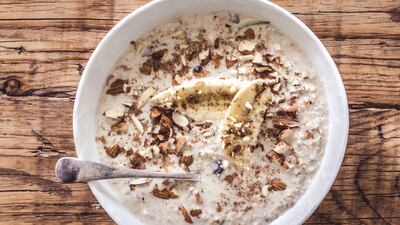
Almond oats with honey-whipped yogurt and banana. Photo: Scott Price -

Pea and pearl barley salad with feta. Silvia Razgova / The National -

Ful medames, an Egyptian dish of cooked fava beans served with vegetable oil, cumin and optionally with chopped parsley, garlic, onion, lemon juice and chilli pepper. Fatima Al Marzooqi / The National -

Rashid Obaid grows cucumbers, tomatoes, aubergine, courgette and okra. Chris Whiteoak / The National -

A fruit bowl spilling over with apples and pears. Photo: Annabel James


During the study period, 2 per cent of the people involved with the UK Biobank study developed dementia compared with 3 per cent of those in the Whitehall II study.
They found that UKBDRS-APOE produced the highest predictive score, closely followed by the UKBDRS risk tool, according to the findings, which have been published in the journal BMJ Mental Health.
The authors said that the assessment “significantly outperforms” similar other risk assessment tools currently available.
As well as identifying those at risk, these tools can also highlight preventive measures people can take while it is still possible.
The academics point out previous work which suggests that up to 40 per cent of dementia cases could be prevented through modifying certain lifestyle factors including stopping smoking, reducing high blood pressure, losing weight and reducing alcohol intake.
They suggest that the new tool could, in the future, be used as an initial screening tool for dementia to put people in “risk groups”.
Those who come back with a high probability of developing dementia, according to the risk score, could be prioritised for further tests including cognitive assessments, brain scans and blood tests.
“The UKBDRS may best be used as an initial screening tool to stratify people into risk groups, and those identified as high risk could then benefit from the more time-intensive follow-up assessments described above for more detailed characterisation,” said lead author Raihaan Patel from the University of Oxford.
“There are many steps we would need to take before we can use this risk score in clinical practice.
“It’s well known that dementia risk, onset, and prevalence vary by race, ethnicity and socioeconomic status.
“Therefore, while the consistent performance of UKBDRS across these two independent groups boosts our confidence in its viability, we need to evaluate it across more diverse groups of people both within and beyond the UK.”
Associate professor Sana Suri, co-lead author from the University of Oxford, added: “It’s important to remember that this risk score only tells us about our chances of developing dementia; it doesn’t represent a definitive outcome.
“The importance of each risk factor varies and given that some of the factors included in the score can be modified or treated, there are things we can all do to help reduce our risk of dementia.
“While older age [60 and above] and APOE confer the greatest risk, modifiable factors, such as diabetes, depression, and high blood pressure also have a key role. For example, the estimated risk for a person with all of these will be approximately three times higher than that of a person of the same age who doesn’t have any.”
It comes as a separate study, published in the Journal of Epidemiology and Community Health, found that over-60s living “unhealthy lifestyles” were more likely to need nursing home care in later life.
Being physically inactive, being a smoker and having poor sleep between the ages of 60 and 64 seemed to be particularly influential, academics found.
Researchers from the University of Sydney examined data on more than 127,000 Australian men and women aged 60 and over.
Information on lifestyle factors, including smoking status, physical activity levels, sitting time, sleep patterns and diet, were assessed.
After 10 years of follow-up, researchers found that 18 per cent of people in the study had been admitted to a nursing home.
Compared with those who lived the healthiest lifestyles, unhealthy over-60s were 43 per cent more likely to be admitted to a nursing home.
“Modifying lifestyle, especially reducing sitting time, increasing physical activity and improving sleep, should be explored as new public health measures to reduce the future risk of nursing home admission,” the authors wrote.

