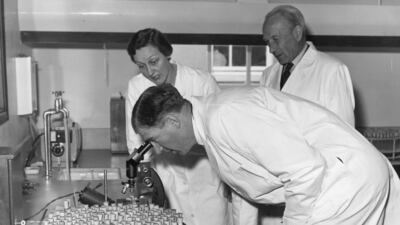
Researchers have developed a “super-engineered” vaccine that could be a major turning point in the battle against polio.
The new vaccine aims to address the resurgence of vaccine-derived polio strains that have hampered global eradication efforts, researchers said in a study published in the journal Nature.
The vaccines, designed by Andrew Macadam and his team at the UK's National Institute for Biological Standards and Control, have demonstrated effectiveness in initial tests and are now undergoing human trials.
Since 1988, global efforts to eradicate polio have brought the world tantalisingly close to eliminating the disease.
The tenacity of these campaigns has led to the eradication of two of the three poliovirus subtypes and the significant containment of the third.
Over the past year, only 21 cases of wild polio were reported in children in Afghanistan, Pakistan and Mozambique.
However, an unexpected challenge has emerged on this path to eradication – vaccine-derived polio.
Despite the overall success in combating wild polio, there were 665 cases of this strain across 23 countries in the past year alone.
This occurs when the weakened poliovirus used in oral vaccines regains its virulence and begins causing the very disease it was meant to prevent.
Addressing this resurgence, the newly developed vaccines employ genetic engineering to significantly lower the risk of the attenuated virus reverting to a virulent state.
More than 650 million children in 30 countries have received the nOPV2 vaccine, a predecessor to these latest vaccines, since March 2021.
Although more genetically stable, it has regained virulence on four separate occasions, underscoring that the fight against polio requires more than scientific advancements alone – it necessitates comprehensive public health initiatives.
Notably, vaccine-derived polio cases are particularly prevalent in under-immunised communities.
These outbreaks have largely been seen in sub-Saharan Africa, though traces have been found in the UK, Canada, Israel and the US.
Factors such as the Covid-19 pandemic, which hindered vaccination campaigns, and conflicts in polio-vulnerable countries have contributed to this rise in cases.
As these challenges are tackled, the global management of polio is transitioning.
The responsibility is shifting from the Global Polio Eradication Initiative, based in Geneva, to national immunisation and disease-surveillance programmes.
Despite some hiccups in this transition, the World Health Organisation is enacting a more nuanced, country-specific approach to ensure that this handover does not undermine the significant progress already achieved.
Joseph Swan, a representative from the WHO and the GPEI, said: “Simply having these new and better tools will not get us over the finish line – vaccination, not just vaccines, is what will end polio.”
Even with the breakthroughs, complete polio eradication remains a complex endeavour, particularly in the world's poorest and most conflict-ridden regions.

Our legal consultant
Name: Hassan Mohsen Elhais
Position: legal consultant with Al Rowaad Advocates and Legal Consultants.
All you need to know about Formula E in Saudi Arabia
What The Saudia Ad Diriyah E-Prix
When Saturday
Where Diriyah in Saudi Arabia
What time Qualifying takes place from 11.50am UAE time through until the Super Pole session, which is due to end at 12.55pm. The race, which will last for 45 minutes, starts at 4.05pm.
Who is competing There are 22 drivers, from 11 teams, on the grid, with each vehicle run solely on electronic power.
Mercer, the investment consulting arm of US services company Marsh & McLennan, expects its wealth division to at least double its assets under management (AUM) in the Middle East as wealth in the region continues to grow despite economic headwinds, a company official said.
Mercer Wealth, which globally has $160 billion in AUM, plans to boost its AUM in the region to $2-$3bn in the next 2-3 years from the present $1bn, said Yasir AbuShaban, a Dubai-based principal with Mercer Wealth.
“Within the next two to three years, we are looking at reaching $2 to $3 billion as a conservative estimate and we do see an opportunity to do so,” said Mr AbuShaban.
Mercer does not directly make investments, but allocates clients’ money they have discretion to, to professional asset managers. They also provide advice to clients.
“We have buying power. We can negotiate on their (client’s) behalf with asset managers to provide them lower fees than they otherwise would have to get on their own,” he added.
Mercer Wealth’s clients include sovereign wealth funds, family offices, and insurance companies among others.
From its office in Dubai, Mercer also looks after Africa, India and Turkey, where they also see opportunity for growth.
Wealth creation in Middle East and Africa (MEA) grew 8.5 per cent to $8.1 trillion last year from $7.5tn in 2015, higher than last year’s global average of 6 per cent and the second-highest growth in a region after Asia-Pacific which grew 9.9 per cent, according to consultancy Boston Consulting Group (BCG). In the region, where wealth grew just 1.9 per cent in 2015 compared with 2014, a pickup in oil prices has helped in wealth generation.
BCG is forecasting MEA wealth will rise to $12tn by 2021, growing at an annual average of 8 per cent.
Drivers of wealth generation in the region will be split evenly between new wealth creation and growth of performance of existing assets, according to BCG.
Another general trend in the region is clients’ looking for a comprehensive approach to investing, according to Mr AbuShaban.
“Institutional investors or some of the families are seeing a slowdown in the available capital they have to invest and in that sense they are looking at optimizing the way they manage their portfolios and making sure they are not investing haphazardly and different parts of their investment are working together,” said Mr AbuShaban.
Some clients also have a higher appetite for risk, given the low interest-rate environment that does not provide enough yield for some institutional investors. These clients are keen to invest in illiquid assets, such as private equity and infrastructure.
“What we have seen is a desire for higher returns in what has been a low-return environment specifically in various fixed income or bonds,” he said.
“In this environment, we have seen a de facto increase in the risk that clients are taking in things like illiquid investments, private equity investments, infrastructure and private debt, those kind of investments were higher illiquidity results in incrementally higher returns.”
The Abu Dhabi Investment Authority, one of the largest sovereign wealth funds, said in its 2016 report that has gradually increased its exposure in direct private equity and private credit transactions, mainly in Asian markets and especially in China and India. The authority’s private equity department focused on structured equities owing to “their defensive characteristics.”
500 People from Gaza enter France
115 Special programme for artists
25 Evacuation of injured and sick
Our family matters legal consultant
Name: Hassan Mohsen Elhais
Position: legal consultant with Al Rowaad Advocates and Legal Consultants.
What vitamins do we know are beneficial for living in the UAE
Vitamin D: Highly relevant in the UAE due to limited sun exposure; supports bone health, immunity and mood.
Vitamin B12: Important for nerve health and energy production, especially for vegetarians, vegans and individuals with absorption issues.
Iron: Useful only when deficiency or anaemia is confirmed; helps reduce fatigue and support immunity.
Omega-3 (EPA/DHA): Supports heart health and reduces inflammation, especially for those who consume little fish.
Electric scooters: some rules to remember
- Riders must be 14-years-old or over
- Wear a protective helmet
- Park the electric scooter in designated parking lots (if any)
- Do not leave electric scooter in locations that obstruct traffic or pedestrians
- Solo riders only, no passengers allowed
- Do not drive outside designated lanes
The specs: 2018 Opel Mokka X
Price, as tested: Dh84,000
Engine: 1.4L, four-cylinder turbo
Transmission: Six-speed auto
Power: 142hp at 4,900rpm
Torque: 200Nm at 1,850rpm
Fuel economy, combined: 6.5L / 100km
The biog:
Favourite book: The Leader Who Had No Title by Robin Sharma
Pet Peeve: Racism
Proudest moment: Graduating from Sorbonne
What puts her off: Dishonesty in all its forms
Happiest period in her life: The beginning of her 30s
Favourite movie: "I have two. The Pursuit of Happiness and Homeless to Harvard"
Role model: Everyone. A child can be my role model
Slogan: The queen of peace, love and positive energy
The specs
Engine: 4.0-litre V8 twin-turbocharged and three electric motors
Power: Combined output 920hp
Torque: 730Nm at 4,000-7,000rpm
Transmission: 8-speed dual-clutch automatic
Fuel consumption: 11.2L/100km
On sale: Now, deliveries expected later in 2025
Price: expected to start at Dh1,432,000
The specs
Engine: 3.0-litre six-cylinder turbo
Power: 398hp from 5,250rpm
Torque: 580Nm at 1,900-4,800rpm
Transmission: Eight-speed auto
Fuel economy, combined: 6.5L/100km
On sale: December
Price: From Dh330,000 (estimate)
The specs: 2019 Haval H6
Price, base: Dh69,900
Engine: 2.0-litre turbocharged four-cylinder
Transmission: Seven-speed automatic
Power: 197hp @ 5,500rpm
Torque: 315Nm @ 2,000rpm
Fuel economy, combined: 7.0L / 100km
UK’s AI plan
- AI ambassadors such as MIT economist Simon Johnson, Monzo cofounder Tom Blomfield and Google DeepMind’s Raia Hadsell
- £10bn AI growth zone in South Wales to create 5,000 jobs
- £100m of government support for startups building AI hardware products
- £250m to train new AI models