People wearing masks in Beijing this week. The report has said that misinformation, fuelled by social media, hampered basic public health measures, such as mask wearing and vaccines. EPA

Covid-19 pandemic response was a 'massive global failure', report says


Neil Murphy
  • English
  • Arabic

A wide-ranging report into the Covid-19 pandemic has condemned the global response as a "massive failure" brought about by slow decision making from public health authorities and a lack of international co-operation.

The Lancet Covid-19 Commission report, released on Wednesday, is the result of two years' work by more than 28 renowned experts in epidemiology, public policy and international governance.

The authors say that the estimated death toll of 17.7 million people is the result of failures in "transparency, rationality and basic public health practice" that have ultimately reversed progress made towards the UN's Sustainable Development Goals.

In particular, the peer-reviewed paper singles out "costly" delays by the World Health Organisation in declaring a global health emergency as reports of the virus's airborne and highly transmissible pathogen were beginning to emerge in early 2020.

The report also outlines its recommendations to prevent further public health threats from reoccurring, including a return to multilateral co-operation, significant reform of the WHO and increased pandemic preparedness.

The report also says that misinformation, fuelled by social media, resulted in a backlash and hampered basic public health measures, such as vaccines and wearing face masks.

Chair of the Commission, Prof Jeffrey Sachs of Columbia University, described the response as a "staggering failure" that was partly fuelled by geopolitical posturing, particularly between the US and China.

Speaking to The National, Prof Sachs was scathing about the lack of leadership, particularly from Washington, in the early stages of the outbreak.

Former US president Donald Trump was criticised by one of the authors of the Lancet Commission report into the Covid-19 outbreak. AFP

"The Trump administration basically walked out of the WHO in mid-2020, leaving the organisation in the lurch and caught in the US-China geopolitical conflict," he said. "This was an utter debacle, and a setback on many fronts."

"The pandemic was too often handled by politicians more interested in the daily news cycle than in public health: Trump, Boris Johnson, Jair Bolsonaro — the list is long," he added.

The report makes it clear that greater involvement in the WHO from heads of state from each region would have supported better decision making at that level.

"It would have been enormously helpful if the WHO could have turned systematically to a council of heads of government to sustain vital political support and global co-ordination, even as Mr Trump went into his pre-election tantrum," Prof Sachs said.

According to Prof Sachs, countries and territories in the Asia-Pacific region, including China, Taiwan, Hong Kong, South Korea, Australia and New Zealand performed best in responding to the virus.

He believed that some health authorities had learnt the lessons of the Sars outbreak, but the Europe and the US did not, leading to a significantly higher death rate in those regions.

The commission report favours a "vaccine plus" strategy as a way to emerge from the pandemic.

This would combine effective public health measures and a high level of vaccine coverage, which can slow the emergence of variants and reduce the risk of new waves of infection.

"The faster the world can act to vaccinate everybody, and provide social and economic support, the better the prospects for exiting the pandemic emergency and achieving long-lasting economic recovery,” said co-author Prof Salim Abdool Karimc.

Authors have called for reform of the WHO and greater involvement from heads of state representing each region "to better support decision-making and actions, especially on urgent and controversial matters".

The report has also called for $60 billion yearly for pandemic preparedness and health system strengthening in developing countries. This could be achieved with the support of WHO, the G20, and major financial institutions such as the World Bank.

In addition, it also recommends a 10-year effort by G20 countries to bolster research and development in pandemic control tools "including testing, diagnostics, vaccines, treatments and PPE, alongside support and training for health workers in low and middle-income countries."

It comes as the number of newly reported Covid cases has dropped to the lowest level since March 2020, prompting the WHO to say that the end of the pandemic was in sight.

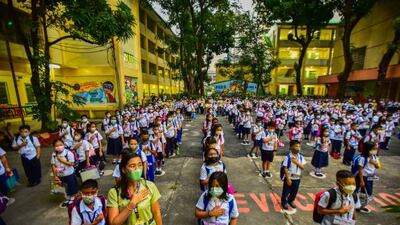
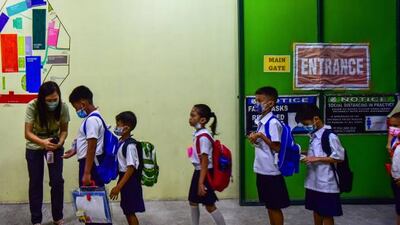
  • Pupils at Pedro Guevarra Elementary School in Manila attend a flag-raising ceremony on August 22, the first day of in-person classes, following two years of Covid-19 lockdowns in the Philippines. AFP
    Pupils at Pedro Guevarra Elementary School in Manila attend a flag-raising ceremony on August 22, the first day of in-person classes, following two years of Covid-19 lockdowns in the Philippines. AFP
  • Pupils walk to school in Quezon city. Bloomberg
    Pupils walk to school in Quezon city. Bloomberg
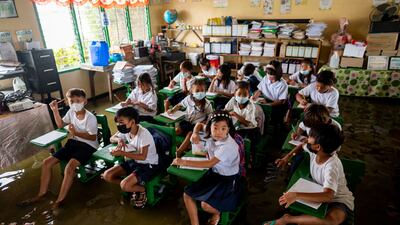
  • Pupils attend the first day of in-person classes at a flooded school due to high tide in Macabebe, Pampanga province. Reuters
    Pupils attend the first day of in-person classes at a flooded school due to high tide in Macabebe, Pampanga province. Reuters
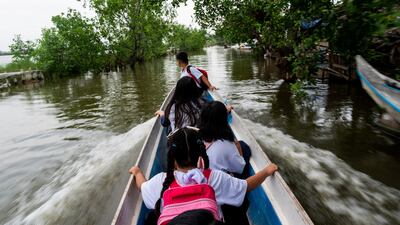
  • Pupils ride a boat to school in Macabebe. Reuters
    Pupils ride a boat to school in Macabebe. Reuters
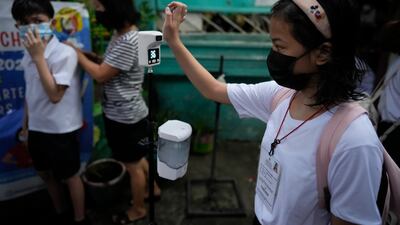
  • A teacher administers hand sanitizer to pupils. AFP
    A teacher administers hand sanitizer to pupils. AFP
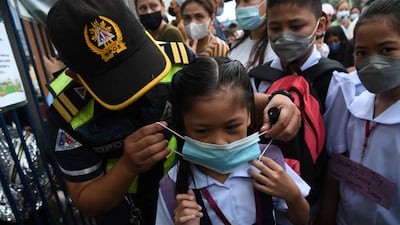
  • A city hall employee helps a pupil put on a face mask in Quezon city. AFP
    A city hall employee helps a pupil put on a face mask in Quezon city. AFP
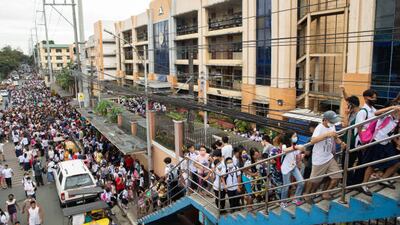
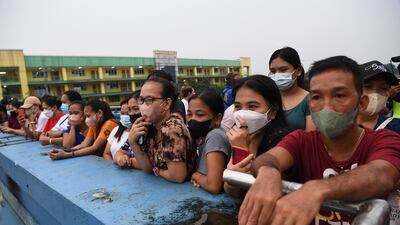
  • Parents watch from a pedestrian overpass as their children head into school. AFP
    Parents watch from a pedestrian overpass as their children head into school. AFP
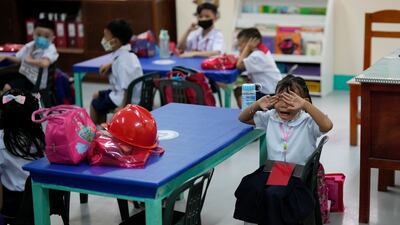
  • It's all too much for one girl, as the new term gets under way at San Juan Elementary School. AP Photo
    It's all too much for one girl, as the new term gets under way at San Juan Elementary School. AP Photo
  • A pupil checks her temperature at San Juan Elementary School. AP Photo
    A pupil checks her temperature at San Juan Elementary School. AP Photo
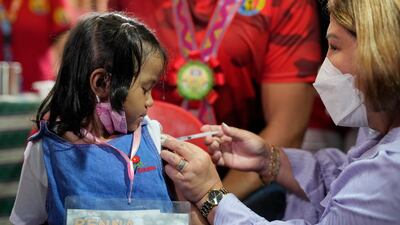
  • A girl receives her first Covid-19 Pfizer vaccination at San Juan Elementary School. AP Photo
    A girl receives her first Covid-19 Pfizer vaccination at San Juan Elementary School. AP Photo
  • Students wash their hands to help keep Covid-19 at bay. Reuters
    Students wash their hands to help keep Covid-19 at bay. Reuters
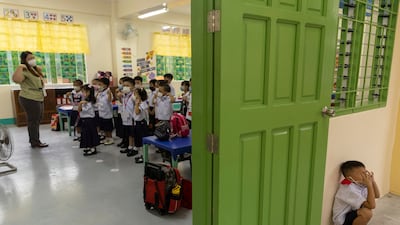
  • A boy cries outside his classroom on the first day of in-person classes at a public school in San Juan city. Reuters
    A boy cries outside his classroom on the first day of in-person classes at a public school in San Juan city. Reuters
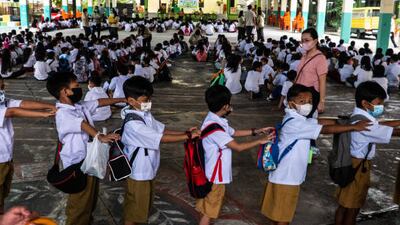
  • Pupils wait to enter their classrooms. Getty Images
    Pupils wait to enter their classrooms. Getty Images
How Voiss turns words to speech

The device has a screen reader or software that monitors what happens on the screen

The screen reader sends the text to the speech synthesiser

This converts to audio whatever it receives from screen reader, so the person can hear what is happening on the screen

A VOISS computer costs between $200 and $250 depending on memory card capacity that ranges from 32GB to 128GB

The speech synthesisers VOISS develops are free

Subsequent computer versions will include improvements such as wireless keyboards

Arabic voice in affordable talking computer to be added next year to English, Portuguese, and Spanish synthesiser

Partnerships planned during Expo 2020 Dubai to add more languages

At least 2.2 billion people globally have a vision impairment or blindness

More than 90 per cent live in developing countries

The Long-term aim of VOISS to reach the technology to people in poor countries with workshops that teach them to build their own device

Mercer, the investment consulting arm of US services company Marsh & McLennan, expects its wealth division to at least double its assets under management (AUM) in the Middle East as wealth in the region continues to grow despite economic headwinds, a company official said.

Mercer Wealth, which globally has $160 billion in AUM, plans to boost its AUM in the region to $2-$3bn in the next 2-3 years from the present $1bn, said Yasir AbuShaban, a Dubai-based principal with Mercer Wealth.

Within the next two to three years, we are looking at reaching $2 to $3 billion as a conservative estimate and we do see an opportunity to do so,” said Mr AbuShaban.

Mercer does not directly make investments, but allocates clients’ money they have discretion to, to professional asset managers. They also provide advice to clients.

“We have buying power. We can negotiate on their (client’s) behalf with asset managers to provide them lower fees than they otherwise would have to get on their own,” he added.

Mercer Wealth’s clients include sovereign wealth funds, family offices, and insurance companies among others.

From its office in Dubai, Mercer also looks after Africa, India and Turkey, where they also see opportunity for growth.

Wealth creation in Middle East and Africa (MEA) grew 8.5 per cent to $8.1 trillion last year from $7.5tn in 2015, higher than last year’s global average of 6 per cent and the second-highest growth in a region after Asia-Pacific which grew 9.9 per cent, according to consultancy Boston Consulting Group (BCG). In the region, where wealth grew just 1.9 per cent in 2015 compared with 2014, a pickup in oil prices has helped in wealth generation.

BCG is forecasting MEA wealth will rise to $12tn by 2021, growing at an annual average of 8 per cent.

Drivers of wealth generation in the region will be split evenly between new wealth creation and growth of performance of existing assets, according to BCG.

Another general trend in the region is clients’ looking for a comprehensive approach to investing, according to Mr AbuShaban.

“Institutional investors or some of the families are seeing a slowdown in the available capital they have to invest and in that sense they are looking at optimizing the way they manage their portfolios and making sure they are not investing haphazardly and different parts of their investment are working together,” said Mr AbuShaban.

Some clients also have a higher appetite for risk, given the low interest-rate environment that does not provide enough yield for some institutional investors. These clients are keen to invest in illiquid assets, such as private equity and infrastructure.

“What we have seen is a desire for higher returns in what has been a low-return environment specifically in various fixed income or bonds,” he said.

“In this environment, we have seen a de facto increase in the risk that clients are taking in things like illiquid investments, private equity investments, infrastructure and private debt, those kind of investments were higher illiquidity results in incrementally higher returns.”

The Abu Dhabi Investment Authority, one of the largest sovereign wealth funds, said in its 2016 report that has gradually increased its exposure in direct private equity and private credit transactions, mainly in Asian markets and especially in China and India. The authority’s private equity department focused on structured equities owing to “their defensive characteristics.”

Updated: September 14, 2022, 10:30 PM