


A study has suggested catching Omicron does not protect you from future infection amid a sustained global rise of concerning Covid-19 subvariants, including BA.4 and BA.5.
Researchers at Imperial College London said Omicron appears to be excellent at 'breaking through' immune systems, in contrast to previous variants.
Their study examined blood samples from health workers in Britain who have been triple-vaccinated with mRNA vaccines and found prior infection, especially from variants earlier in the pandemic, offered little to no protection against the highly-transmissible Omicron strain.
Professor Danny Altmann, from Imperial’s department of immunology and inflammation, said: "The message is a little bleak. Omicron and its variants are great at breakthrough, but bad at inducing immunity, thus we get reinfections ad nauseam, and a badly depleted workforce.
"Not only can it break through vaccine defences, it looks to leave very few of the hallmarks we’d expect on the immune system – it’s more stealthy than previous variants and flies under the radar, so the immune system is unable to remember it."
Authors of the study, which was published in the Science journal, also said Omicron could potentially mutate further into a more "pathogenic strain" or become better able to overcome vaccine protection.
"In this scenario, people who have had omicron infection would be poorly boosted against future infection depending on their immune imprinting", said Professor Rosemary Boyton, the study's lead author.
-

A family member pays their respects to those who lost their lives to Covid-19, as the one year anniversary of the National Covid Memorial Wall is marked in London. PA -

A woman holds a photograph of a family member who died as she takes part in a march from the National Covid Memorial wall to Downing Street in London. AP Photo -

Bereaved families travelled to the wall from across the country to mark the day, with a petition to make the wall a permanent memorial. AP Photo -
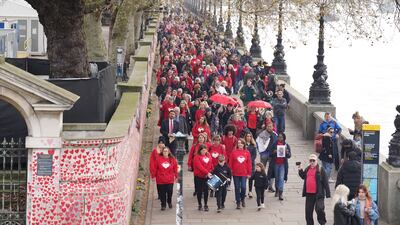
Bereaved families march alongside the wall. PA -
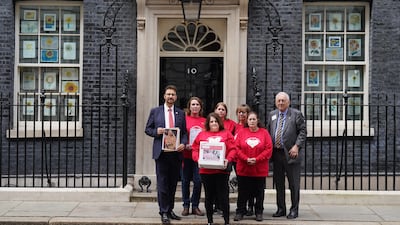
Families with MPs Sir Peter Bottomley, right, and Afzal Khan, left, deliver a petition to 10 Downing Street. PA -

Family members write a message to two sisters who died of Covid-19 on the National Covid Memorial wall. AP Photo -

Becca Slater, centre, receives a hug as she remembers her father Anthony Elward, who died in 2020. AP Photo -

A woman writes a message in a red heart on the wall. AP Photo -

Families marching through central London. PA


A total of 989,800 people in private households in the UK are estimated to have had the virus in the week ending June 2, up from 953,900 the previous week, according to the Office for National Statistics.
It comes amid warnings that two new sub-variants of Omicron, BA.4 and BA.5, are spreading more quickly than other coronavirus variants in Europe, which could lead to more hospitalisations and deaths as they become dominant.
Most EU countries have so far detected low rates of the two subgroups. But in countries where the proportion has risen — such as Portugal, where BA.5 accounted for 87 per cent of cases by May 30 — there have been surges in overall cases, the European Centre for Disease Prevention and Control said last week.
The two sublineages were added to the World Health Organisation's monitoring list in March and have also been designated as variants of concern by the ECDC.
BA.4 and BA.5 do not appear to carry a higher risk of severe disease than other forms of Omicron. But an increase in case numbers from higher transmission rates risks leading to an increase in hospitalisations and deaths, the ECDC said.
"The growth advantage reported for BA.4 and BA.5 suggest that these variants will become dominant," it said on its website.

