



Researchers in the UAE have uncovered new details about how a person’s genetic make-up influences their susceptibility to Covid-19.
By analysing hundreds of people, the scientists identified various parts of people’s chromosomes that appear to affect the severity of disease.
Their work adds to a growing body of evidence from other laboratories around the world and could help to identify new ways to treat or prevent the condition, which has contributed to the death of more than five million people globally.
The study’s senior author, Dr Habiba Alsafar, director of the Centre for Biotechnology and associate professor of molecular biology and genetics at Khalifa University in Abu Dhabi, said she and her colleagues were “very intrigued by the findings”.
The researchers carried out a genome-wide association study, which looks for links between a condition and any part of a person’s complete set of genetic material or genome.
“We compared the genome of non-hospitalised cases with hospitalised cases of Covid-19 and identified eight genes that play a role. This is a very interesting finding,” said Dr Alsafar.
The genes are associated with a variety of characteristics associated with the lungs, including how tumours grow, emphysema and the obstruction of airways. Some are linked to inflammation.
One gene, VWA8, is associated with a significant increase in the risk of being admitted to hospital with Covid-19, the study found. Previous research has shown this gene is linked to types of emphysema and deformities in the lungs.
People have 23 pairs of chromosomes – the bundles of genetic material and protein through which genes are transmitted from one generation to the next – and the eight genes identified are scattered across six of them.
Genetic studies key to virus fight
-
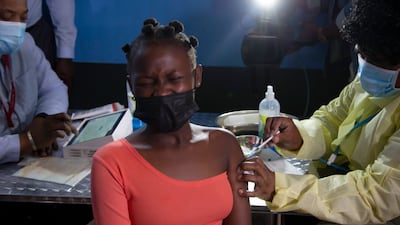
A young woman receives a Pfizer jab in Diepsloot Township near Johannesburg, South Africa. AP Photo -

A girl wearing a face mask rides on a merry-go-round at the Christmas market in Frankfurt, Germany. AP Photo -

People travel on a London underground tube train on the Jubilee Line, in London, during the pandemic. AP Photo -

People wait for the tram in Vienna, Austria, amid the crisis. AP Photo -

A woman passes by an empty terrace in the Marrolles quarter in Brussels, Belgium. AP Photo -

A teacher gives online lessons via webcam at the temporarily closed elementary school in the town of Trebisov, eastern Slovakia. TASR via AP -

Hairdressers and clients wear masks in Amsterdam, Netherlands. AFP -

A man disinfects seats for tourists at a beach in Kuta, Bali, Indonesia. EPA -
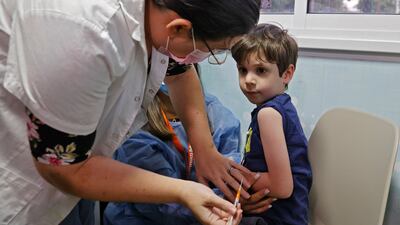
Israeli boy Itamar, 5, receives a dose of the Pfizer/BioNTech Covid-19 vaccine at the Meuhedet Healthcare Services Organisation in Tel Aviv. AFP -

A patient suffering from Covid-19 is admitted in the intensive care unit of the Basaksehir Cam and Sakura City Hospital in Istanbul, Turkey. Reuters -
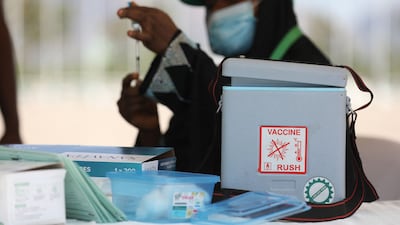
A health worker prepares to administer the AstraZeneca jab in Abuja, Nigeria. AFP


The work involved 646 patients, of whom 482 were admitted to hospital with Covid-19. About half the patients were European, while about 100 each were American, South Asian or East Asian.
While the sample size was relatively small, Dr Alsafar said that genetic studies across different racial or ethnic populations were “crucial” to better understand the disease.
Other authors of the study, published in the journal EBioMedicine, are at Sheikh Khalifa Medical City in Abu Dhabi, Rashid Hospital in Dubai and two Australian universities.
The researchers published their study shortly after scientists at the University of Oxford and other institutions revealed that they had identified a gene called LZTFL1 on Chromosome 3 that can double a person’s risk of dying from respiratory failure with Covid-19.
Previous research indicated that part of this chromosome was associated with a doubling of risk, but the gene itself had not been identified.
The version of LZTFL1 that can increase a person’s risk is carried by 60 per cent of people of South Asian heritage, but only 15 per cent with European ancestry.
The gene does not affect how a person’s immune system responds to the virus, so is not thought to influence how well someone responds to vaccination. Instead, it affects how cells lining the airways and lungs respond to the virus.
“By knowing how the gene works we can have a better understanding of how the body would respond to the virus and vaccination,” said Dr Damien Downes, a postdoctoral researcher at the University of Oxford’s Radcliffe Department of Medicine and first author of the LZTFL1 study, which was published in Nature Genetics.
Identifying the gene and how it works could, he said, lead to new drug treatments that aim at the biochemical chain of events the gene is linked to.
More than a dozen areas on chromosomes have been found to affect a person’s response to Covid-19, but the way in which this happens has been worked out for only about half, said Dr Downes.
“We’re halfway there in terms of understanding the genetic contribution, but there’s a lot of work [to be done] before we can translate it into treatments,” he said.

